OCR · GCSE · Physics
Course version: J249 · Version from Sept 2018
Explain why, if two resistors are in series the net resistance is…
Full specification wording
Simple circuits: explain why, if two resistors are in series the net resistance is increased, whereas with two in parallel the net resistance is decreased (qualitative explanation only)
Learners explain, without calculation, why combining resistors changes the net resistance.
Checked against the OCR J249 specification (opens in a new tab) on .
- Point 11 of 14
- 4 key terms
Study notes
From the checked teaching notes for this specification point.
The idea
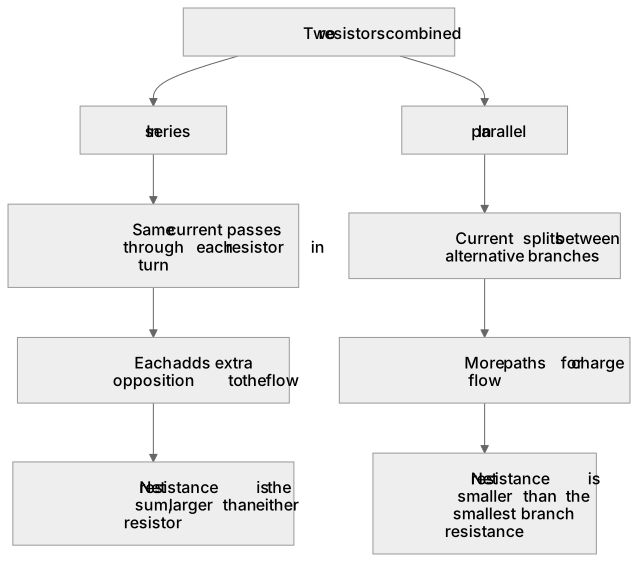
Learners explain, without calculation, why combining resistors changes the net resistance. In series, the same current passes through each resistor in turn, so each adds an extra opposition to the flow; the net resistance equals the sum and is larger than either resistor. In parallel, the current splits between alternative branches, giving more paths for charge to flow; the net resistance is smaller than the smallest branch resistance. A useful check is that two equal resistors in parallel give half the resistance of one, while in series they give double. The explanation is qualitative: describe the effect of added opposition or extra paths rather than deriving a formula.
What earns the marks
- States that resistors in series each add opposition so the net resistance is the sum of the individual values.
- Explains that the same current passes through each series resistor, so the total opposition increases.
- States that resistors in parallel provide additional paths for current, lowering the net resistance.
- Explains that the net resistance in parallel is less than the smallest individual resistance.
- Uses the idea of current splitting between branches to justify the reduced net resistance.
Common mistakes and how to put them right
Adds parallel resistances directly as if in series.
Put it right: Explain that extra branches lower the net resistance instead.
Claims parallel net resistance lies between the two values.
Put it right: State that it is smaller than the smallest.
Says series resistors share the current equally.
Put it right: Note that the same current flows through each in series.
Gives a numerical formula when a qualitative explanation is required.
Put it right: Describe the effect of extra opposition or paths.
Exam tips
- Contrast the two arrangements in one sentence: series adds opposition, parallel adds paths.
- Anchor the explanation to current behaviour, since current is the same in series and splits in parallel.
- Use the 'smaller than the smallest' check for parallel combinations.
- Keep the answer qualitative unless the question supplies values.
Try the lesson
The start of the Simple circuits: explain why, if two resistors are in series the net resistance is increased, whereas with two in parallel the net resistance is decreased (qualitative explanation only) lesson, made from checked teaching notes for this specification point.
Have a go first
A student connects a 4 Ω resistor and a 6 Ω resistor in series. Why is the total resistance of the pair greater than 6 Ω?
Listen
Learners explain, without calculation, why combining resistors changes the net resistance. In series, the same current passes through each resistor in turn, so each adds an extra opposition to the flow; the net resistance equals the sum and is larger than either resistor. In parallel, the current splits between alternative branches, giving more paths for charge to flow; the net resistance is smaller than the smallest branch resistance. A useful check is that two equal resistors in parallel give half the resistance of one, while in series they give double. The explanation is qualitative: describe the effect of added opposition or extra paths rather than deriving a formula. A strong answer earns marks for these points. States that resistors in series each add opposition so the net resistance is the sum of the individual values. Explains that the same current passes through each series resistor, so the total opposition increases. States that resistors in parallel provide additional paths for current, lowering the net resistance. Explains that the net resistance in parallel is less than the smallest individual resistance. Exam tip: Contrast the two arrangements in one sentence: series adds opposition, parallel adds paths.
See it
Key words
Say what each word means before you turn the card.
Series and parallel circuits
Try answering aloud or in your head before turning the card.
Net resistance
Try answering aloud or in your head before turning the card.
Current paths and splitting
Try answering aloud or in your head before turning the card.
Qualitative circuit reasoning
Try answering aloud or in your head before turning the card.
See every definition
- Series and parallel circuits
- In series the same current passes through each resistor in turn, whereas in parallel the current splits between alternative branches.
- Net resistance
- In series it equals the sum and is larger than either resistor; in parallel it is smaller than the smallest branch resistance.
- Current paths and splitting
- In parallel the current splits between alternative branches, giving more paths for charge to flow.
- Qualitative circuit reasoning
- Describing the effect of added opposition or extra paths rather than deriving a formula.
Label the diagram
Some boxes have lost their names. Pick the right name for each number.
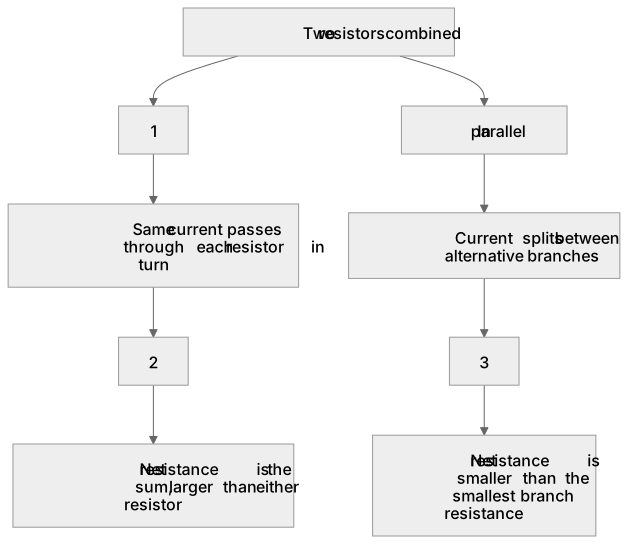
1Box 1
2Box 2
3Box 3
There is more to this lesson
The full lesson goes on to check your understanding and help you earn the marks. Create a free account to carry on, with your progress saved.
A week of Premium from your first lesson · Then the free plan continues · No card, no charge
Test your understanding of Simple circuits: explain why, if two resistors are in series the net resistance is increased, whereas with two in parallel the net resistance is decreased (qualitative explanation only)
Active recall beats re-reading. Take an instant quiz now to test what you’ve learned and lock it into long-term memory.
A week of Premium from your first lesson · Then the free plan continues · No card, no charge