OCR · GCSE · Physics
Course version: J249 · Version from Sept 2018
Recall and apply: energy transferred (J, kW h) = power (W, kW) × time (s, h)
Full specification wording
Simple circuits: recall and apply: energy transferred (J, kW h) = power (W, kW) × time (s, h)
This equation links the energy a device transfers to how quickly it works and for how long.
Checked against the OCR J249 specification (opens in a new tab) on .
- Point 4 of 14
- 4 key terms
Study notes
From the checked teaching notes for this specification point.
The idea
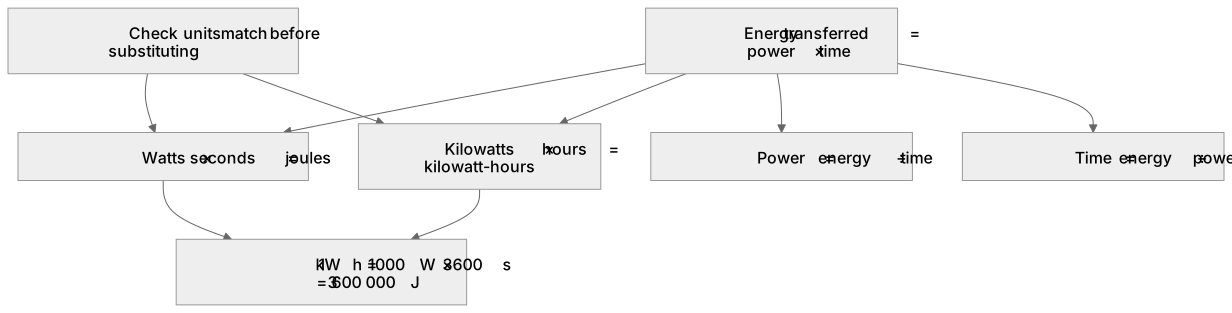
This equation links the energy a device transfers to how quickly it works and for how long. Energy transferred in joules equals power in watts multiplied by time in seconds, so a 60 W lamp left on for 120 s transfers 60 × 120 = 7200 J. The same relationship works in the domestic units: energy in kilowatt-hours equals power in kilowatts multiplied by time in hours, so a 2 kW heater running for 3 h transfers 2 × 3 = 6 kW h. Keep each quantity in its matching unit pair: watts with seconds give joules, kilowatts with hours give kilowatt-hours. To convert, 1 kW h = 1000 W × 3600 s = 3 600 000 J. Rearranging gives power = energy ÷ time and time = energy ÷ power. In a multiple-choice question, check the units offered before substituting numbers, because mixing watts with hours or kilowatts with seconds is the usual trap.
What earns the marks
- Selects the option that multiplies power in watts by time in seconds to give energy in joules.
- Chooses the answer that pairs kilowatts with hours to give energy in kilowatt-hours.
- Applies the rearrangement power = energy ÷ time when the question supplies energy and time.
- Uses the conversion 1 kW h = 3 600 000 J correctly when changing between the two energy units.
- Rejects options that mix a power unit with a mismatched time unit, such as watts with hours.
Common mistakes and how to put them right
Multiplies watts by hours and labels the result in joules.
Put it right: Convert the time to seconds first or switch the power to kilowatts.
Divides power by time instead of multiplying.
Put it right: Energy transferred is power × time.
Forgets to convert kilowatts to watts before using seconds.
Put it right: Multiply the power by 1000 first.
Treats 1 kW h as 1000 J.
Put it right: The correct conversion is 3 600 000 J.
Exam tips
- Write the unit of every number beside it before choosing an option, so a mismatch becomes obvious.
- Convert all values to one consistent pair (W with s, or kW with h) before calculating.
- Sanity-check the size of the answer: a few hundred watts for a few minutes should give thousands of joules, not millions.
Try the lesson
The start of the Simple circuits: recall and apply: energy transferred (J, kW h) = power (W, kW) × time (s, h) lesson, made from checked teaching notes for this specification point.
Have a go first
A 500 W heater is switched on for 20 s. How much energy does it transfer?
Listen
This equation links the energy a device transfers to how quickly it works and for how long. Energy transferred in joules equals power in watts multiplied by time in seconds, so a 60 W lamp left on for 120 s transfers 60 × 120 = 7200 J. The same relationship works in the domestic units: energy in kilowatt-hours equals power in kilowatts multiplied by time in hours, so a 2 kW heater running for 3 h transfers 2 × 3 = 6 kW h. Keep each quantity in its matching unit pair: watts with seconds give joules, kilowatts with hours give kilowatt-hours. To convert, 1 kW h = 1000 W × 3600 s = 3 600 000 J. Rearranging gives power = energy ÷ time and time = energy ÷ power. In a multiple-choice question, check the units offered before substituting numbers, because mixing watts with hours or kilowatts with seconds is the usual trap. A strong answer earns marks for these points. Selects the option that multiplies power in watts by time in seconds to give energy in joules. Chooses the answer that pairs kilowatts with hours to give energy in kilowatt-hours. Applies the rearrangement power = energy ÷ time when the question supplies energy and time. Uses the conversion 1 kW h = 3 600 000 J correctly when changing between the two energy units. Exam tip: Write the unit of every number beside it before choosing an option, so a mismatch becomes obvious.
See it
Key words
Say what each word means before you turn the card.
Energy transferred
Try answering aloud or in your head before turning the card.
Unit pairing
Try answering aloud or in your head before turning the card.
Conversion between joules and kilowatt-hours
Try answering aloud or in your head before turning the card.
Rearranging the equation
Try answering aloud or in your head before turning the card.
See every definition
- Energy transferred
- Equals power multiplied by time, given in joules when power is in watts and time is in seconds, or in kilowatt-hours when power is in kilowatts and time is in hours.
- Unit pairing
- Each quantity must be kept in its matching pair: watts with seconds give joules, and kilowatts with hours give kilowatt-hours.
- Conversion between joules and kilowatt-hours
- One kilowatt-hour equals 1000 W multiplied by 3600 s, which is 3 600 000 J.
- Rearranging the equation
- Gives power = energy ÷ time and time = energy ÷ power.
Label the diagram
Some boxes have lost their names. Pick the right name for each number.
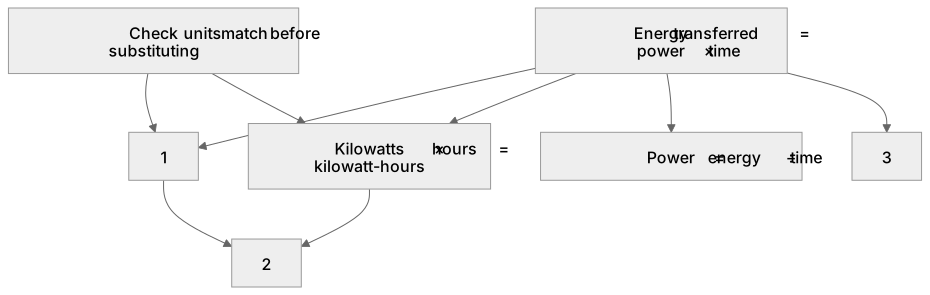
1Box 1
2Box 2
3Box 3
There is more to this lesson
The full lesson goes on to check your understanding and help you earn the marks. Create a free account to carry on, with your progress saved.
A week of Premium from your first lesson · Then the free plan continues · No card, no charge
Test your understanding of Simple circuits: recall and apply: energy transferred (J, kW h) = power (W, kW) × time (s, h)
Active recall beats re-reading. Take an instant quiz now to test what you’ve learned and lock it into long-term memory.
A week of Premium from your first lesson · Then the free plan continues · No card, no charge