OCR · GCSE · Physics
Specific Heat Capacity
This guide provides a comprehensive, exam-focused breakdown of Specific Heat Capacity (SHC) for OCR GCSE Physics (6.4). It covers the core concepts, the essential equation you must memorise, the required practical (PAG 1), and common pitfalls to help you secure every possible mark on this frequently tested topic.
- 6 min read
- 3 worked examples
- 5 practice questions
- 6 key terms
Study Notes
Overview
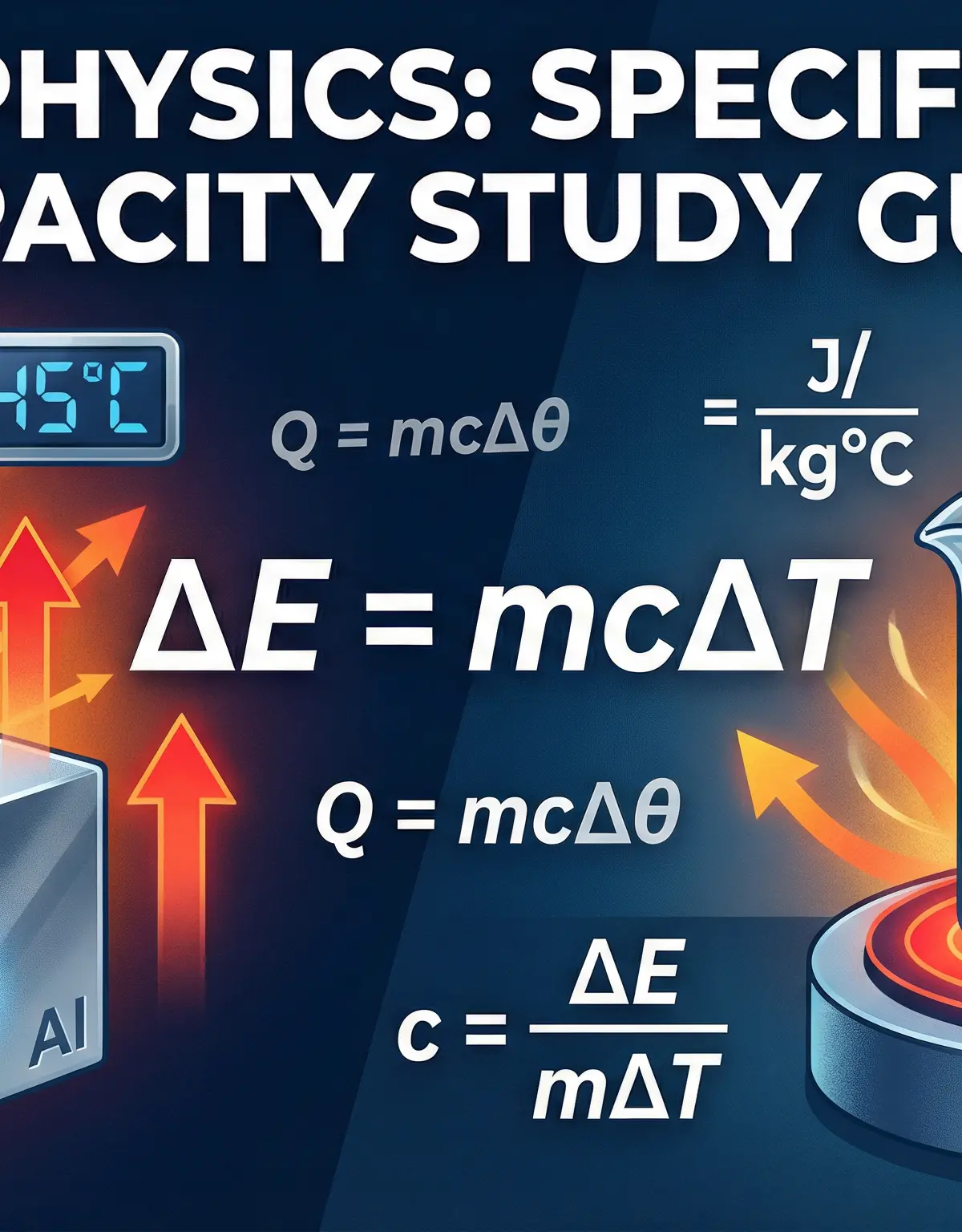
Specific Heat Capacity (SHC) is a fundamental concept in thermal physics that quantifies how much energy a substance must absorb to heat up. In your OCR GCSE exam, this topic, found in section P1 (Matter), is a rich source of marks, blending calculation, practical skills, and conceptual understanding. Examiners frequently test your ability to not only use the core equation but also to analyse the associated required practical (PAG 1), evaluating sources of error and suggesting improvements. A typical exam question might be a multi-step calculation involving a unit conversion, or a 6-mark question asking you to describe the experimental method and explain its limitations. Mastering SHC is crucial as it forms a synoptic link to topics like Conservation of Energy, Power, and States of Matter. This guide will equip you with the knowledge and exam technique to tackle any SHC question with confidence.
Key Concepts
Concept 1: What is Specific Heat Capacity?
In simple terms, specific heat capacity is a measure of a substance's resistance to changing temperature. Substances with a high SHC require a lot of energy to increase their temperature, while those with a low SHC heat up very quickly. The formal definition, which is worth 1-2 marks if you can state it precisely, is: The energy required to raise the temperature of 1 kg of a substance by 1 °C.
Analogy: The Shopping BagThink of thermal energy as groceries and temperature as how full a shopping bag looks. A substance with a low SHC is like a small, flimsy plastic bag – a few items (energy) make it look full (high temperature) very quickly. A substance with a high SHC, like water, is like a giant, sturdy hiking backpack. You can pile in tons of groceries (energy) before it even starts to look full (its temperature rises slowly). This is why water is used in central heating systems; it can carry a huge amount of thermal energy around your house.
Concept 2: The Required Practical (PAG 1)
This is one of the most important parts of the topic. Examiners will test your knowledge of the apparatus, method, and, most importantly, the errors involved.
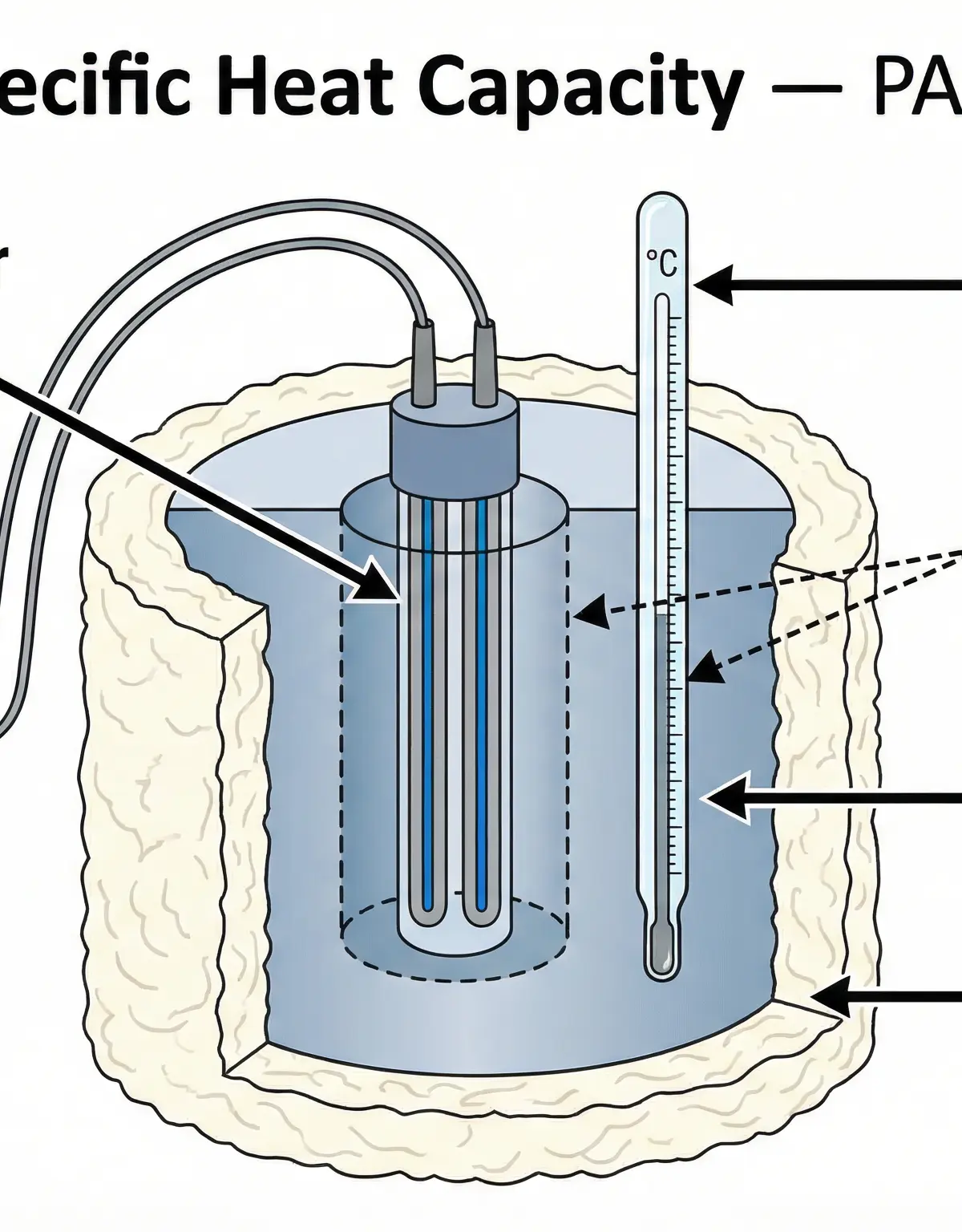
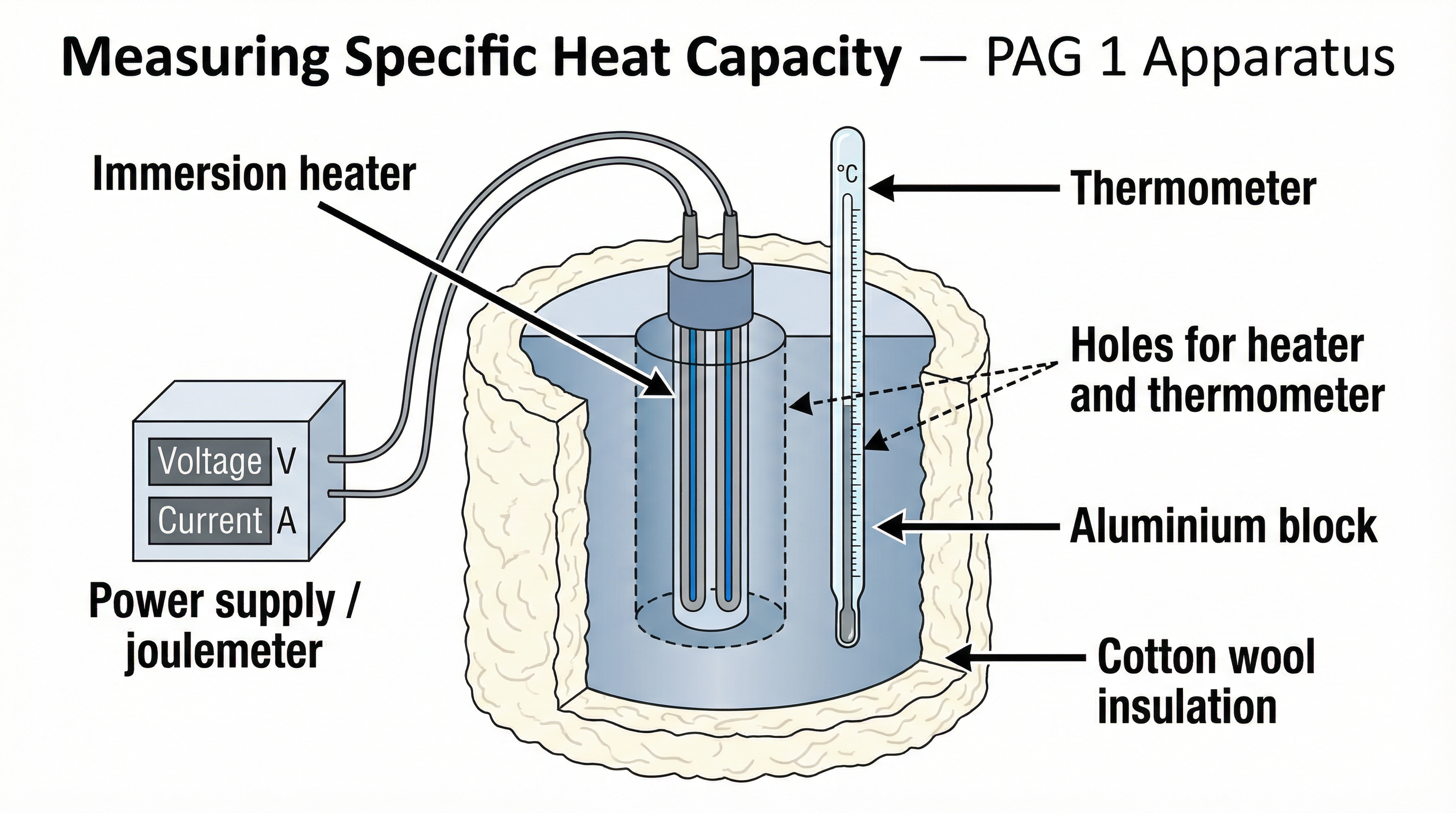
Objective: To measure the specific heat capacity of a material (e.g., an aluminium block).
Method Summary:
- Measure the mass of the block in kilograms.
- Place a heater in the larger hole and a thermometer in the smaller one. Add a drop of water to the thermometer hole to ensure good thermal contact.
- Record the starting temperature of the block.
- Connect the heater to a power supply and a joulemeter. Turn it on for a set amount of time (e.g., 10 minutes).
- Record the total energy supplied by the joulemeter (ΔE) and the final temperature.
- Calculate the temperature change (ΔT).
- Use the rearranged equation
c = ΔE / (m × ΔT)to find the specific heat capacity.
Crucial Examiner Points:
- Insulation: You MUST state that the block is insulated (e.g., wrapped in cotton wool) to reduce the transfer of thermal energy to the surroundings. Vague answers like 'to stop heat loss' will not be credited.
- Systematic Error: A key source of error is energy loss to the atmosphere. This means not all the energy from the heater goes into the block. This results in a smaller temperature change (ΔT) than expected. When you calculate
c = ΔE / (m × ΔT), dividing by a smaller ΔT gives a calculated value for 'c' that is higher than the true value. This is a 1-2 mark point that frequently appears.
Mathematical/Scientific Relationships
The cornerstone of this topic is one vital equation. You are expected to know it by heart, as it is not provided on the OCR formula sheet.
The Specific Heat Capacity Equation (Must Memorise)
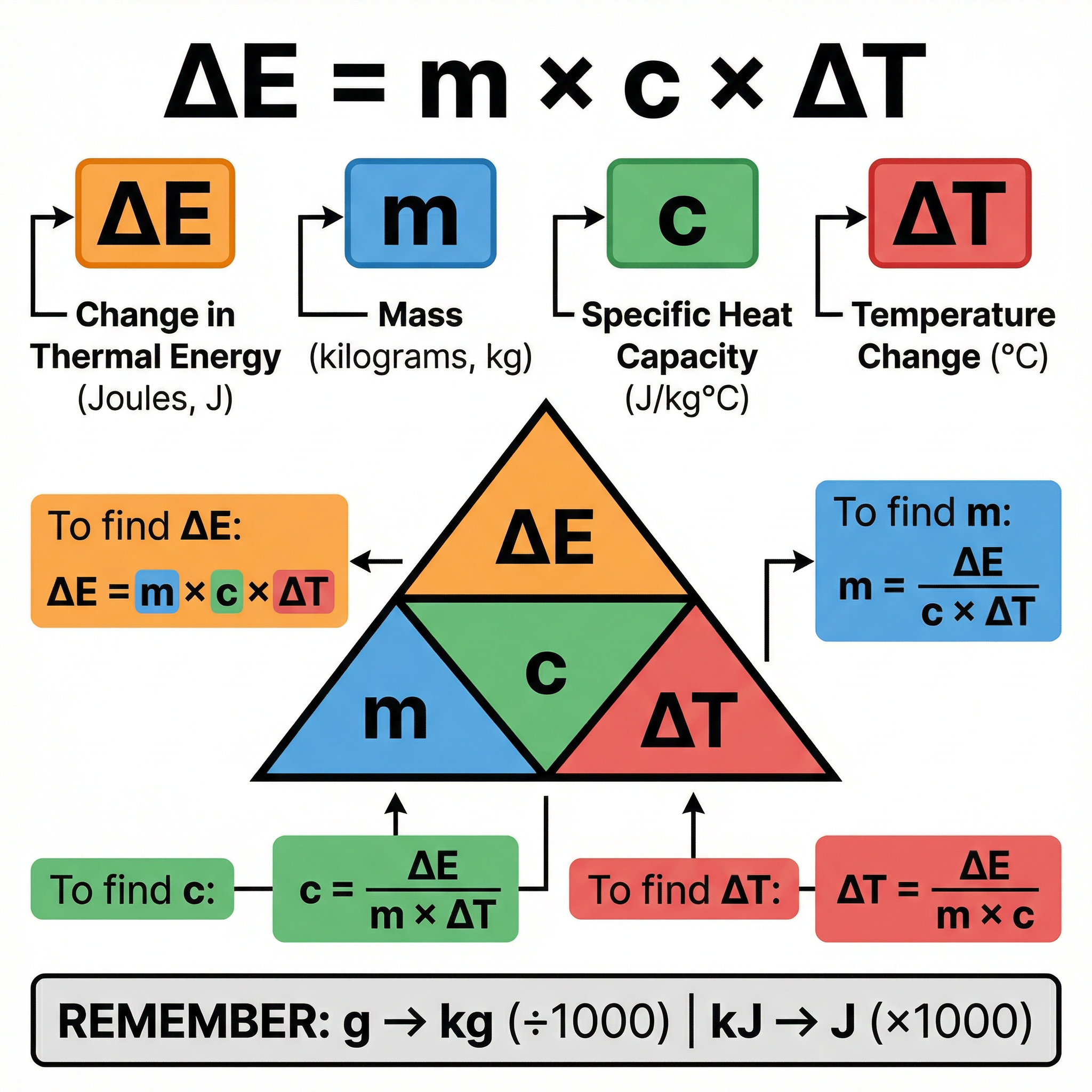
ΔE = m × c × ΔT
Where:
- ΔE = Change in Thermal Energy, measured in Joules (J)
- m = Mass, measured in kilograms (kg)
- c = Specific Heat Capacity, measured in Joules per kilogram per degree Celsius (J/kg°C)
- ΔT (delta T) = Change in Temperature, measured in degrees Celsius (°C)
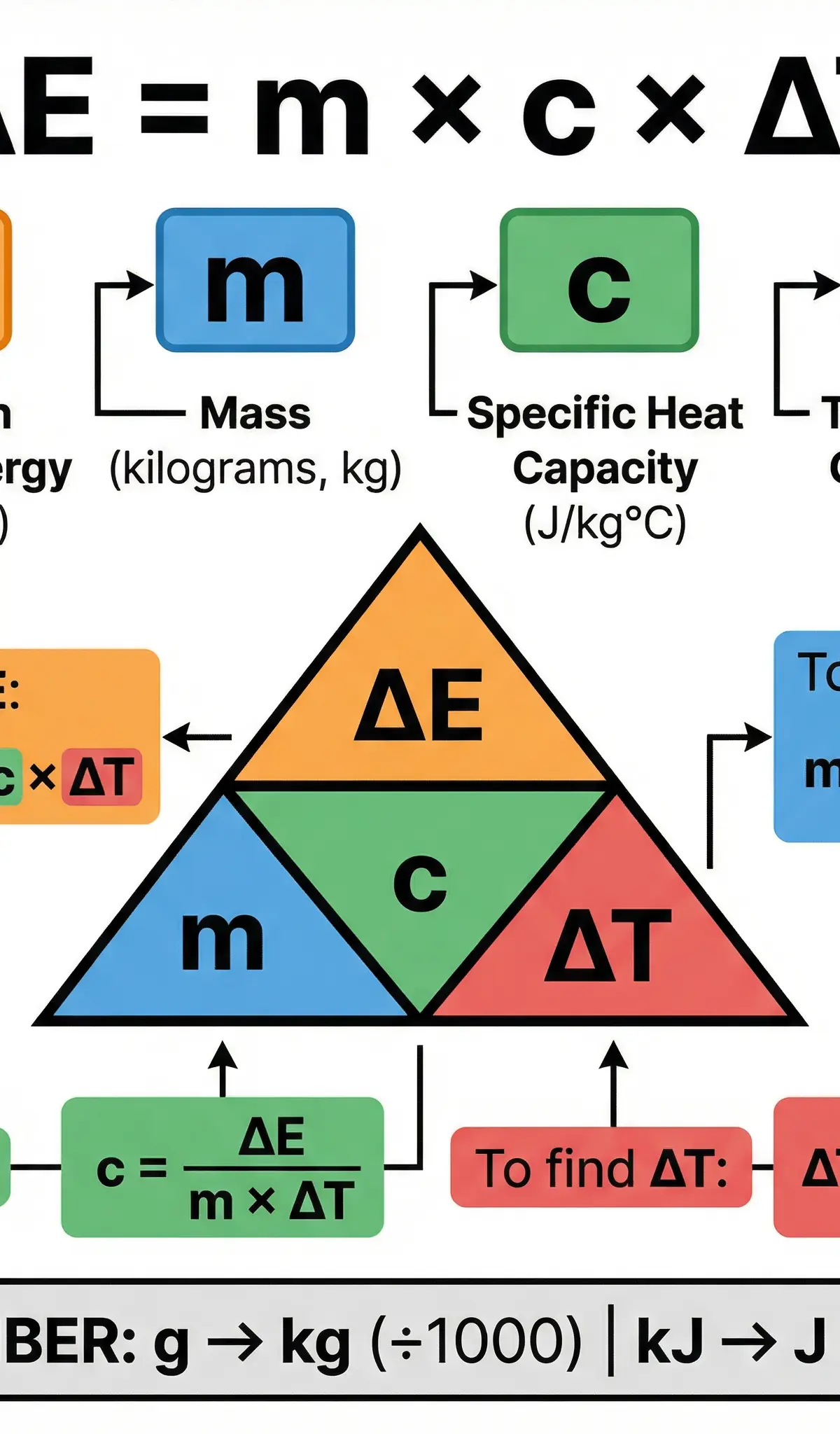
Rearranging the EquationExaminers will often ask you to find 'c', 'm', or 'ΔT', so you must be confident in rearranging the formula:
- To find c:
c = ΔE / (m × ΔT) - To find m:
m = ΔE / (c × ΔT) - To find ΔT:
ΔT = ΔE / (m × c)
Unit Conversions (Common Mistakes)
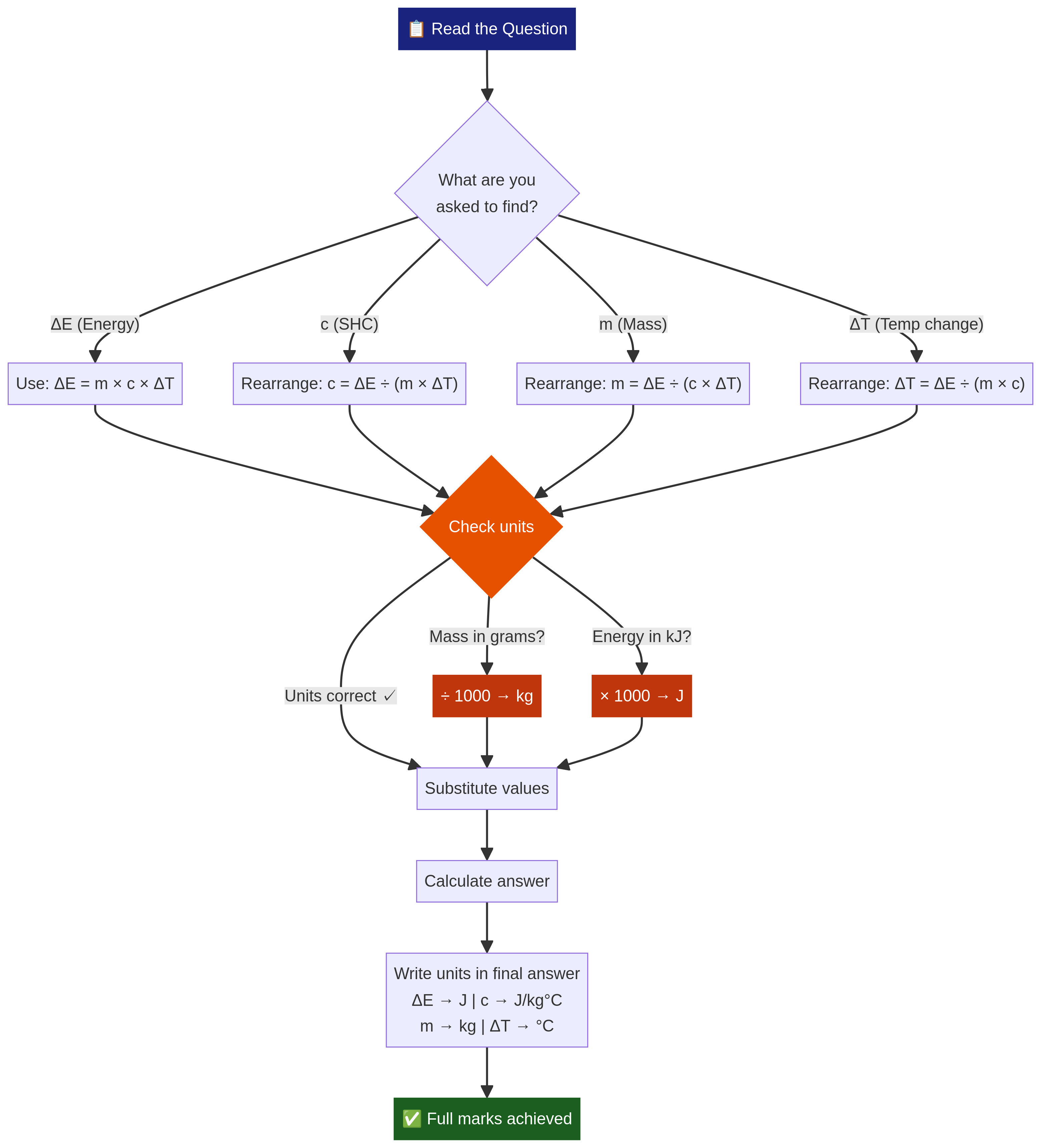
- Mass: If given in grams (g), you MUST convert to kilograms (kg) by dividing by 1000. (e.g., 500 g = 0.5 kg)
- Energy: If given in kilojoules (kJ), you MUST convert to joules (J) by multiplying by 1000. (e.g., 7.2 kJ = 7200 J)
Practical Applications
- Engine Coolant: Water's very high SHC (4200 J/kg°C) makes it an excellent coolant. It can absorb a large amount of waste thermal energy from a car engine without its temperature rising to dangerous levels.
- Saucepans: The base of a saucepan is made from a material with a low SHC (like copper or aluminium), so it heats up very quickly to cook food. The handle, however, is made from a material with a high SHC and low thermal conductivity (like plastic), so it doesn't get hot.
- Coastal Climates: Coastal areas have milder climates than inland areas. The large body of water (ocean) has a high SHC, so it heats up slowly in summer and cools down slowly in winter, moderating the temperature of the nearby land.
Visual Resources
4 diagrams and illustrations
Interactive Diagrams
2 interactive diagrams to visualise key concepts
Conceptual Flow Outline
A flowchart showing the step-by-step thinking process for tackling any SHC calculation question to ensure no marks are lost.
Conceptual Flow Outline
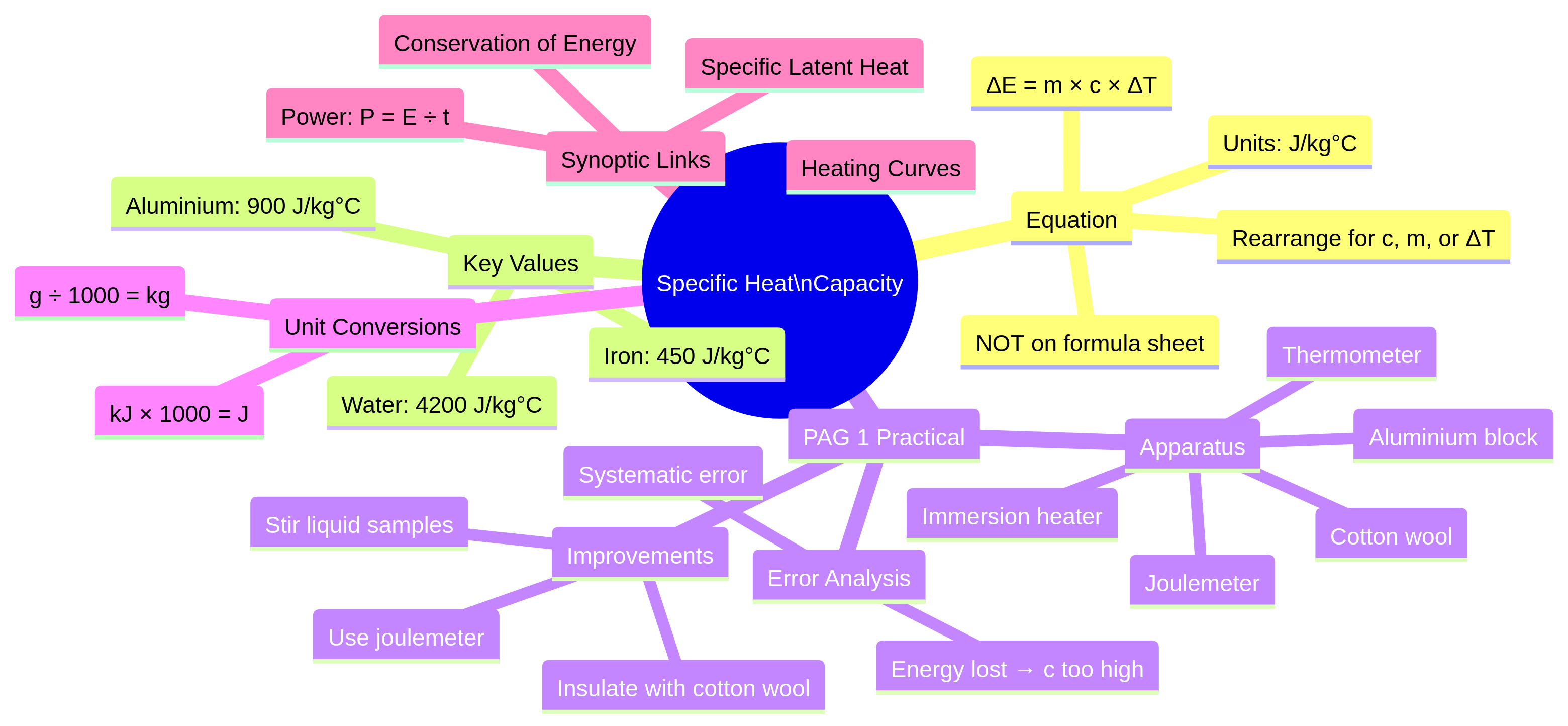
A concept map linking the core ideas within the Specific Heat Capacity topic, from the equation to practical work and synoptic connections.
Worked Examples
3 worked examples — open one to explore the question and available guidance.
Practice Questions
Test your understanding — click to reveal model answers
State the definition of specific heat capacity. [2 marks]
Hint: Think about the two key quantities that are kept at 'one' in the definition.
A 200 g sample of oil is heated from 10 °C to 40 °C using 11.4 kJ of energy. Calculate the specific heat capacity of the oil. [5 marks]
Hint: Don't forget to check the units for BOTH mass and energy before you start calculating!
Describe an experiment to determine the specific heat capacity of a block of aluminium. [6 marks]
Hint: Structure your answer like a lab report: list the apparatus, then give a numbered method. Mention every measurement you need to take.
A kettle has a power rating of 2.2 kW. It is used to heat 1.5 kg of water from 15 °C to its boiling point of 100 °C. Calculate the minimum time this should take. The specific heat capacity of water is 4200 J/kg°C. [5 marks]
Hint: This is a two-stage problem. First, find the energy needed using the SHC equation. Then, use the power equation (P = E/t) to find the time.
Explain why the actual time taken to boil the water in the kettle from the previous question would be longer than the calculated minimum time. [2 marks]
Hint: Think about the principle of conservation of energy. Where does the 'lost' energy go?
Test your understanding of Specific Heat Capacity
Active recall beats re-reading. Take an instant quiz now to test what you’ve learned and lock it into long-term memory.
7 days Premium · Then free forever · No card, no charge