OCR · GCSE · Physics
Spring Constant
This guide provides a comprehensive, exam-focused breakdown of the OCR GCSE Physics topic on the Spring Constant (2.7). It covers Hooke's Law, elastic potential energy, and the required practical (PAG P1), equipping candidates with the knowledge to secure maximum marks.
- 6 min read
- 3 worked examples
- 5 practice questions
- 7 key terms
Study Notes

Overview
Welcome to your deep dive into one of the foundational topics of mechanics: the Spring Constant and Hooke's Law. This area of physics, specification point 2.7, is crucial for both Foundation and Higher tier candidates as it explores how materials behave when stretched or compressed. Understanding the relationship between force, extension, and energy storage is not just about springs; it's the basis for understanding material properties, engineering design, and energy transformations. Examiners frequently test this topic through a combination of calculations using the F=kx and E=0.5kx² equations, interpretation of force-extension graphs, and questions related to the required practical (PAG P1). By mastering the concepts of elastic and plastic deformation, you'll be able to confidently tackle a wide range of questions, from simple definitions to multi-step calculations and graph analysis.
Key Concepts
Concept 1: Hooke's Law and the Spring Constant (k)
Hooke's Law is the central principle of this topic. It states that the extension of a spring is directly proportional to the force applied to it, as long as the limit of proportionality is not exceeded. This means that if you double the force, you double the extension. This linear relationship is what makes the behaviour of springs predictable and useful.
The 'stiffness' of a spring is quantified by its spring constant (k). This value tells you how much force is needed to stretch the spring by one metre. A higher spring constant means a stiffer spring, requiring more force for the same extension. The unit for the spring constant is Newtons per metre (N/m).
Example: A spring with k = 100 N/m requires 100 Newtons of force to stretch it by 1 metre. A softer spring with k = 20 N/m would only require 20 Newtons for the same 1-metre extension.
Concept 2: Elastic vs. Plastic Deformation
When a force is applied to a material, it can deform in one of two ways:
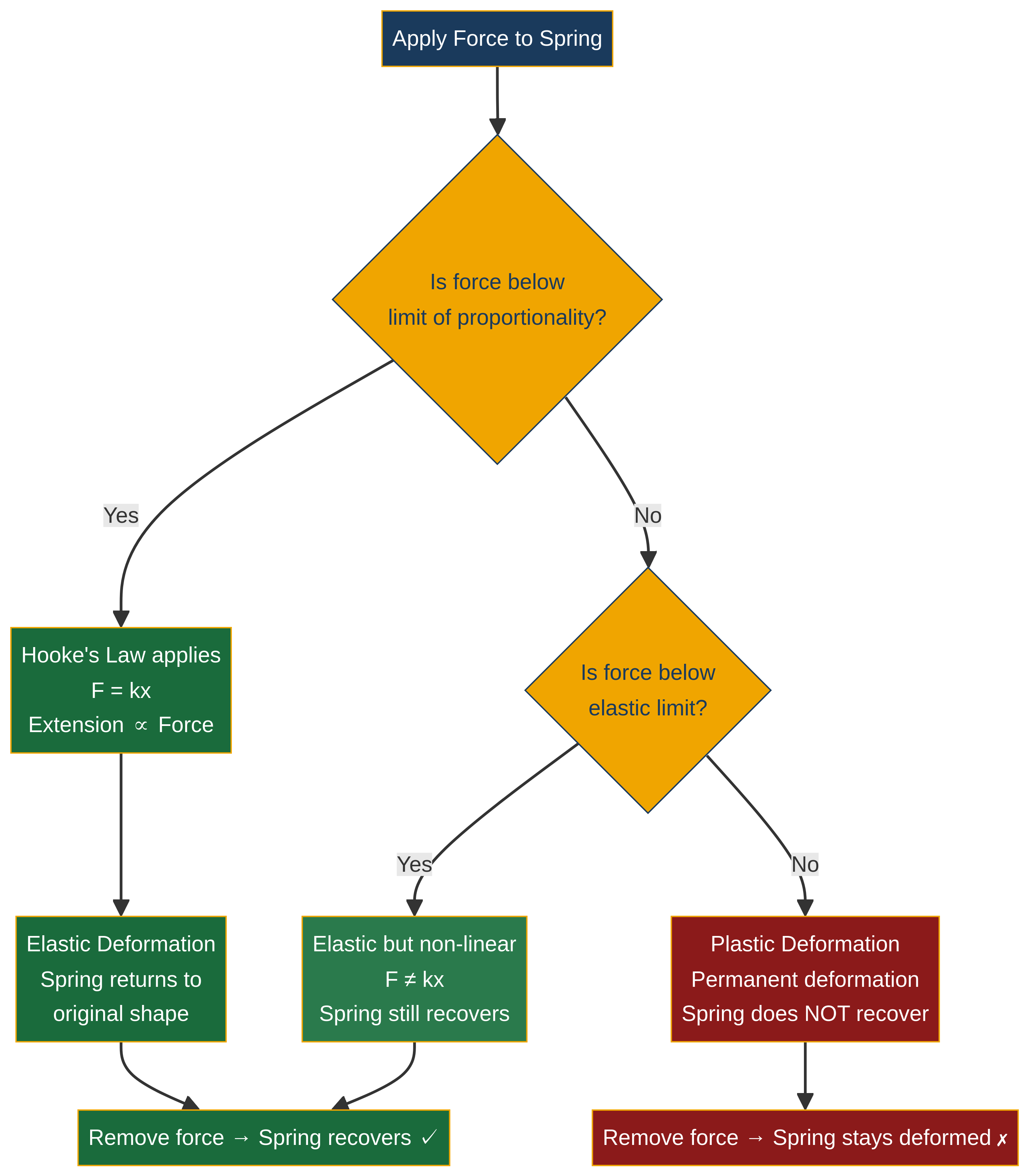
- Elastic Deformation: This is a temporary change in shape. When the force is removed, the object returns to its original, unstretched length. This is the behaviour described by Hooke's Law. For marks to be awarded, candidates must state that the object returns to its original shape.
- Plastic Deformation: This is a permanent change in shape. If you stretch a spring too far (beyond its elastic limit), it will not return to its original length. It has been permanently deformed. Credit is given for responses that clearly state the deformation is permanent.

Concept 3: Force-Extension Graphs
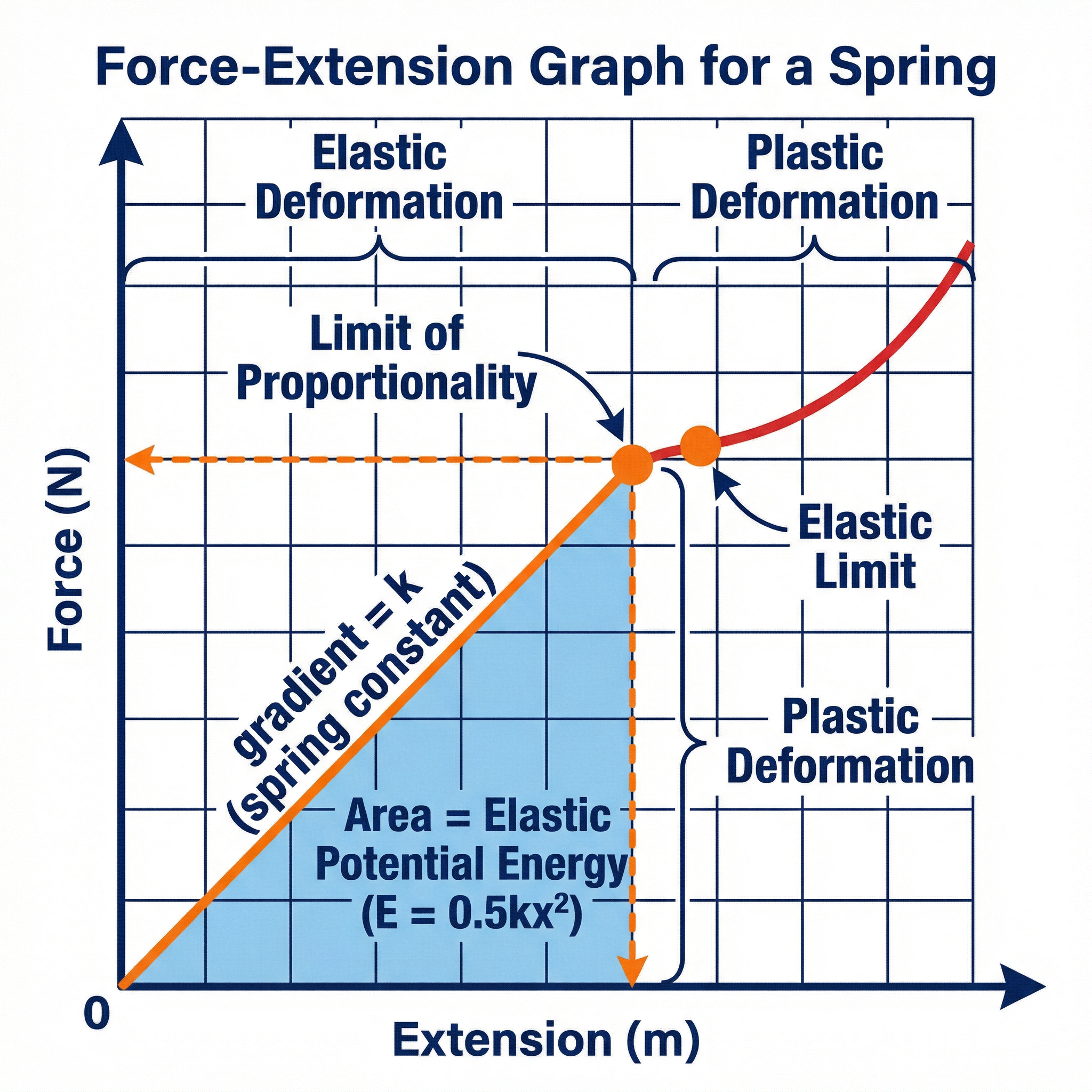
Examiners love using graphs to test this topic. A graph of Force (y-axis) vs. Extension (x-axis) provides a wealth of information:
- The Linear Region: The initial straight-line section passing through the origin shows where Hooke's Law is obeyed. The gradient (change in y / change in x) of this section is equal to the spring constant, k.
- The Limit of Proportionality: This is the precise point where the graph stops being a straight line and begins to curve. OCR requires this exact terminology. Beyond this point, force is no longer directly proportional to extension.
- The Elastic Limit: A point just beyond the limit of proportionality. Up to this point, the object will still return to its original shape (elastic deformation). Beyond it, the object undergoes plastic deformation.
- The Area Under the Graph: The work done in stretching the spring is stored as elastic potential energy. This energy is represented by the area under the force-extension graph. For the linear region, this is the area of a triangle.

Mathematical/Scientific Relationships
There are two key equations you must be able to use and rearrange. One is given on the formula sheet, the other you must memorise.
-
Hooke's Law Equation (Given on formula sheet)
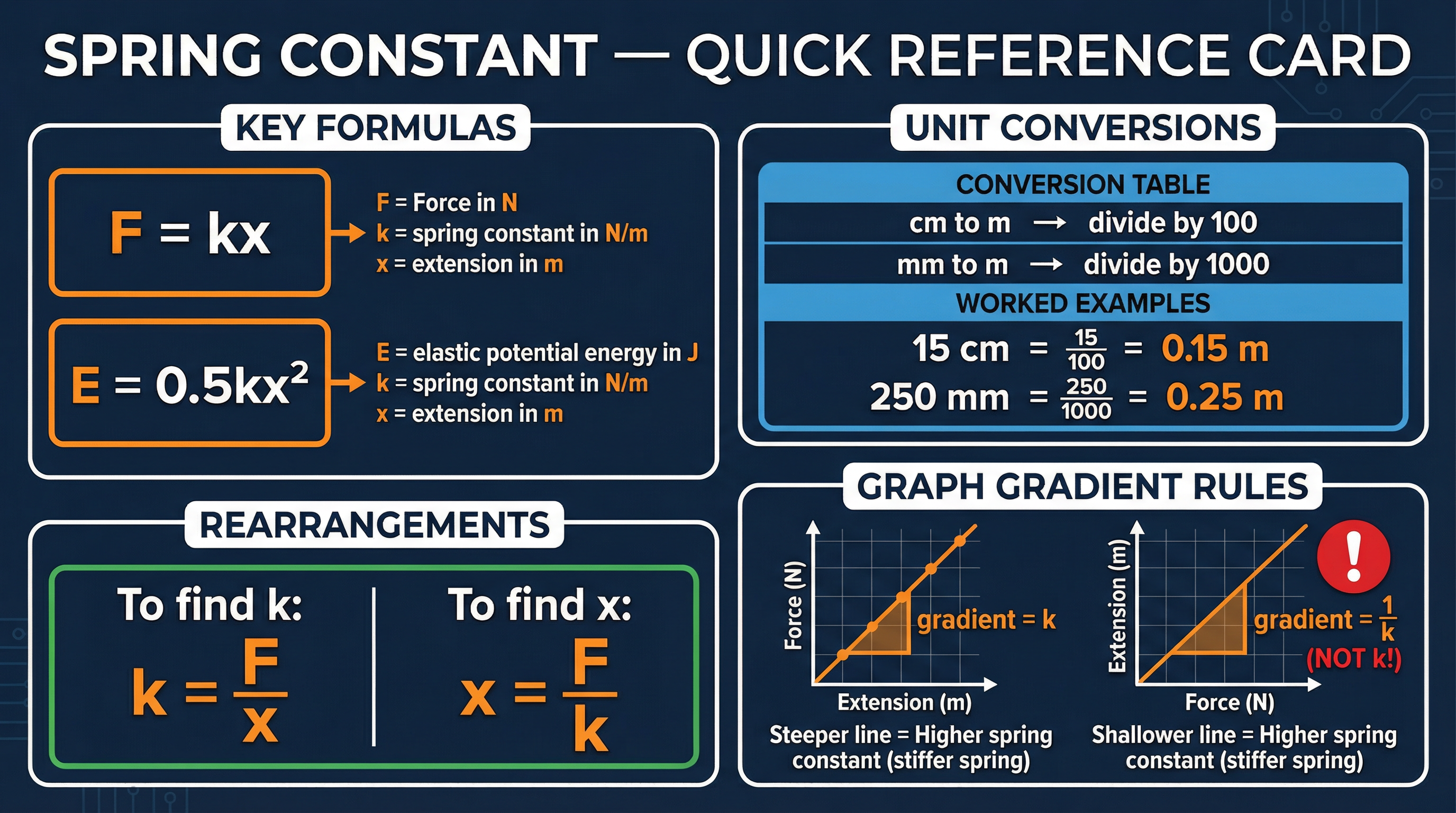
F = kx- F: Force applied, in Newtons (N)
- k: Spring Constant, in Newtons per metre (N/m)
- x: Extension (not total length!), in metres (m)
-
Elastic Potential Energy Equation (Must memorise)
Eₑ = 0.5 * k * x²- Eₑ: Elastic Potential Energy stored, in Joules (J)
- k: Spring Constant, in Newtons per metre (N/m)
- x: Extension, in metres (m)

Practical Applications
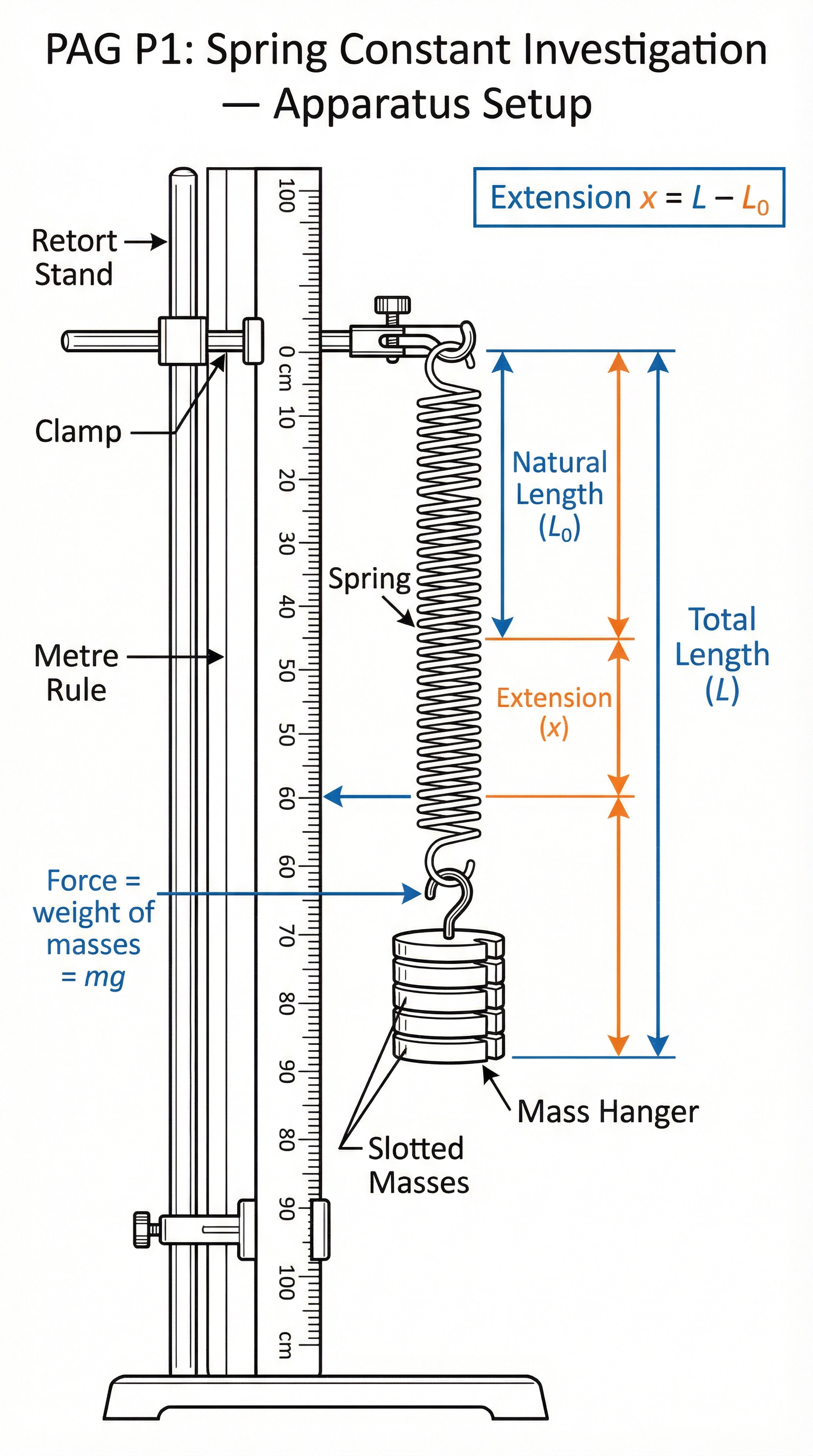
This topic is directly assessed through the Required Practical Activity Group (PAG) P1: Investigating Springs. Candidates must be familiar with the experimental setup and procedure.
PAG P1: Investigating the relationship between force and extension for a spring
- Apparatus: Retort stand, clamp, boss; spring; metre rule; mass hanger and slotted masses (e.g., 100g masses); safety goggles.
- Method:
- Set up the apparatus as shown in the diagram, ensuring the ruler is vertical and close to the spring.
- Measure the original, unloaded length of the spring. This is the 'natural length'.
- Add a single mass (e.g., 100g, which is a weight of 0.98N). Measure the new length of the spring.
- Calculate the extension by subtracting the natural length from the new length.
- Repeat this process, adding one mass at a time, recording the new length and calculating the extension for each new total mass.
- Plot a graph of Force (y-axis) against Extension (x-axis).
- Draw a line of best fit through the points that form a straight line.
- Calculate the gradient of this straight-line section to find the spring constant, k.
- Common Errors: Failing to measure from the same point on the spring each time; parallax error when reading the ruler; using total length instead of extension; adding too much mass and exceeding the elastic limit.

Visual Resources
5 diagrams and illustrations
Interactive Diagrams
2 interactive diagrams to visualise key concepts
Conceptual Flow Outline
A flowchart showing the process of determining the type of deformation in a spring based on the applied force.
Conceptual Flow Outline
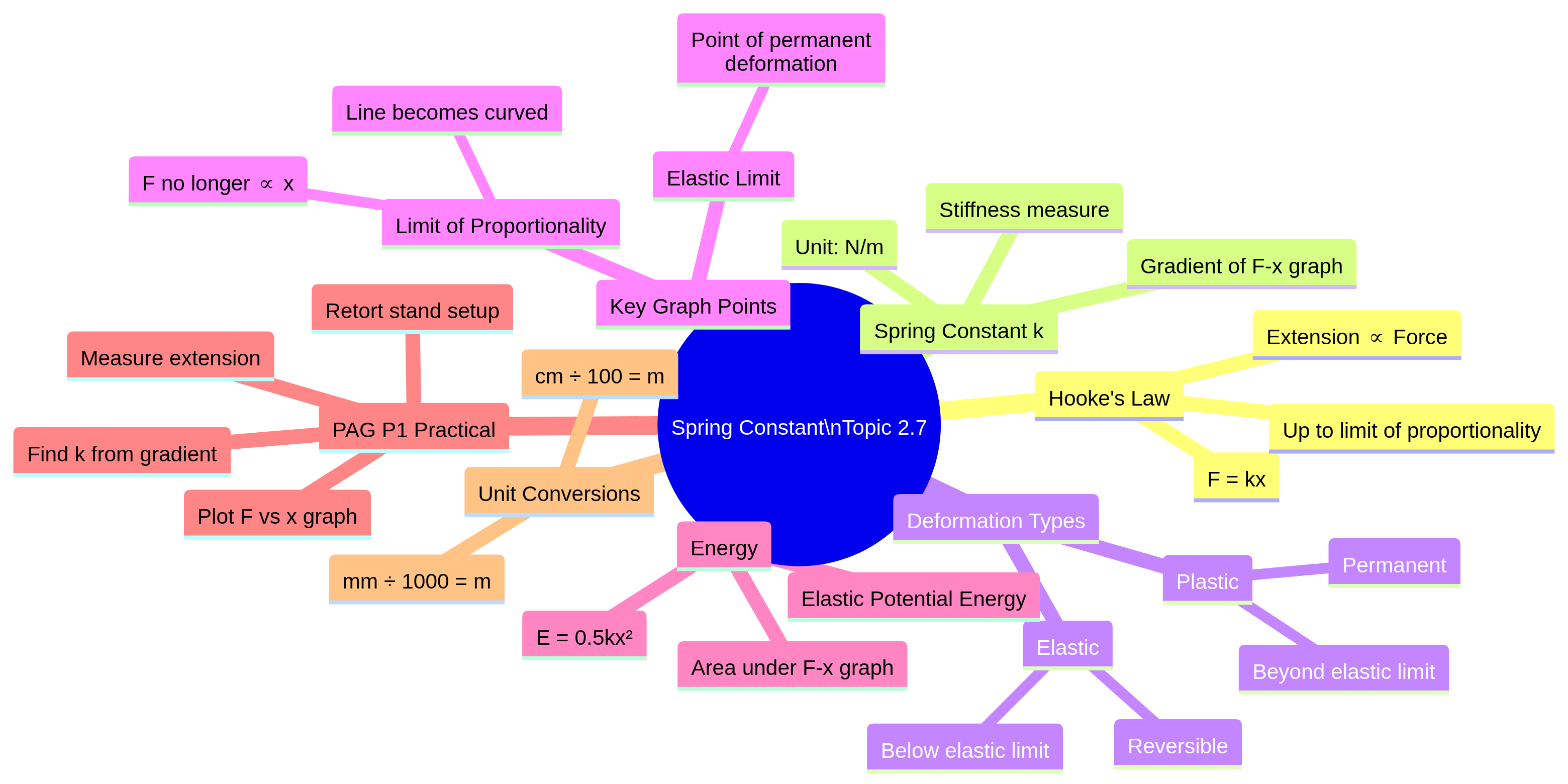
A concept map linking the key ideas within the Spring Constant topic, from Hooke's Law to the required practical.
Worked Examples
3 worked examples — open one to explore the question and available guidance.
Practice Questions
Test your understanding — click to reveal model answers
A spring has a natural length of 15 cm. When a 400 g mass is hung from it, its length becomes 23 cm. Calculate the spring constant of the spring. (g = 9.8 N/kg)
Hint: First, calculate the force (weight) from the mass. Then, calculate the extension in metres.
State two ways a student could improve the accuracy of the experiment to determine a spring constant.
Hint: Think about sources of error when measuring.
A spring with a spring constant of 200 N/m is stretched by 10 cm. How much elastic potential energy is stored in the spring?
Hint: Remember to use the energy formula and convert your units first!
A force-extension graph for a different spring is plotted with Extension (m) on the y-axis and Force (N) on the x-axis. The gradient of the straight line section is 0.025. What is the spring constant of this spring?
Hint: Be very careful! Look at which way the axes are plotted.
Explain why a spring feels stiffer the more it is stretched, even within its elastic limit.
Hint: Think about the relationship F=kx.
Test your understanding of Spring Constant
Active recall beats re-reading. Take an instant quiz now to test what you’ve learned and lock it into long-term memory.
7 days Premium · Then free forever · No card, no charge