OCR · GCSE · Physics
The Big Bang Theory
This guide covers the Big Bang Theory (OCR GCSE Physics 8.12), focusing on the crucial evidence of Redshift and Cosmic Microwave Background Radiation. It's designed to help you master the concepts and exam techniques needed to secure top marks.
- 4 min read
- 3 worked examples
- 5 practice questions
- 6 key terms
Study Notes
Overview
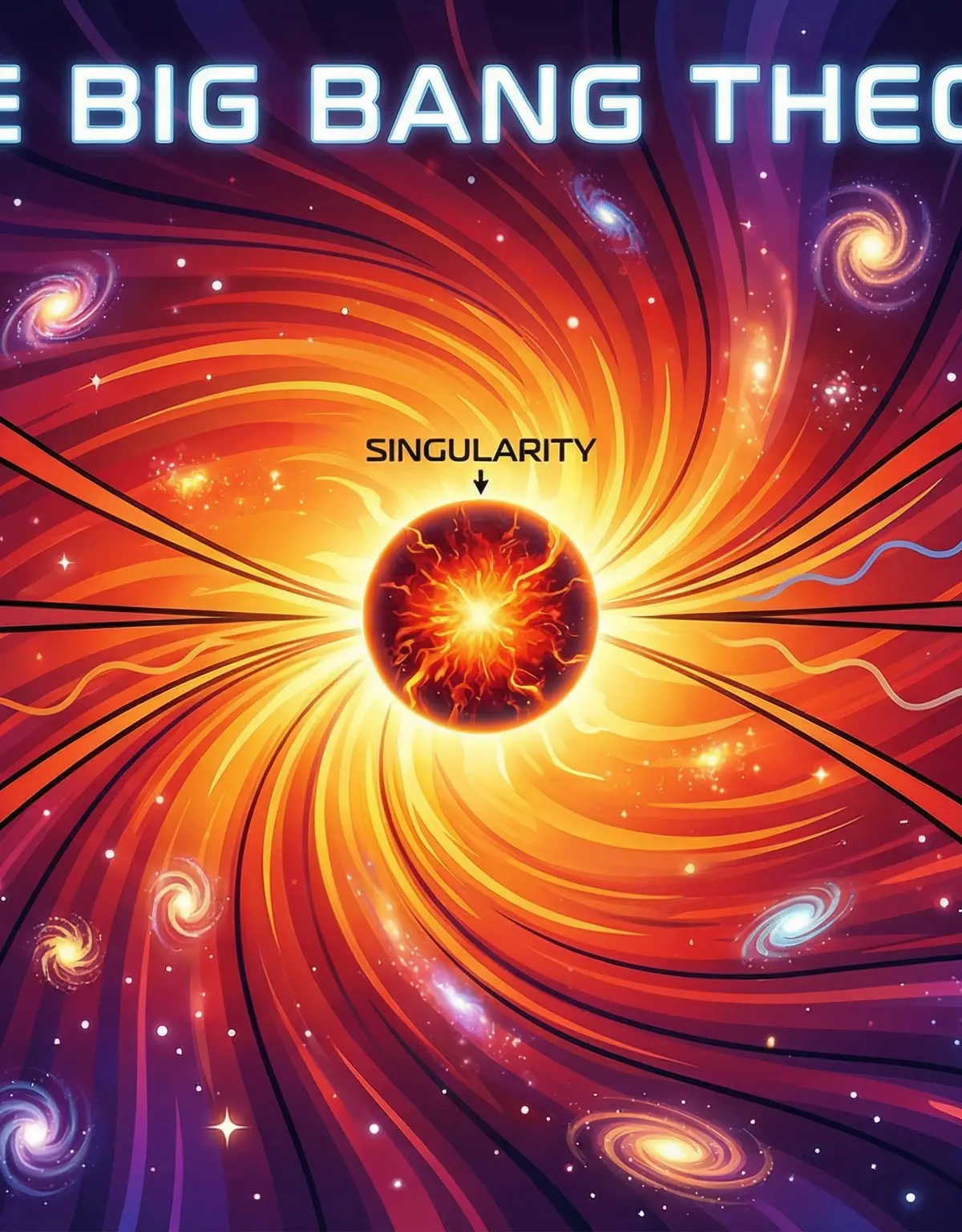
The Big Bang Theory is the leading scientific explanation for how the universe began. It states that approximately 13.8 billion years ago, the entire universe was concentrated into a single, incredibly small, hot, and dense point. From this initial state, the universe has been expanding and cooling ever since. This topic is fundamental to understanding cosmology and our place in the universe. In your OCR GCSE Physics exam, you will be expected to explain the key evidence supporting this theory and distinguish it from competing theories like the Steady State model. Questions often involve interpreting data, explaining phenomena, and linking observations to conclusions, so a clear understanding of the underlying principles is essential.
Key Concepts
Concept 1: The Expanding Universe
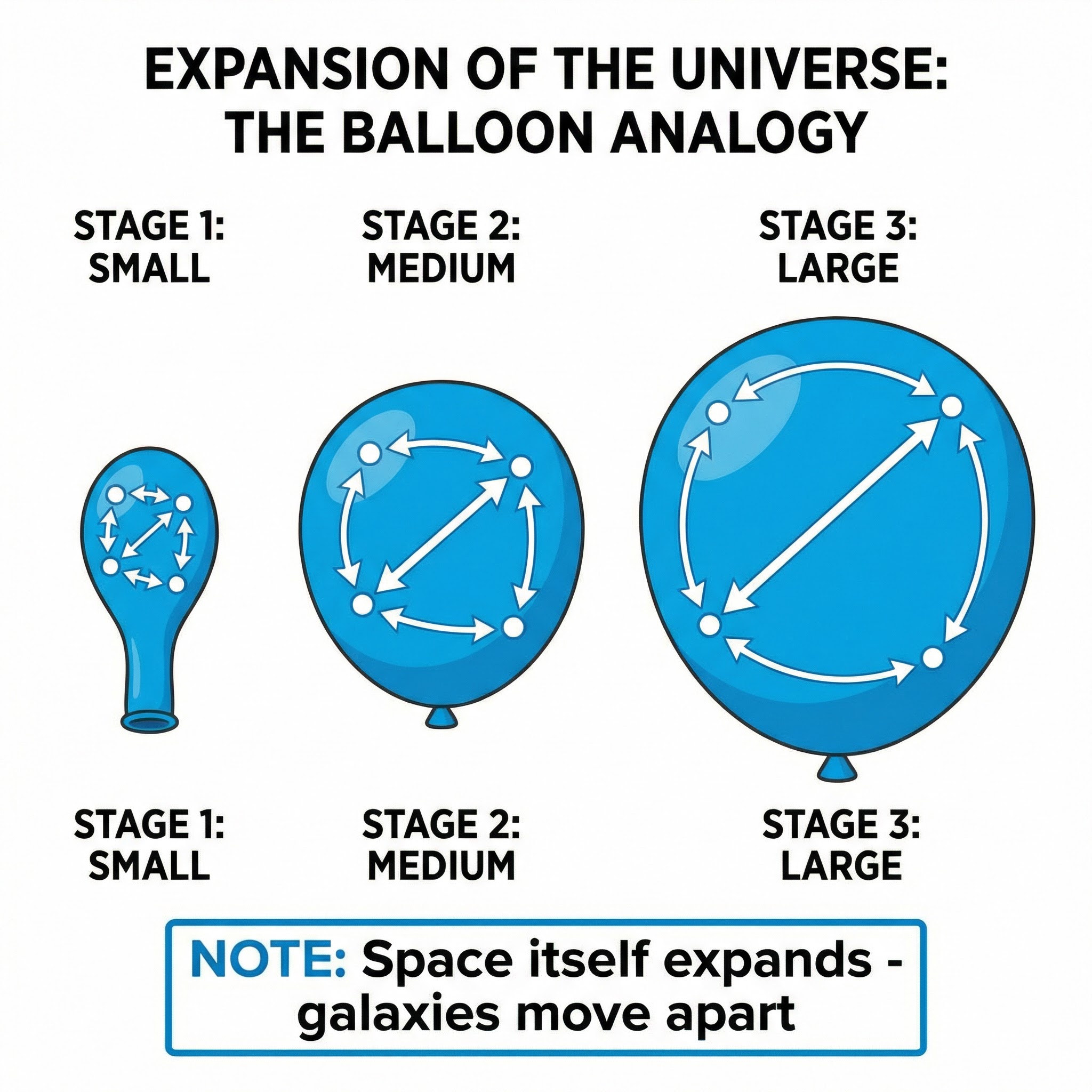
The core idea of the Big Bang is that space itself is expanding. It is not that galaxies are flying through space away from a central point, but rather that the fabric of space itself is stretching, carrying galaxies along with it. A common analogy is dots on the surface of an expanding balloon – the dots themselves aren't moving across the surface, but the distance between them increases as the balloon inflates. This concept is crucial for understanding redshift.
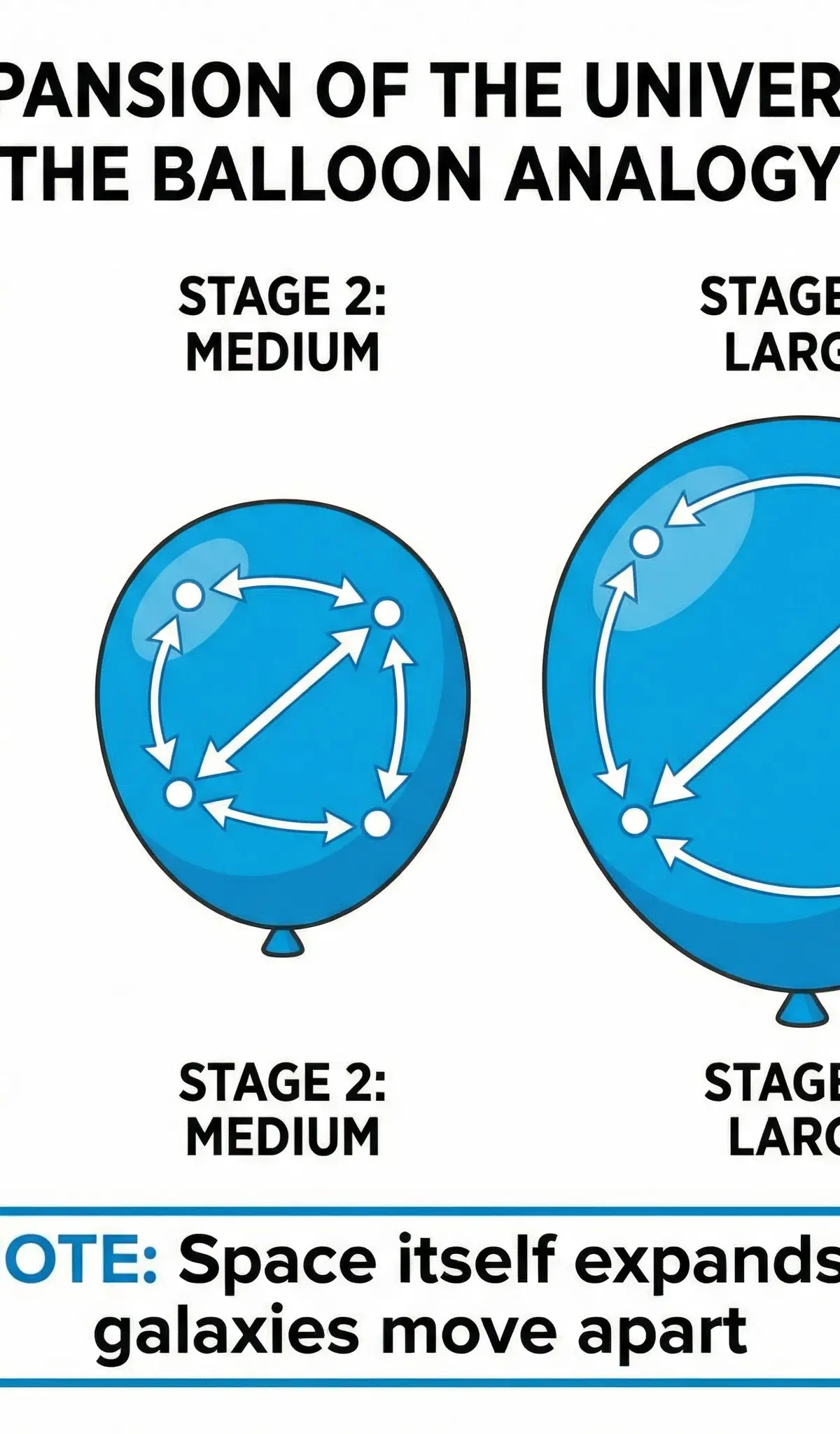
Example: Imagine two galaxies are 1 billion light-years apart. As the universe expands, the space between them stretches, and in the future, they will be further apart, even if they haven't moved through space.
Concept 2: Redshift of Distant Galaxies
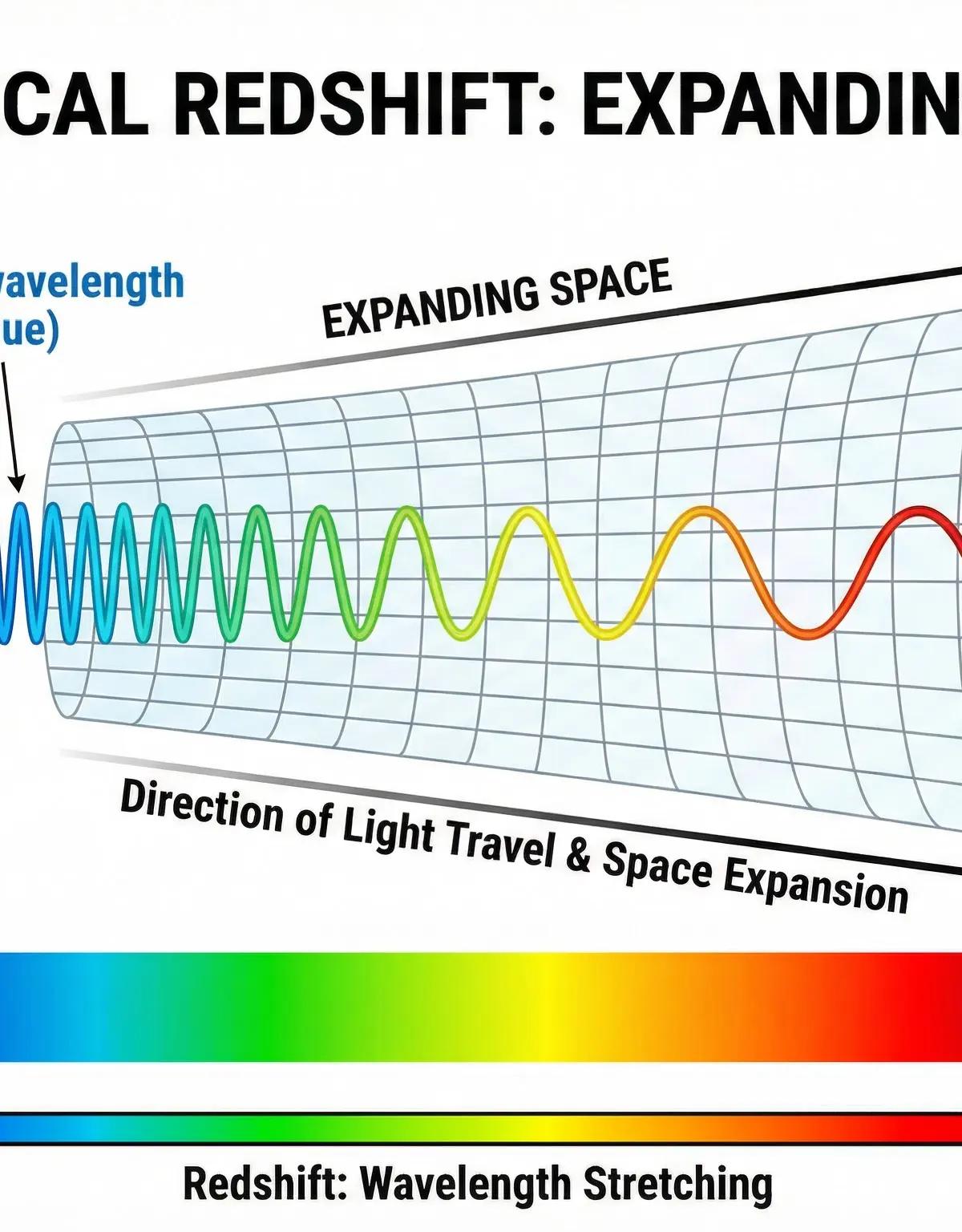
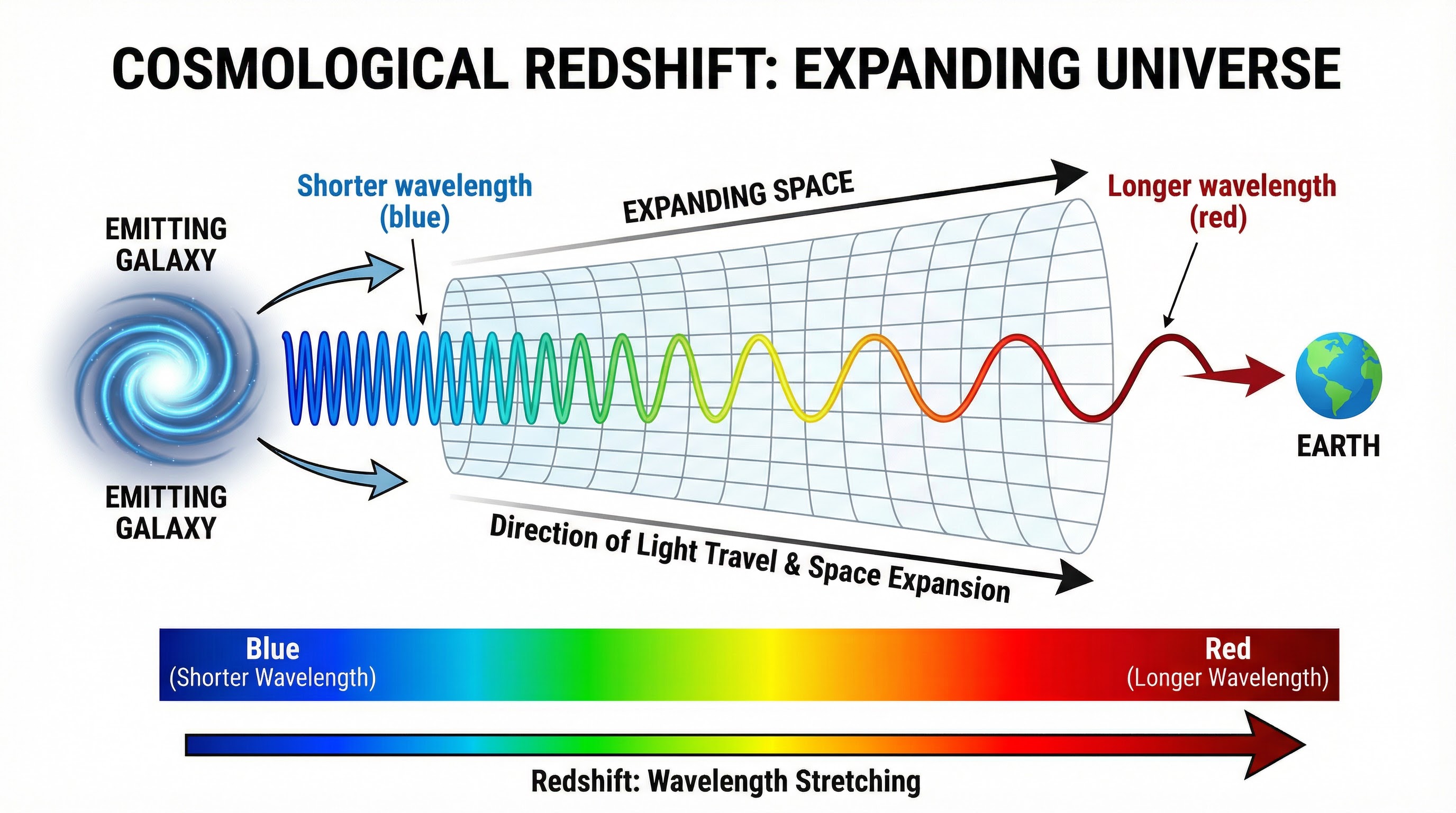
Redshift is the primary observational evidence for the expansion of the universe. When we observe light from distant galaxies, we find that its wavelength has been stretched, shifting it towards the red end of the electromagnetic spectrum. This happens because as light travels through expanding space, its wavelength is stretched along with it. The further a galaxy is from us, the more space the light has had to travel through, and so the more its wavelength has been stretched, resulting in a greater redshift. This relationship, known as Hubble's Law, shows that the further away a galaxy is, the faster it is moving away from us.
Concept 3: Cosmic Microwave Background Radiation (CMBR)
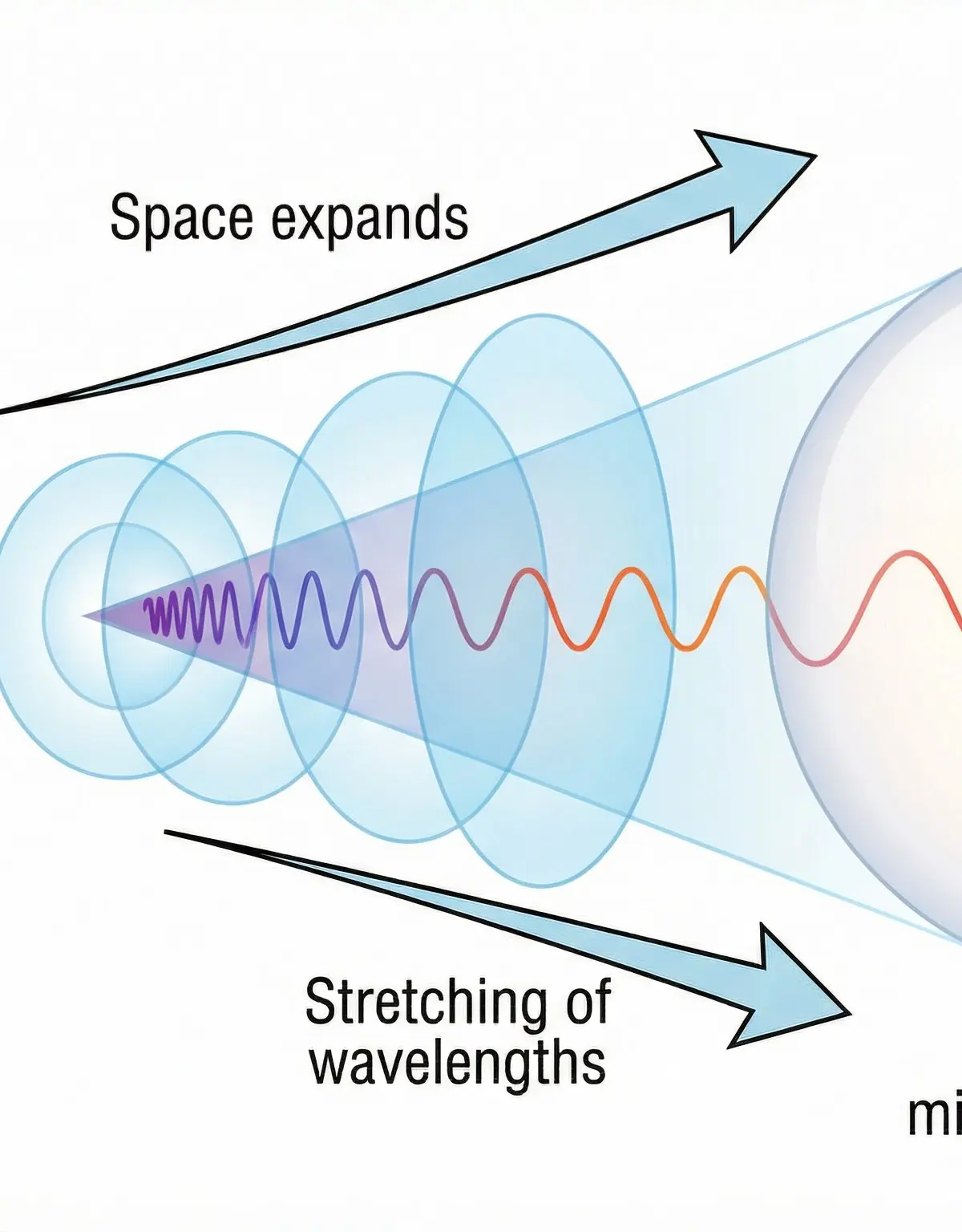
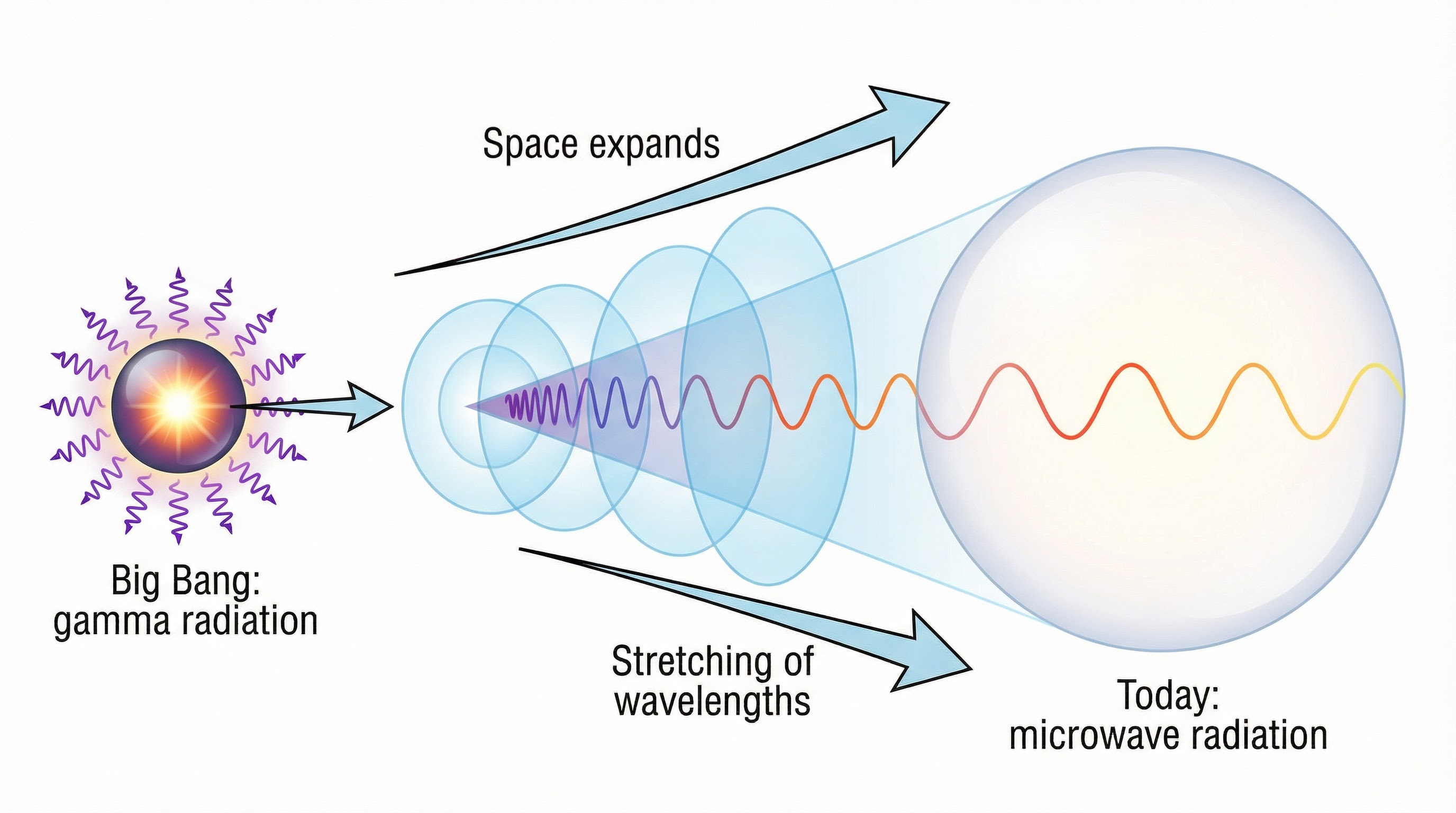
CMBR is the afterglow of the Big Bang, a faint glow of radiation that permeates the entire universe. In the very early universe, it was incredibly hot and filled with high-energy gamma radiation. As the universe expanded and cooled, this radiation was stretched to longer and longer wavelengths. Today, it is detected as microwave radiation with a temperature of just 2.7 Kelvin. The fact that CMBR is detected with almost perfect uniformity in all directions is strong evidence that the universe began in a hot, dense state, as predicted by the Big Bang theory.
Mathematical/Scientific Relationships
There are no specific formulas you need to memorise for this topic at GCSE level. However, you need to understand the conceptual relationship of Hubble's Law:
Recessional Velocity is proportional to DistanceThis means that the further away a galaxy is, the faster it is moving away from us. You may be shown a graph of velocity against distance for distant galaxies and asked to interpret it.
Practical Applications
While there are no direct 'practicals' for the Big Bang theory, the principles of spectroscopy are fundamental to gathering the evidence. Astronomers use spectrometers to analyse the light from distant galaxies and measure their redshift. This data is then used to calculate the galaxy's speed and distance, providing the evidence for the expanding universe.
Visual Resources
3 diagrams and illustrations
Interactive Diagrams
2 interactive diagrams to visualise key concepts
Conceptual Flow Outline
Flowchart showing how the evidence of Redshift and CMBR leads to the conclusion of an expanding universe, supporting the Big Bang Theory.
Diagram could not be rendered
Sequence diagram illustrating the stretching of radiation from the early universe to the present day, resulting in the Cosmic Microwave Background Radiation (CMBR).
Worked Examples
3 worked examples — open one to explore the question and available guidance.
Practice Questions
Test your understanding — click to reveal model answers
State two pieces of evidence for the Big Bang theory. (2 marks)
Hint: Think about the two main phenomena that were predicted by the Big Bang model.
A distant galaxy is observed to have a large redshift. What can be concluded about the galaxy's motion and distance relative to us? (3 marks)
Hint: How does redshift relate to speed, and how does speed relate to distance according to Hubble's Law?
Explain why the discovery of CMBR was a major problem for the Steady State theory. (4 marks)
Hint: What did the Steady State theory propose about the universe's origin and history?
Describe the balloon analogy used to model the expansion of the universe and explain one of its limitations. (4 marks)
Hint: What do the balloon surface and the dots represent? What does the real universe have that the balloon doesn't?
Explain, in terms of wavelength, why Cosmic Microwave Background Radiation is not detected as gamma rays. (3 marks)
Hint: Think about the journey of this radiation since the Big Bang.
Test your understanding of The Big Bang Theory
Active recall beats re-reading. Take an instant quiz now to test what you’ve learned and lock it into long-term memory.
7 days Premium · Then free forever · No card, no charge