OCR · GCSE · Physics
Course version: J249 · Version from Sept 2018
Describe that our eyes can only detect a limited range of the…
Full specification wording
The electromagnetic spectrum: describe that our eyes can only detect a limited range of the electromagnetic spectrum
The electromagnetic spectrum extends from radio waves to gamma rays, but the human eye responds to only a small slice of it: the visible region.
Checked against the OCR J249 specification (opens in a new tab) on .
- Point 5 of 9
- 3 key terms
Study notes
From the checked teaching notes for this specification point.
The idea
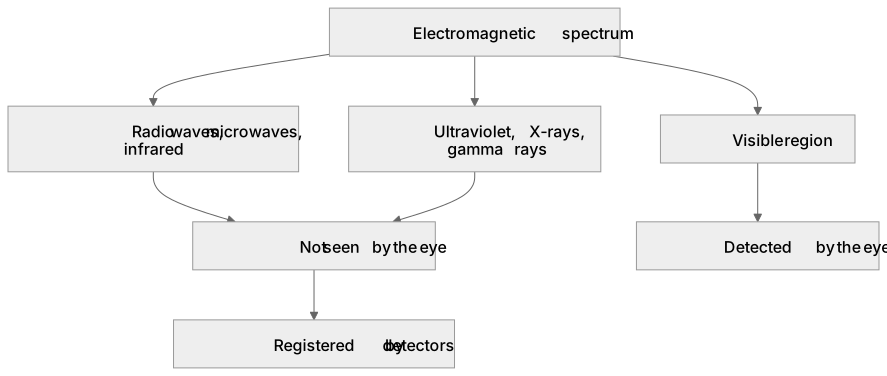
The electromagnetic spectrum extends from radio waves to gamma rays, but the human eye responds to only a small slice of it: the visible region. That region sits between infrared and ultraviolet and covers roughly 400 nm to 700 nm, with violet near the short-wavelength end and red near the long-wavelength end. Radio waves, microwaves, infrared, ultraviolet, X-rays and gamma rays all pass through or around us without being seen, because our eyes lack receptors tuned to those wavelengths. A detector such as a radio aerial, a thermal camera or a photographic film can register them instead. The key idea is that detection by the eye is limited, not that the other groupings are absent.
What earns the marks
- States that the human eye detects only the visible region of the electromagnetic spectrum.
- Identifies the visible region as a small part of the whole spectrum lying between infrared and ultraviolet.
- Explains that other groupings such as radio, microwave, infrared, ultraviolet, X-rays and gamma rays are not seen by the eye.
- Recognises that instruments or detectors can register groupings the eye cannot detect.
Common mistakes and how to put them right
Claims the eye can see all electromagnetic waves.
Put it right by restricting detection to the visible region.
Places the visible region at the extreme end of the spectrum.
Put it right by locating it between infrared and ultraviolet.
Assumes invisible groupings do not exist or cannot be detected.
Put it right by naming detectors that register them.
Exam tips
- Name the visible region explicitly whenever the question asks what the eye detects.
- Use the phrase limited range to signal that only part of the spectrum is seen.
- Contrast the eye with a named detector to show understanding of the wider spectrum.
Try the lesson
The start of the The electromagnetic spectrum: describe that our eyes can only detect a limited range of the electromagnetic spectrum lesson, made from checked teaching notes for this specification point.
Have a go first
Which grouping of the electromagnetic spectrum can the human eye detect?
Listen
The electromagnetic spectrum extends from radio waves to gamma rays, but the human eye responds to only a small slice of it: the visible region. That region sits between infrared and ultraviolet and covers roughly 400 nm to 700 nm, with violet near the short-wavelength end and red near the long-wavelength end. Radio waves, microwaves, infrared, ultraviolet, X-rays and gamma rays all pass through or around us without being seen, because our eyes lack receptors tuned to those wavelengths. A detector such as a radio aerial, a thermal camera or a photographic film can register them instead. The key idea is that detection by the eye is limited, not that the other groupings are absent. A strong answer earns marks for these points. States that the human eye detects only the visible region of the electromagnetic spectrum. Identifies the visible region as a small part of the whole spectrum lying between infrared and ultraviolet. Explains that other groupings such as radio, microwave, infrared, ultraviolet, X-rays and gamma rays are not seen by the eye. Recognises that instruments or detectors can register groupings the eye cannot detect. A common slip: Claims the eye can see all electromagnetic waves. Instead, restricting detection to the visible region. Exam tip: Name the visible region explicitly whenever the question asks what the eye detects.
See it
Key words
Say what each word means before you turn the card.
Limited range of human vision
Try answering aloud or in your head before turning the card.
Position of visible light in the spectrum
Try answering aloud or in your head before turning the card.
Detection by instruments
Try answering aloud or in your head before turning the card.
See every definition
- Limited range of human vision
- Our eyes can only detect a limited range of the electromagnetic spectrum, responding to only a small slice of it.
- Position of visible light in the spectrum
- The visible region sits between infrared and ultraviolet, with violet near the short-wavelength end and red near the long-wavelength end.
- Detection by instruments
- A detector such as a radio aerial, a thermal camera or a photographic film can register groupings the eye cannot detect.
Label the diagram
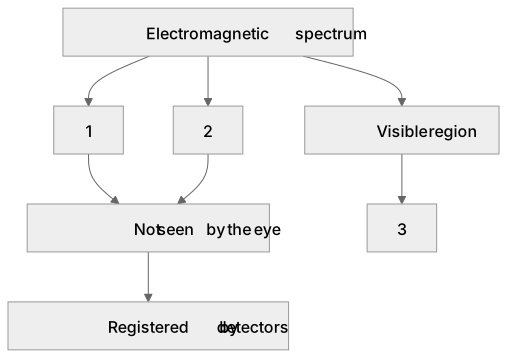
Some boxes have lost their names. Pick the right name for each number.
1Box 1
2Box 2
3Box 3
There is more to this lesson
The full lesson goes on to check your understanding and help you earn the marks. Create a free account to carry on, with your progress saved.
A week of Premium from your first lesson · Then the free plan continues · No card, no charge
Test your understanding of The electromagnetic spectrum: describe that our eyes can only detect a limited range of the electromagnetic spectrum
Active recall beats re-reading. Take an instant quiz now to test what you’ve learned and lock it into long-term memory.
A week of Premium from your first lesson · Then the free plan continues · No card, no charge