OCR · GCSE · Physics
Course version: J249 · Version from Sept 2018
Recall that radio waves can be produced by, or can themselves induce,…
Full specification wording
The electromagnetic spectrum: recall that radio waves can be produced by, or can themselves induce, oscillations in electrical circuits (Higher tier only)
Radio waves and electrical circuits are linked in both directions.
Checked against the OCR J249 specification (opens in a new tab) on .
- Point 9 of 9
- 4 key terms
Study notes
From the checked teaching notes for this specification point.
The idea
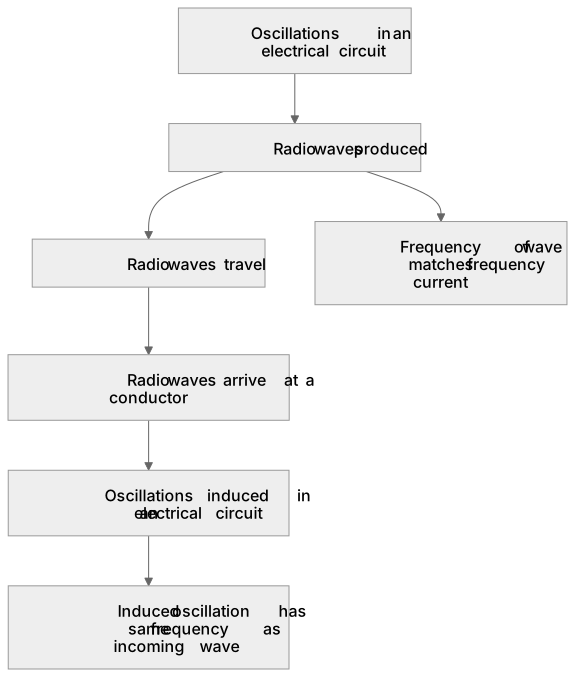
Radio waves and electrical circuits are linked in both directions. An oscillating current in a circuit produces radio waves, because accelerating charges radiate electromagnetic energy; the frequency of the emitted wave matches the frequency of the current oscillation. The reverse also happens: a radio wave arriving at a conductor can induce an oscillating current in that circuit, which is how a receiving aerial works. The induced oscillation has the same frequency as the incoming wave. This two-way relationship explains transmission and reception: a transmitting circuit drives charges to and fro to radiate, and a receiving circuit responds to passing radio waves by developing its own small oscillation. The key recall point is that radio waves can be produced by oscillations in electrical circuits and can themselves induce oscillations in electrical circuits.
What earns the marks
- States that radio waves can be produced by oscillations in electrical circuits.
- States that radio waves can induce oscillations in electrical circuits.
- Recognises that the frequency of the emitted or induced oscillation matches the frequency of the radio wave or current.
- Applies the two-way relationship to explain transmission and reception of radio waves.
Common mistakes and how to put them right
Claims that radio waves are produced only by magnets.
Put it right by stating that oscillating currents in electrical circuits produce them.
States that radio waves cannot affect circuits.
Put it right by explaining that they can induce oscillations in a circuit.
Assumes the induced oscillation has a different frequency from the incoming wave.
Put it right by stating that the frequencies match.
Exam tips
- Read the question carefully to check whether it asks about production or induction, since both directions are examinable.
- Link the answer to a real device such as a transmitting or receiving aerial to make the mechanism concrete.
- Remember the frequency relationship: the oscillation and the radio wave share the same frequency.
Try the lesson
The start of the The electromagnetic spectrum: recall that radio waves can be produced by, or can themselves induce, oscillations in electrical circuits (Higher tier only) lesson, made from checked teaching notes for this specification point.
Have a go first
How can an alternating current in an aerial produce radio waves?
Listen
Radio waves and electrical circuits are linked in both directions. An oscillating current in a circuit produces radio waves, because accelerating charges radiate electromagnetic energy; the frequency of the emitted wave matches the frequency of the current oscillation. The reverse also happens: a radio wave arriving at a conductor can induce an oscillating current in that circuit, which is how a receiving aerial works. The induced oscillation has the same frequency as the incoming wave. This two-way relationship explains transmission and reception: a transmitting circuit drives charges to and fro to radiate, and a receiving circuit responds to passing radio waves by developing its own small oscillation. The key recall point is that radio waves can be produced by oscillations in electrical circuits and can themselves induce oscillations in electrical circuits. A strong answer earns marks for these points. States that radio waves can be produced by oscillations in electrical circuits. States that radio waves can induce oscillations in electrical circuits. Recognises that the frequency of the emitted or induced oscillation matches the frequency of the radio wave or current. Applies the two-way relationship to explain transmission and reception of radio waves. A common slip: Claims that radio waves are produced only by magnets. Instead, stating that oscillating currents in electrical circuits produce them. Exam tip: Read the question carefully to check whether it asks about production or induction, since both directions are examinable.
See it
Key words
Say what each word means before you turn the card.
Production of radio waves by oscillating currents
Try answering aloud or in your head before turning the card.
Induction of oscillations by radio waves
Try answering aloud or in your head before turning the card.
Frequency matching between wave and circuit
Try answering aloud or in your head before turning the card.
Transmission and reception of radio signals
Try answering aloud or in your head before turning the card.
See every definition
- Production of radio waves by oscillating currents
- An oscillating current in a circuit produces radio waves, because accelerating charges radiate electromagnetic energy.
- Induction of oscillations by radio waves
- A radio wave arriving at a conductor can induce an oscillating current in that circuit, which is how a receiving aerial works.
- Frequency matching between wave and circuit
- The frequency of the emitted wave matches the frequency of the current oscillation, and the induced oscillation has the same frequency as the incoming wave.
- Transmission and reception of radio signals
- A transmitting circuit drives charges to and fro to radiate, and a receiving circuit responds to passing radio waves by developing its own small oscillation.
Label the diagram
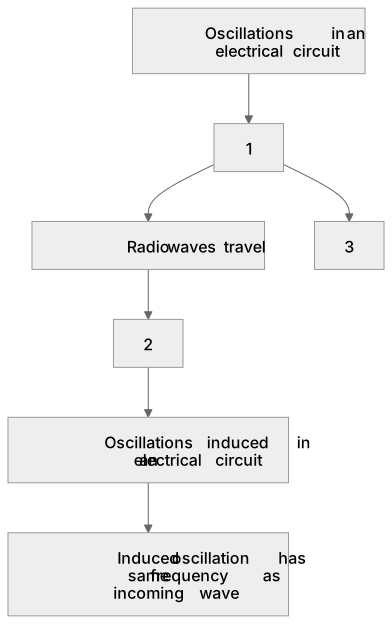
Some boxes have lost their names. Pick the right name for each number.
1Box 1
2Box 2
3Box 3
There is more to this lesson
The full lesson goes on to check your understanding and help you earn the marks. Create a free account to carry on, with your progress saved.
A week of Premium from your first lesson · Then the free plan continues · No card, no charge
Test your understanding of The electromagnetic spectrum: recall that radio waves can be produced by, or can themselves induce, oscillations in electrical circuits (Higher tier only)
Active recall beats re-reading. Take an instant quiz now to test what you’ve learned and lock it into long-term memory.
A week of Premium from your first lesson · Then the free plan continues · No card, no charge