OCR · GCSE · Physics
The life cycle of a star
This guide covers the complete life cycle of stars, from their birth in nebulae to their dramatic deaths as white dwarfs or supernovae. Mastering this topic is key to unlocking high-mark questions on space physics in your OCR GCSE exam.
- 7 min read
- 3 worked examples
- 5 practice questions
- 8 key terms
Study Notes

Overview
The life cycle of a star is a story of cosmic birth, life, and death, governed by the laws of physics. This topic (OCR GCSE Physics 8.9) explores how stars form from clouds of gas and dust, how they generate energy through nuclear fusion, and how their ultimate fate is determined by their mass. Understanding this sequence is not just about memorising stages; it's about explaining the physics of the forces at play. Examiners will expect you to be able to compare the life cycle of a star like our Sun with that of a much more massive star, and to pinpoint where the elements that make up our world are created. This topic frequently appears in exams as structured questions worth 4-6 marks, often requiring you to describe or explain a specific stage or compare the two main pathways.
Key Concepts
Concept 1: From Nebula to Protostar
All stars begin in a nebula, a vast cloud of gas (mostly hydrogen) and dust. These are the stellar nurseries of the universe. For a star to be born, a part of this nebula must begin to collapse. The driving force behind this collapse is gravity. Gravity pulls the particles of gas and dust closer together. As they get closer, the gravitational force between them increases, causing them to spiral inwards and clump together. This process converts gravitational potential energy into thermal energy, causing the core of the collapsing cloud to heat up. This hot, dense, contracting core is known as a protostar.
Concept 2: The Main Sequence - A Star is Born
A protostar is not yet a true star because it doesn't generate its own energy through nuclear fusion. For that to happen, the core needs to become incredibly hot and dense. As more and more material from the nebula falls onto the protostar, its mass, and therefore its gravitational pull, increases. This causes the core to contract further, and the temperature and pressure skyrocket. When the core temperature reaches about 15 million degrees Celsius, the conditions are right for nuclear fusion to begin.
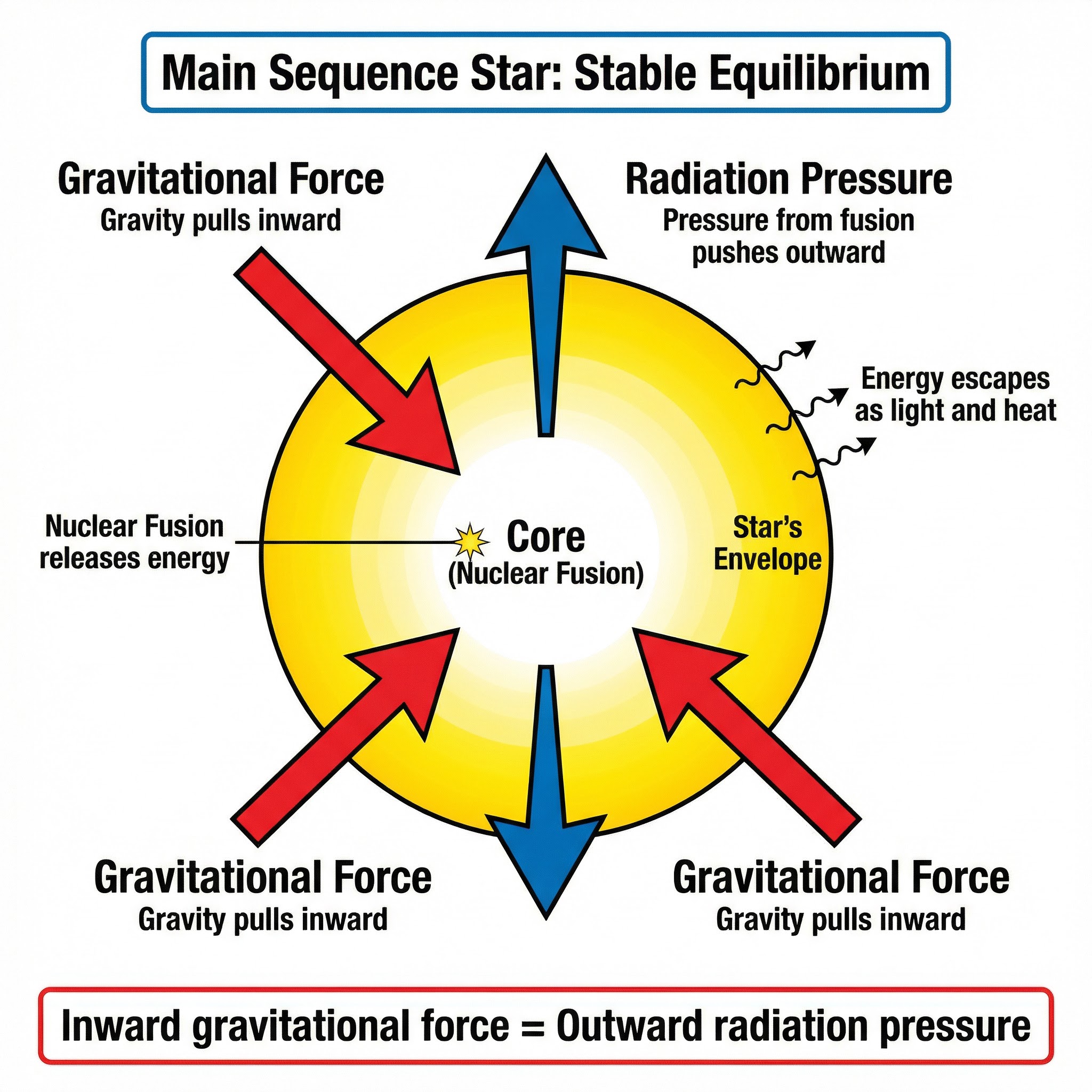
In this process, hydrogen nuclei (protons) fuse together to form helium nuclei. This reaction releases a tremendous amount of energy, which pushes outwards from the core. This outward force is called radiation pressure. A star is born when this outward radiation pressure perfectly balances the inward pull of gravity. The star is now stable and is known as a main sequence star. Our Sun is currently in this phase. A star will spend most of its life in the main sequence, steadily fusing hydrogen into helium.

Concept 3: The Two Paths - Mass Matters
What happens to a star after the main sequence phase is entirely dependent on its initial mass. There are two distinct pathways:
- Sun-like (Low-Mass) Stars: Stars with a mass similar to our Sun (up to about 1.5 times the mass of the Sun).
- Massive Stars: Stars with a mass greater than about 8 times the mass of the Sun.
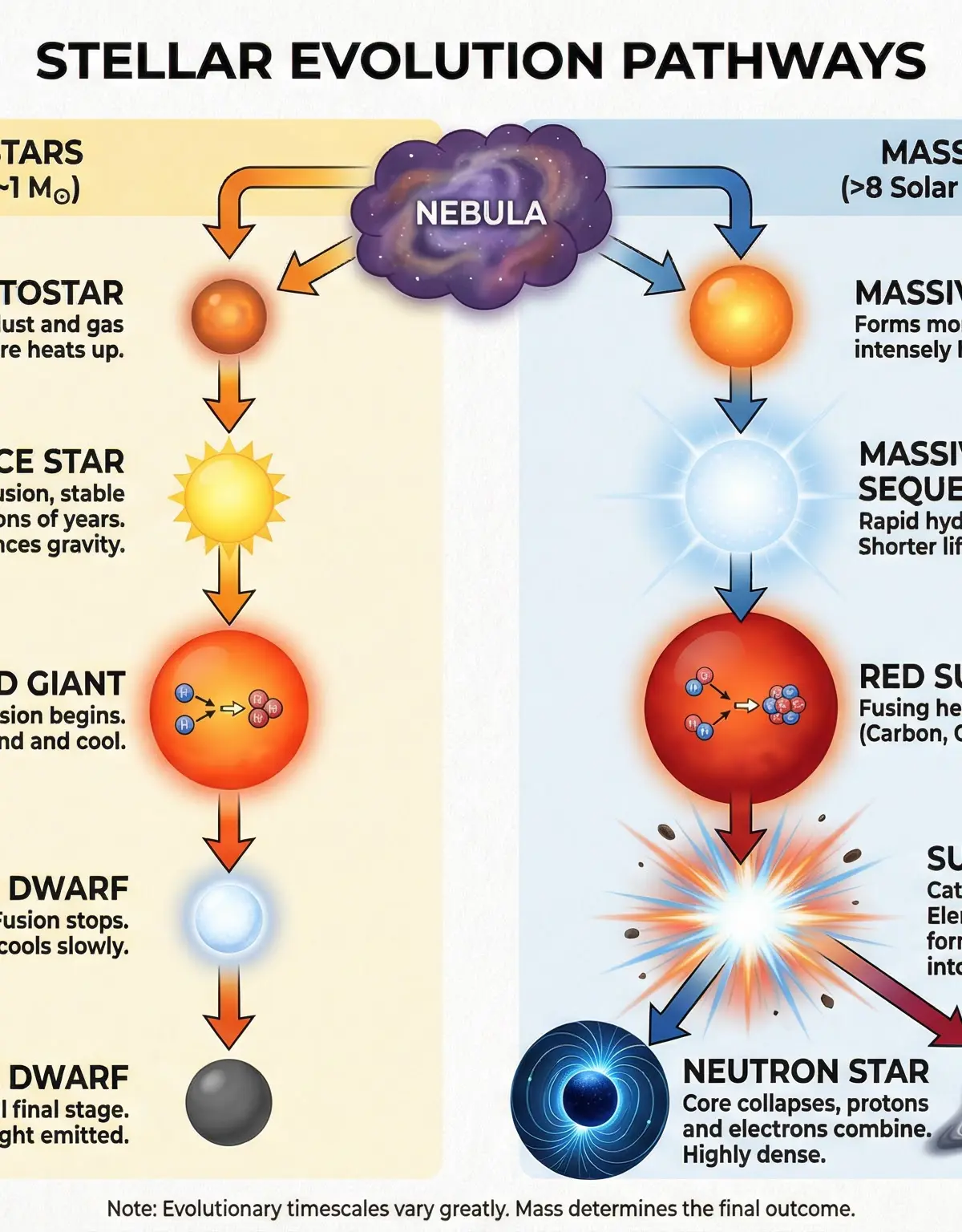
The Fate of a Sun-like Star
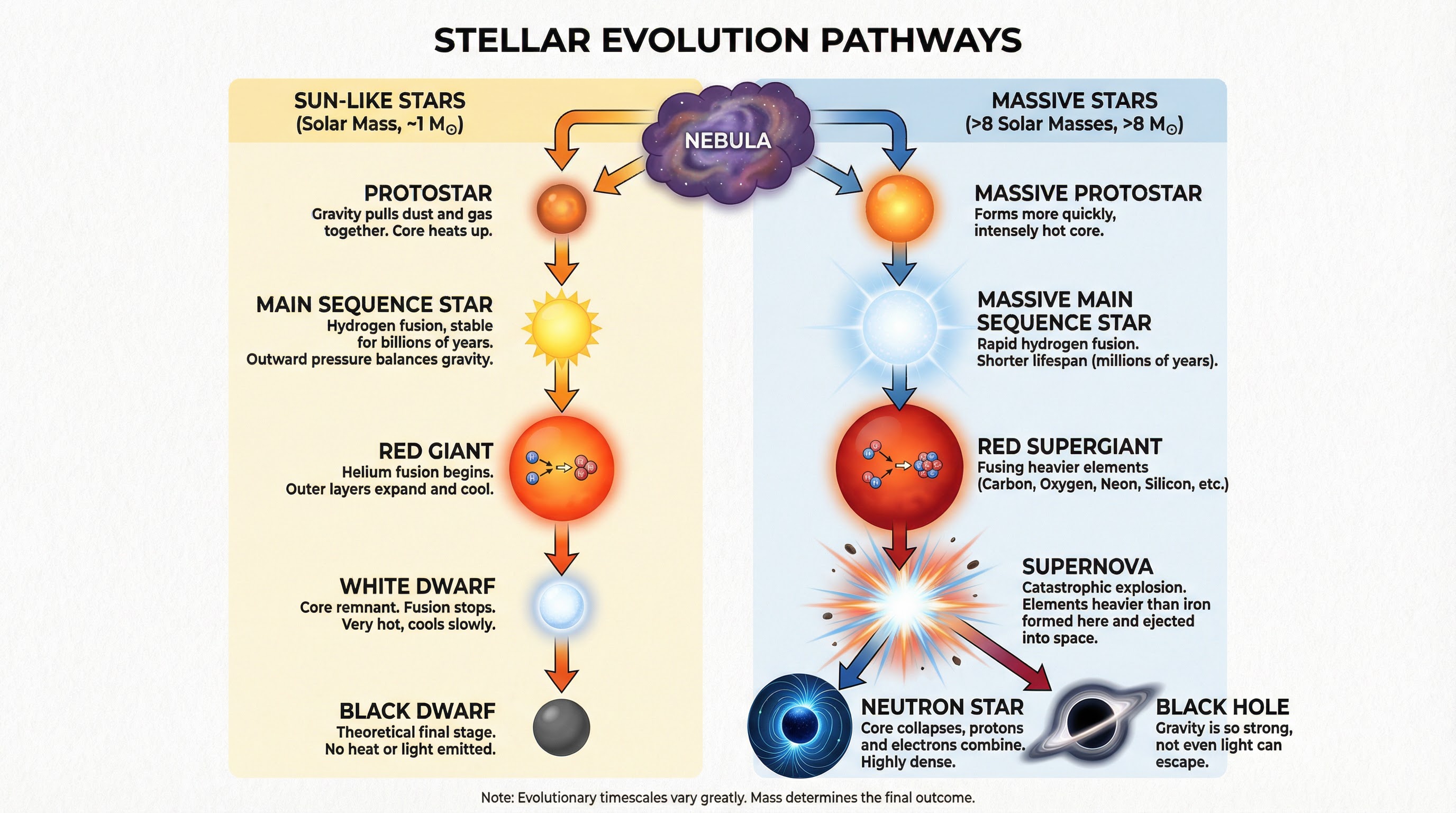
After billions of years, a sun-like star will have fused most of the hydrogen in its core into helium. With less hydrogen fusion, the outward radiation pressure decreases, and gravity starts to win. The core begins to contract and heat up. This extra heat causes the outer layers of the star to expand dramatically, and the star swells into a red giant. The surface of the star cools down, which is why it appears red.
Inside the core of the red giant, the temperature and pressure are now high enough to start fusing helium into heavier elements like carbon and oxygen. Eventually, the helium fuel also runs out. The star is not massive enough to fuse carbon, so fusion stops. The outer layers of the red giant drift away into space, creating a beautiful structure called a planetary nebula. The hot, dense, solid core left behind is called a white dwarf. A white dwarf is incredibly dense – a teaspoonful would weigh several tonnes on Earth! It no longer produces energy through fusion and simply cools down over billions of years, eventually becoming a cold, dark black dwarf.
The Fate of a Massive Star
Massive stars live fast and die young. They are much hotter and brighter than sun-like stars and burn through their hydrogen fuel in only a few million years. When they run out of hydrogen, they also expand, but they become much larger than red giants, forming red supergiants.
Because of their immense mass and gravity, the core of a red supergiant becomes hot enough to fuse a whole series of elements, from helium to carbon, oxygen, and all the way up to iron. However, fusing iron does not release energy; it consumes it. This means that once the core is made of iron, fusion stops. With no outward pressure to counteract gravity, the core collapses catastrophically in a fraction of a second. This collapse triggers a massive shockwave that blasts the outer layers of the star into space in a spectacular explosion called a supernova.
For a few weeks, a supernova can outshine an entire galaxy. The energy of this explosion is so immense that it is the only place in the universe where elements heavier than iron (like gold, silver, and uranium) are created. The material thrown out by the supernova enriches the interstellar medium with these heavy elements, providing the raw materials for new stars, planets, and even life.
What remains after the supernova depends on the mass of the core. If the core is between about 1.5 and 3 solar masses, it will collapse into an incredibly dense neutron star. If the core is more massive than about 3 solar masses, gravity will overwhelm all other forces, and the core will collapse indefinitely to form a black hole – an object with a gravitational field so strong that nothing, not even light, can escape.
Mathematical/Scientific Relationships
While you don't need to perform complex calculations for this topic at GCSE, understanding the core relationship is crucial:
Main Sequence Equilibrium:
- **Force of Gravity (inwards) = Radiation Pressure (outwards)**This balance is the key to a star's stability. If the forces become unbalanced, the star will either expand or contract, moving it into the next phase of its life cycle.
Practical Applications
While there are no required practicals for this specific topic, the study of the life cycle of stars has profound applications:
- Element Creation: Understanding stellar evolution explains the origin of all the chemical elements in the universe. The hydrogen and helium were formed in the Big Bang, but every other element, including the carbon in our bodies and the oxygen we breathe, was forged inside stars and scattered by supernovae. We are literally made of stardust.
- Cosmology and the Fate of the Universe: By studying stars in different stages of their lives, astronomers can piece together the history of the universe and make predictions about its future.
- Distance Measurement: Certain types of supernovae (Type Ia) have a known brightness, which allows astronomers to use them as 'standard candles' to measure vast distances across the universe.
Visual Resources
2 diagrams and illustrations
Interactive Diagrams
2 interactive diagrams to visualise key concepts
Conceptual Flow Outline
Flowchart showing the two main pathways of stellar evolution, depending on the initial mass of the star.
Conceptual Flow Outline
Concept map illustrating the equilibrium of forces that keeps a main sequence star stable.
Worked Examples
3 worked examples — open one to explore the question and available guidance.
Practice Questions
Test your understanding — click to reveal model answers
State the two possible outcomes for a star that is much more massive than the Sun after it has undergone a supernova. [2 marks]
Hint: Think about what is left behind after the explosion. The answer depends on how massive the core is.
Explain how elements heavier than iron are formed and distributed throughout the universe. [3 marks]
Hint: Which stage of a star's life is energetic enough for this process? How do these elements then get into space?
A student claims, 'The Sun will eventually become a black hole.' Evaluate this statement. [4 marks]
Hint: Consider the mass of the Sun. What is the requirement for a black hole to form?
Describe the process that causes a protostar to become a main sequence star. [3 marks]
Hint: What process needs to start in the core? What conditions are needed for this?
What is a planetary nebula and at what stage of a star's life cycle is it formed? [2 marks]
Hint: This happens to stars like our Sun after they have expanded.
Test your understanding of The life cycle of a star
Active recall beats re-reading. Take an instant quiz now to test what you’ve learned and lock it into long-term memory.
7 days Premium · Then free forever · No card, no charge