OCR · GCSE · Physics
Course version: J249 · Version from Sept 2018
Apply the relationship between density, mass and volume to changes where…
Full specification wording
The particle model: apply the relationship between density, mass and volume to changes where mass is conserved
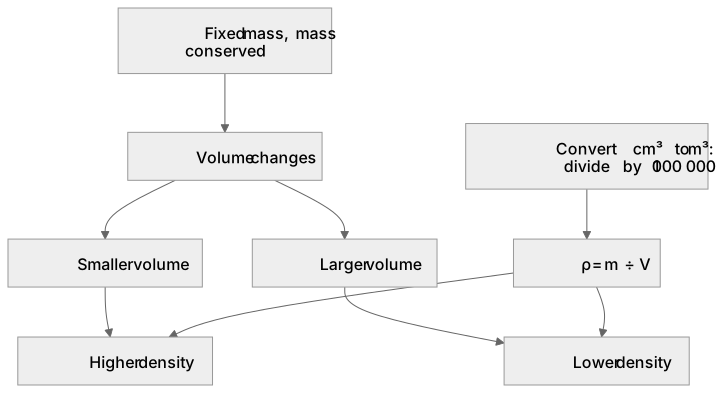
Density links mass and volume through ρ = m ÷ V, so a fixed mass squeezed into a smaller volume has a higher density and the same mass spread through a larger volume has a lower density.
Checked against the OCR J249 specification (opens in a new tab) on .
- Point 7 of 7
- 4 key terms
Study notes
From the checked teaching notes for this specification point.
The idea
Density links mass and volume through ρ = m ÷ V, so a fixed mass squeezed into a smaller volume has a higher density and the same mass spread through a larger volume has a lower density. Because mass is conserved, only volume changes in these situations: heating a gas in a sealed rigid container raises pressure but keeps both mass and volume, while compressing a gas in a syringe keeps mass constant and reduces volume, raising density. Worked method: a 0.60 kg sample occupies 200 cm³, so ρ = 0.60 kg ÷ 0.000200 m³ = 3000 kg/m³; halving the volume to 100 cm³ doubles density to 6000 kg/m³ with mass still 0.60 kg. Convert cm³ to m³ by dividing by 1 000 000, and check that the mass value you use is the same before and after the change.
What earns the marks
- Selects the form ρ = m ÷ V and substitutes a mass that stays unchanged across the change.
- Converts a volume in cm³ to m³ by dividing by 1 000 000 before substituting.
- States that halving the volume of a fixed mass doubles the density.
- Explains that a change in density arises from a change in volume because mass is conserved.
- Rejects an option that treats mass as changing when only the volume changes.
Common mistakes and how to put them right
Uses a changed mass value after the volume change.
Put it right: Keep the mass identical and alter only the volume.
Forgets to convert cm³ to m³ and divides kilograms by cubic centimetres.
Put it right: Divide the volume by 1 000 000 first.
Assumes density stays the same when a gas is compressed.
Put it right: Recognise that reduced volume at constant mass raises density.
Inverts the relationship and multiplies mass by volume.
Put it right: Divide mass by volume instead.
Exam tips
- Write the equation, then list the known mass and both volumes before touching the options.
- Convert every volume to m³ in one step and note the conversion factor beside your working.
- Use ratio reasoning as a check: quarter the volume and density should rise fourfold at constant mass.
Try the lesson
The start of the The particle model: apply the relationship between density, mass and volume to changes where mass is conserved lesson, made from checked teaching notes for this specification point.
Have a go first
A sample of gas is compressed so that its volume halves while no gas escapes. The original density was 1.6 kg/m³. What is the new density?
Listen
Density links mass and volume through ρ = m ÷ V, so a fixed mass squeezed into a smaller volume has a higher density and the same mass spread through a larger volume has a lower density. Because mass is conserved, only volume changes in these situations: heating a gas in a sealed rigid container raises pressure but keeps both mass and volume, while compressing a gas in a syringe keeps mass constant and reduces volume, raising density. Worked method: a 0.60 kg sample occupies 200 cm³, so ρ = 0.60 kg ÷ 0.000200 m³ = 3000 kg/m³; halving the volume to 100 cm³ doubles density to 6000 kg/m³ with mass still 0.60 kg. Convert cm³ to m³ by dividing by 1 000 000, and check that the mass value you use is the same before and after the change. A strong answer earns marks for these points. Selects the form ρ = m ÷ V and substitutes a mass that stays unchanged across the change. Converts a volume in cm³ to m³ by dividing by 1 000 000 before substituting. States that halving the volume of a fixed mass doubles the density. Explains that a change in density arises from a change in volume because mass is conserved. Exam tip: Write the equation, then list the known mass and both volumes before touching the options.
See it
Key words
Say what each word means before you turn the card.
Density
Try answering aloud or in your head before turning the card.
Conservation of mass
Try answering aloud or in your head before turning the card.
Unit conversion between cm³ and m³
Try answering aloud or in your head before turning the card.
Proportional reasoning with inverse relationships
Try answering aloud or in your head before turning the card.
See every definition
- Density
- A quantity found by dividing mass by volume, so a fixed mass squeezed into a smaller volume has a higher density.
- Conservation of mass
- Mass stays the same across a change, so only volume changes and a change in density arises from a change in volume.
- Unit conversion between cm³ and m³
- Converting a volume in cm³ to m³ by dividing by 1 000 000 before substituting into the density equation.
- Proportional reasoning with inverse relationships
- Halving the volume of a fixed mass doubles the density, and quartering the volume raises density fourfold at constant mass.
Label the diagram
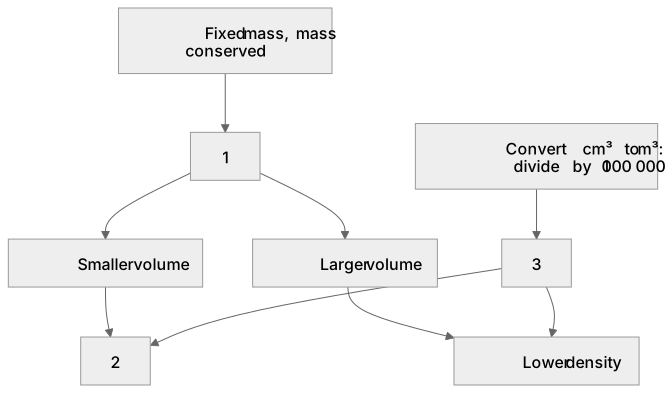
Some boxes have lost their names. Pick the right name for each number.
1Box 1
2Box 2
3Box 3
There is more to this lesson
The full lesson goes on to check your understanding and help you earn the marks. Create a free account to carry on, with your progress saved.
A week of Premium from your first lesson · Then the free plan continues · No card, no charge
Test your understanding of The particle model: apply the relationship between density, mass and volume to changes where mass is conserved
Active recall beats re-reading. Take an instant quiz now to test what you’ve learned and lock it into long-term memory.
A week of Premium from your first lesson · Then the free plan continues · No card, no charge