OCR · GCSE · Physics
Course version: J249 · Version from Sept 2018
Describe the process of nuclear fusion (to include: knowledge that mass…
Full specification wording
Uses and hazards: describe the process of nuclear fusion (to include: knowledge that mass may be converted into the energy of radiation) (content found only in the physics separate science qualification)
Nuclear fusion happens when two light nuclei, such as the hydrogen isotopes deuterium and tritium, are forced close enough together that the strong nuclear force binds them into one heavier…
Checked against the OCR J249 specification (opens in a new tab) on .
- Point 5 of 5
- 4 key terms
Study notes
From the checked teaching notes for this specification point.
The idea
Nuclear fusion happens when two light nuclei, such as the hydrogen isotopes deuterium and tritium, are forced close enough together that the strong nuclear force binds them into one heavier nucleus, for example helium. Because the total mass of the product nucleus is slightly less than the combined mass of the original nuclei, the missing mass appears as energy of radiation, often carried away by a fast neutron and gamma rays. This is the process that powers stars, where very high temperature and pressure let nuclei overcome their electrostatic repulsion. Fusion differs from fission, which splits a heavy nucleus. In a multiple-choice question, identify the option that names light nuclei joining and states that mass is converted into radiation energy.
What earns the marks
- Selects the option in which two light nuclei join to form a single heavier nucleus.
- Recognises that the total mass after fusion is slightly less than the mass before.
- States that the lost mass is converted into the energy of radiation.
- Distinguishes fusion, which joins light nuclei, from fission, which splits a heavy nucleus.
- Identifies the very high temperature and pressure needed to bring nuclei close enough to fuse.
Common mistakes and how to put them right
Chooses the option that describes a heavy nucleus splitting.
Put it right by recalling that fusion joins light nuclei.
Assumes that mass simply disappears with no energy released.
Put it right by stating that the mass difference becomes radiation energy.
Confuses fusion with radioactive decay.
Put it right by noting that fusion combines nuclei rather than emitting particles from an unstable one.
Believes fusion needs no energy input.
Put it right by noting that high temperature and pressure are needed to overcome repulsion.
Exam tips
- Read every option and reject any that describes splitting rather than joining.
- Look for the option that mentions both light nuclei joining and mass becoming radiation energy.
- Link the answer to stars, where fusion occurs naturally, to check your reasoning.
Try the lesson
The start of the Uses and hazards: describe the process of nuclear fusion (to include: knowledge that mass may be converted into the energy of radiation) (content found only in the physics separate science qualification) lesson, made from checked teaching notes for this specification point.
Have a go first
In the core of the Sun, hydrogen nuclei join together to form helium nuclei. What name is given to this process?
Listen
Nuclear fusion happens when two light nuclei, such as the hydrogen isotopes deuterium and tritium, are forced close enough together that the strong nuclear force binds them into one heavier nucleus, for example helium. Because the total mass of the product nucleus is slightly less than the combined mass of the original nuclei, the missing mass appears as energy of radiation, often carried away by a fast neutron and gamma rays. This is the process that powers stars, where very high temperature and pressure let nuclei overcome their electrostatic repulsion. Fusion differs from fission, which splits a heavy nucleus. In a multiple-choice question, identify the option that names light nuclei joining and states that mass is converted into radiation energy. A strong answer earns marks for these points. Selects the option in which two light nuclei join to form a single heavier nucleus. Recognises that the total mass after fusion is slightly less than the mass before. States that the lost mass is converted into the energy of radiation. Distinguishes fusion, which joins light nuclei, from fission, which splits a heavy nucleus. A common slip: Chooses the option that describes a heavy nucleus splitting. Instead, recalling that fusion joins light nuclei. Exam tip: Read every option and reject any that describes splitting rather than joining.
See it
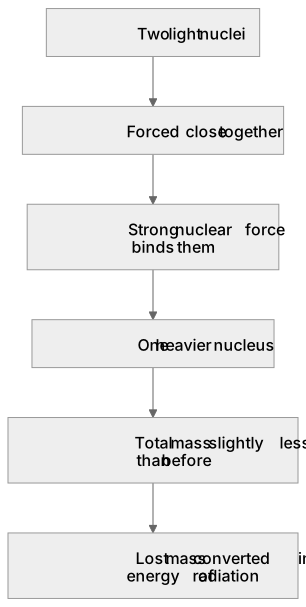
Put it in order
Put these steps in the order they happen.
- 1. Strong nuclear force binds them
- 2. Forced close together
- 3. Two light nuclei
- 4. Lost mass converted into energy of radiation
- 5. Total mass slightly less than before
- 6. One heavier nucleus
Key words
Say what each word means before you turn the card.
Nuclear fusion
Try answering aloud or in your head before turning the card.
Mass-energy conversion
Try answering aloud or in your head before turning the card.
Light nuclei joining
Try answering aloud or in your head before turning the card.
Energy of radiation
Try answering aloud or in your head before turning the card.
See every definition
- Nuclear fusion
- Two light nuclei are forced close enough together that the strong nuclear force binds them into one heavier nucleus.
- Mass-energy conversion
- The total mass of the product nucleus is slightly less than the combined mass of the original nuclei, and the missing mass appears as energy of radiation.
- Light nuclei joining
- Two light nuclei join to form a single heavier nucleus, as in a multiple-choice option that names this process.
- Energy of radiation
- The missing mass appears as this, often carried away by a fast neutron and gamma rays.
Label the diagram
Some boxes have lost their names. Pick the right name for each number.
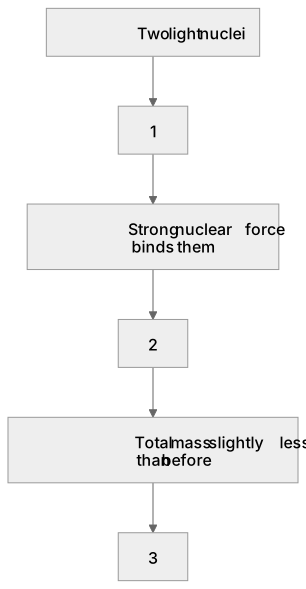
1Box 1
2Box 2
3Box 3
There is more to this lesson
The full lesson goes on to check your understanding and help you earn the marks. Create a free account to carry on, with your progress saved.
A week of Premium from your first lesson · Then the free plan continues · No card, no charge
Test your understanding of Uses and hazards: describe the process of nuclear fusion (to include: knowledge that mass may be converted into the energy of radiation) (content found only in the physics separate science qualification)
Active recall beats re-reading. Take an instant quiz now to test what you’ve learned and lock it into long-term memory.
A week of Premium from your first lesson · Then the free plan continues · No card, no charge