OCR · GCSE · Physics
Course version: J249 · Version from Sept 2018
Apply: force on a conductor (at right angles to a magnetic field) carrying…
Full specification wording
Uses of magnetism: apply: force on a conductor (at right angles to a magnetic field) carrying a current: force (N) = magnetic flux density (T) × current (A) × length (m) (Higher tier only)
This Higher tier equation gives the force on a straight conductor carrying a current when the conductor sits at right angles to a uniform magnetic field.
Checked against the OCR J249 specification (opens in a new tab) on .
- Point 1 of 8
- 4 key terms
Study notes
From the checked teaching notes for this specification point.
The idea
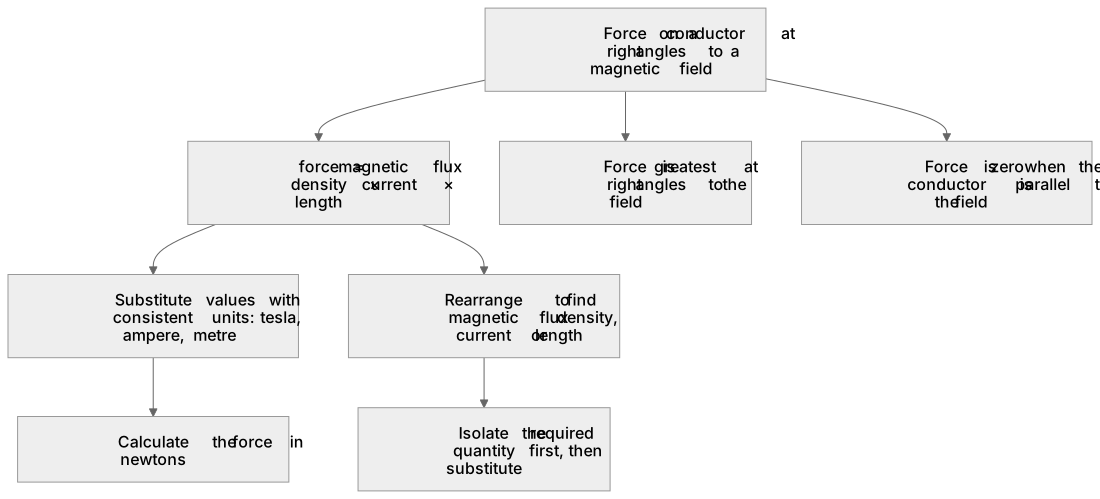
This Higher tier equation gives the force on a straight conductor carrying a current when the conductor sits at right angles to a uniform magnetic field. The force in newtons equals magnetic flux density in tesla multiplied by current in amperes multiplied by the length of conductor in metres within the field: F = B × I × L. For example, a 0.5 T field acting on a 2 A current in 0.3 m of wire gives F = 0.5 × 2 × 0.3 = 0.3 N. Learners apply the equation, keep units consistent and recognise that the force is greatest at right angles and zero when the conductor is parallel to the field. Rearranging to find B, I or L is also expected.
What earns the marks
- Selects the relationship force = magnetic flux density × current × length and substitutes the given values correctly.
- Calculates the force in newtons using consistent units of tesla, ampere and metre.
- Rearranges the equation to determine magnetic flux density, current or length when the force is known.
- Recognises that the force is greatest when the conductor is at right angles to the field and zero when parallel.
Common mistakes and how to put them right
Multiplies the values without checking units, giving an answer in the wrong unit.
Put it right: Convert lengths to metres and keep tesla and ampere before calculating.
Assumes the force is largest when the conductor is parallel to the field.
Put it right: State that the force is greatest at right angles and zero when parallel.
Forgets to rearrange before substituting when finding current or flux density.
Put it right: Isolate the required quantity first, then substitute.
Exam tips
- Write the equation, substitute values with units, then state the unit of the answer.
- Convert any length given in centimetres to metres before multiplying.
- Check whether the question asks for force, flux density, current or length, and rearrange before calculating.
Try the lesson
The start of the Uses of magnetism: apply: force on a conductor (at right angles to a magnetic field) carrying a current: force (N) = magnetic flux density (T) × current (A) × length (m) (Higher tier only) lesson, made from checked teaching notes for this specification point.
Have a go first
A straight wire of length 0.40 m carries a current of 3.0 A at right angles to a uniform magnetic field of flux density 0.25 T. Calculate the force on the wire.
Listen
This Higher tier equation gives the force on a straight conductor carrying a current when the conductor sits at right angles to a uniform magnetic field. The force in newtons equals magnetic flux density in tesla multiplied by current in amperes multiplied by the length of conductor in metres within the field: F = B × I × L. For example, a 0.5 T field acting on a 2 A current in 0.3 m of wire gives F = 0.5 × 2 × 0.3 = 0.3 N. Learners apply the equation, keep units consistent and recognise that the force is greatest at right angles and zero when the conductor is parallel to the field. Rearranging to find B, I or L is also expected. A strong answer earns marks for these points. Selects the relationship force = magnetic flux density × current × length and substitutes the given values correctly. Calculates the force in newtons using consistent units of tesla, ampere and metre. Rearranges the equation to determine magnetic flux density, current or length when the force is known. Recognises that the force is greatest when the conductor is at right angles to the field and zero when parallel. Exam tip: Write the equation, substitute values with units, then state the unit of the answer.
See it
Key words
Say what each word means before you turn the card.
Force on a current-carrying conductor
Try answering aloud or in your head before turning the card.
Magnetic flux density in tesla
Try answering aloud or in your head before turning the card.
Applying and rearranging equations
Try answering aloud or in your head before turning the card.
Orientation of conductor to the field
Try answering aloud or in your head before turning the card.
See every definition
- Force on a current-carrying conductor
- The force in newtons equals magnetic flux density in tesla multiplied by current in amperes multiplied by the length of conductor in metres within the field.
- Magnetic flux density in tesla
- A quantity in tesla that is multiplied by current in amperes and length in metres to give the force in newtons.
- Applying and rearranging equations
- Substituting the given values correctly, keeping units consistent, and isolating the required quantity before substituting when finding flux density, current or length.
- Orientation of conductor to the field
- The force is greatest when the conductor is at right angles to the field and zero when the conductor is parallel to the field.
Label the diagram
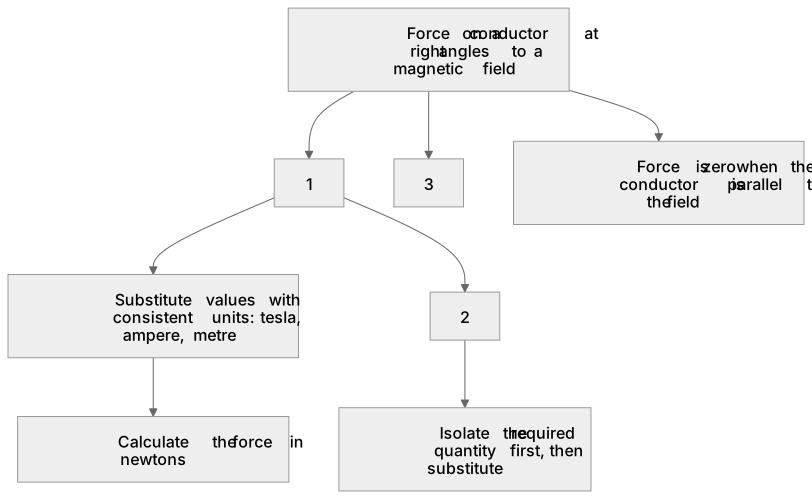
Some boxes have lost their names. Pick the right name for each number.
1Box 1
2Box 2
3Box 3
There is more to this lesson
The full lesson goes on to check your understanding and help you earn the marks. Create a free account to carry on, with your progress saved.
A week of Premium from your first lesson · Then the free plan continues · No card, no charge
Test your understanding of Uses of magnetism: apply: force on a conductor (at right angles to a magnetic field) carrying a current: force (N) = magnetic flux density (T) × current (A) × length (m) (Higher tier only)
Active recall beats re-reading. Take an instant quiz now to test what you’ve learned and lock it into long-term memory.
A week of Premium from your first lesson · Then the free plan continues · No card, no charge