OCR · GCSE · Physics
Course version: J249 · Version from Sept 2018
Explain how the ratio of the potential differences across the two coils in…
Full specification wording
Uses of magnetism: explain how the ratio of the potential differences across the two coils in a transformer depends on the ratio of the numbers of turns in each (content found only in the physics separate science qualification) (Higher tier only)
A transformer has a primary coil of Np turns and a secondary coil of Ns turns.
Checked against the OCR J249 specification (opens in a new tab) on .
- Point 7 of 8
- 4 key terms
Study notes
From the checked teaching notes for this specification point.
The idea
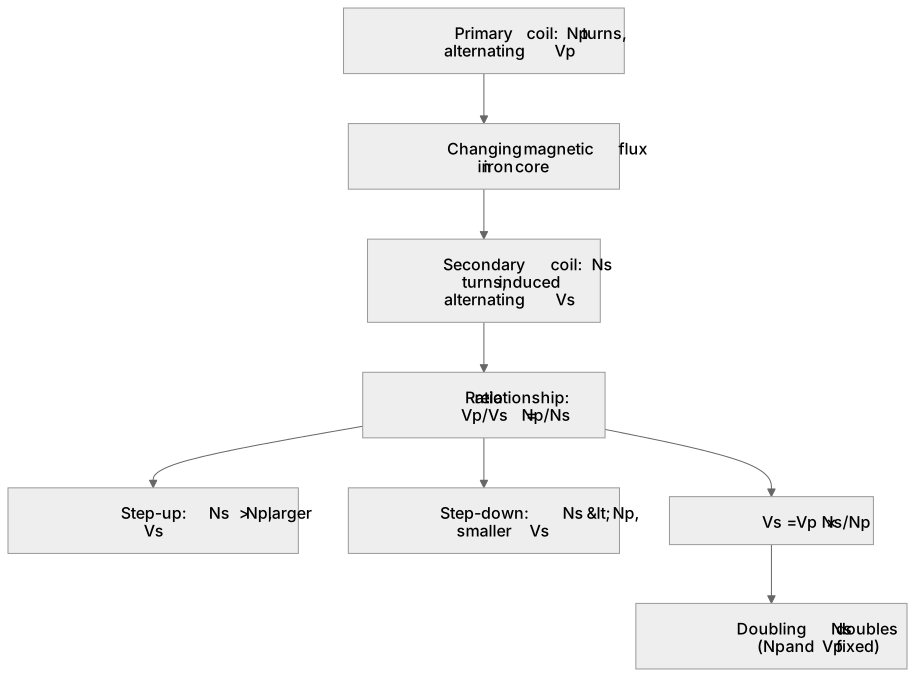
A transformer has a primary coil of Np turns and a secondary coil of Ns turns. The alternating potential difference across the primary, Vp, produces a changing magnetic flux in the iron core, and this induces an alternating potential difference Vs across the secondary. For an ideal transformer the ratio of the potential differences equals the ratio of the turns: Vp/Vs = Np/Ns. So a step-up transformer has more turns on the secondary (Ns > Np) and gives a larger Vs; a step-down transformer has fewer secondary turns and gives a smaller Vs. Doubling Ns while keeping Np and Vp fixed doubles Vs. Rearranged, Vs = Vp × Ns/Np.
What earns the marks
- States that the ratio of the potential differences across the two coils equals the ratio of the numbers of turns in each, so Vp/Vs = Np/Ns.
- Identifies a step-up transformer as one with more turns on the secondary coil than on the primary coil, giving a larger secondary potential difference.
- Identifies a step-down transformer as one with fewer turns on the secondary coil than on the primary coil, giving a smaller secondary potential difference.
- Explains that increasing the number of secondary turns while keeping the primary turns and primary potential difference fixed increases the secondary potential difference in proportion.
Common mistakes and how to put them right
Inverts the ratio and writes Vs/Vp = Np/Ns.
Put it right: Correct it to Vp/Vs = Np/Ns so the primary quantities sit on the same side.
Assumes a step-up transformer increases power as well as potential difference.
Put it right by noting an ideal transformer keeps power the same, so a larger Vs comes with a smaller Is.
Treats the turns ratio as an additive difference rather than a ratio.
Put it right by comparing Ns with Np as a fraction, for example Ns/Np = 2 doubles Vs.
Exam tips
- Write the relationship as Vp/Vs = Np/Ns before substituting any numbers, so the ratio is set up correctly.
- Check the direction of the change: more secondary turns than primary turns means a step-up transformer and a larger secondary potential difference.
- Keep the primary potential difference and primary turns fixed when reasoning about how changing the secondary turns alters the secondary potential difference.
Try the lesson
The start of the Uses of magnetism: explain how the ratio of the potential differences across the two coils in a transformer depends on the ratio of the numbers of turns in each (content found only in the physics separate science qualification) (Higher tier only) lesson, made from checked teaching notes for this specification point.
Have a go first
An ideal transformer has 200 turns on its primary coil and 100 turns on its secondary coil. The primary potential difference is 12 V. What is the secondary potential difference?
Listen
A transformer has a primary coil of Np turns and a secondary coil of Ns turns. The alternating potential difference across the primary, Vp, produces a changing magnetic flux in the iron core, and this induces an alternating potential difference Vs across the secondary. For an ideal transformer the ratio of the potential differences equals the ratio of the turns: Vp/Vs = Np/Ns. So a step-up transformer has more turns on the secondary (Ns > Np) and gives a larger Vs; a step-down transformer has fewer secondary turns and gives a smaller Vs. Doubling Ns while keeping Np and Vp fixed doubles Vs. Rearranged, Vs = Vp × Ns/Np. A strong answer earns marks for these points. States that the ratio of the potential differences across the two coils equals the ratio of the numbers of turns in each, so Vp/Vs = Np/Ns. Identifies a step-up transformer as one with more turns on the secondary coil than on the primary coil, giving a larger secondary potential difference. Identifies a step-down transformer as one with fewer turns on the secondary coil than on the primary coil, giving a smaller secondary potential difference. Explains that increasing the number of secondary turns while keeping the primary turns and primary potential difference fixed increases the secondary potential difference in proportion. A common slip: Assumes a step-up transformer increases power as well as potential difference. Instead, noting an ideal transformer keeps power the same, so a larger Vs comes with a smaller Is. Exam tip: Write the relationship as Vp/Vs = Np/Ns before substituting any numbers, so the ratio is set up correctly.
See it
Key words
Say what each word means before you turn the card.
Transformer turns ratio
Try answering aloud or in your head before turning the card.
Step-up and step-down transformers
Try answering aloud or in your head before turning the card.
Induced potential difference from a changing magnetic flux
Try answering aloud or in your head before turning the card.
Proportional reasoning with ratios
Try answering aloud or in your head before turning the card.
See every definition
- Transformer turns ratio
- The ratio of the potential differences across the two coils equals the ratio of the numbers of turns in each, so Vp/Vs = Np/Ns.
- Step-up and step-down transformers
- A step-up transformer has more turns on the secondary coil than on the primary coil and gives a larger secondary potential difference; a step-down transformer has fewer secondary turns and gives a smaller one.
- Induced potential difference from a changing magnetic flux
- The alternating potential difference across the primary produces a changing magnetic flux in the iron core, and this induces an alternating potential difference across the secondary.
- Proportional reasoning with ratios
- Doubling the number of secondary turns while keeping the primary turns and primary potential difference fixed doubles the secondary potential difference.
Label the diagram
Some boxes have lost their names. Pick the right name for each number.
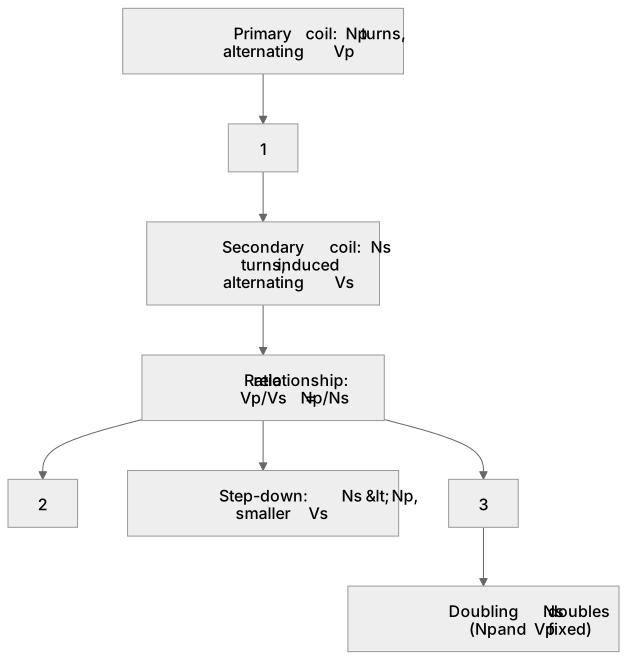
1Box 1
2Box 2
3Box 3
There is more to this lesson
The full lesson goes on to check your understanding and help you earn the marks. Create a free account to carry on, with your progress saved.
A week of Premium from your first lesson · Then the free plan continues · No card, no charge
Test your understanding of Uses of magnetism: explain how the ratio of the potential differences across the two coils in a transformer depends on the ratio of the numbers of turns in each (content found only in the physics separate science qualification) (Higher tier only)
Active recall beats re-reading. Take an instant quiz now to test what you’ve learned and lock it into long-term memory.
A week of Premium from your first lesson · Then the free plan continues · No card, no charge