OCR · GCSE · Physics
Course version: J249 · Version from Sept 2018
Describe and apply the relationship between wavelength, frequency and wave…
Full specification wording
Wave behaviour: describe and apply the relationship between wavelength, frequency and wave velocity
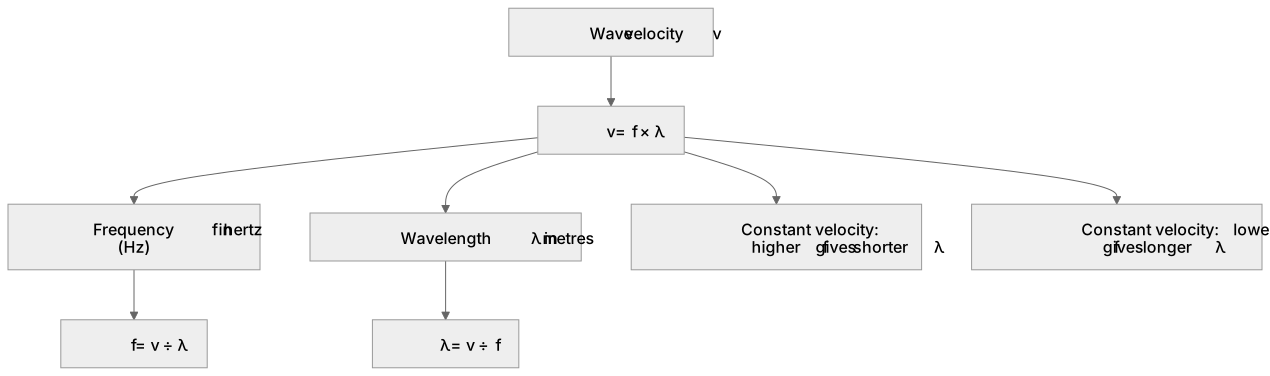
Wavelength, frequency and wave velocity are linked by one relationship: velocity equals frequency multiplied by wavelength (v = f × λ).
Checked against the OCR J249 specification (opens in a new tab) on .
- Point 4 of 12
- 4 key terms
Study notes
From the checked teaching notes for this specification point.
The idea
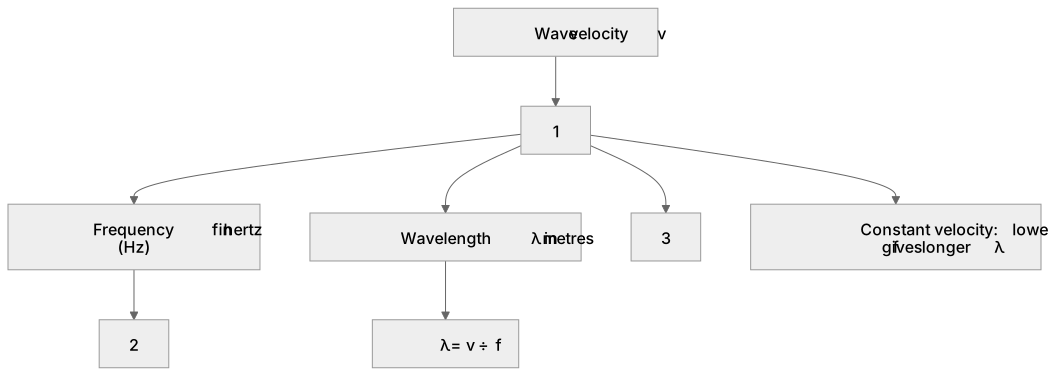
Wavelength, frequency and wave velocity are linked by one relationship: velocity equals frequency multiplied by wavelength (v = f × λ). Wavelength λ is the distance between two matching points on consecutive waves, measured in metres; frequency f is the number of complete waves passing a point each second, measured in hertz (Hz), where 1 Hz = 1 s⁻¹. Multiplying hertz by metres gives metres per second, so the units confirm the equation. A wave of frequency 50 Hz and wavelength 4 m travels at 50 × 4 = 200 m/s. For a fixed velocity, increasing frequency shortens wavelength and decreasing frequency lengthens it, because f and λ are inversely proportional when v is constant. Describe the relationship in words, then apply it by substituting two known quantities to find the third, rearranging to f = v ÷ λ or λ = v ÷ f as needed.
What earns the marks
- States that wave velocity equals frequency multiplied by wavelength, written v = f × λ.
- Identifies wavelength as the distance between matching points on successive waves, measured in metres.
- Identifies frequency as the number of waves passing a point each second, measured in hertz.
- Rearranges the relationship to find frequency as velocity divided by wavelength or wavelength as velocity divided by frequency.
- Explains that for a constant velocity a higher frequency gives a shorter wavelength and a lower frequency gives a longer wavelength.
- Substitutes two known values into the relationship and calculates the third with correct units, for example 50 Hz × 4 m = 200 m/s.
Common mistakes and how to put them right
Adds frequency and wavelength instead of multiplying them.
Put it right: Multiply the two quantities to obtain velocity.
Divides wavelength by frequency when finding velocity.
Put it right: Multiply frequency by wavelength instead.
Treats hertz as a unit of wavelength.
Put it right: Record frequency in hertz and wavelength in metres.
Forgets to rearrange before substituting when finding frequency or wavelength.
Put it right: Divide velocity by the known quantity.
Exam tips
- Write the equation v = f × λ before substituting so the rearrangement is clear.
- Check units: hertz multiplied by metres must give metres per second.
- Use the inverse relationship to sanity-check an answer: a larger frequency should pair with a smaller wavelength at fixed velocity.
Try the lesson
The start of the Wave behaviour: describe and apply the relationship between wavelength, frequency and wave velocity lesson, made from checked teaching notes for this specification point.
Have a go first
A water wave has a frequency of 4 Hz and a wavelength of 3 m. What is the velocity of the wave?
Listen
Wavelength, frequency and wave velocity are linked by one relationship: velocity equals frequency multiplied by wavelength (v = f × λ). Wavelength λ is the distance between two matching points on consecutive waves, measured in metres; frequency f is the number of complete waves passing a point each second, measured in hertz (Hz), where 1 Hz = 1 s⁻¹. Multiplying hertz by metres gives metres per second, so the units confirm the equation. A wave of frequency 50 Hz and wavelength 4 m travels at 50 × 4 = 200 m/s. For a fixed velocity, increasing frequency shortens wavelength and decreasing frequency lengthens it, because f and λ are inversely proportional when v is constant. Describe the relationship in words, then apply it by substituting two known quantities to find the third, rearranging to f = v ÷ λ or λ = v ÷ f as needed. A strong answer earns marks for these points. States that wave velocity equals frequency multiplied by wavelength, written v = f × λ. Identifies wavelength as the distance between matching points on successive waves, measured in metres. Identifies frequency as the number of waves passing a point each second, measured in hertz. Rearranges the relationship to find frequency as velocity divided by wavelength or wavelength as velocity divided by frequency. Exam tip: Write the equation v = f × λ before substituting so the rearrangement is clear.
See it
Key words
Say what each word means before you turn the card.
Wave velocity
Try answering aloud or in your head before turning the card.
Wavelength
Try answering aloud or in your head before turning the card.
Frequency
Try answering aloud or in your head before turning the card.
Inverse relationship
Try answering aloud or in your head before turning the card.
See every definition
- Wave velocity
- Equals frequency multiplied by wavelength, written v = f × λ, and is found by multiplying the two quantities.
- Wavelength
- The distance between two matching points on consecutive waves, measured in metres.
- Frequency
- The number of complete waves passing a point each second, measured in hertz (Hz), where 1 Hz = 1 s⁻¹.
- Inverse relationship
- For a fixed velocity, increasing frequency shortens wavelength and decreasing frequency lengthens it, because f and λ are inversely proportional when v is constant.
Label the diagram
Some boxes have lost their names. Pick the right name for each number.
1Box 1
2Box 2
3Box 3
There is more to this lesson
The full lesson goes on to check your understanding and help you earn the marks. Create a free account to carry on, with your progress saved.
A week of Premium from your first lesson · Then the free plan continues · No card, no charge
Test your understanding of Wave behaviour: describe and apply the relationship between wavelength, frequency and wave velocity
Active recall beats re-reading. Take an instant quiz now to test what you’ve learned and lock it into long-term memory.
A week of Premium from your first lesson · Then the free plan continues · No card, no charge