OCR · GCSE · Physics
Course version: J249 · Version from Sept 2018
Describe differences between transverse and longitudinal waves (to…
Full specification wording
Wave behaviour: describe differences between transverse and longitudinal waves (to include: direction of travel and direction of vibration)
Both transverse and longitudinal waves carry energy away from a source, but they differ in how the particles or fields vibrate relative to the direction the wave travels.
Checked against the OCR J249 specification (opens in a new tab) on .
- Point 6 of 12
- 4 key terms
Study notes
From the checked teaching notes for this specification point.
The idea
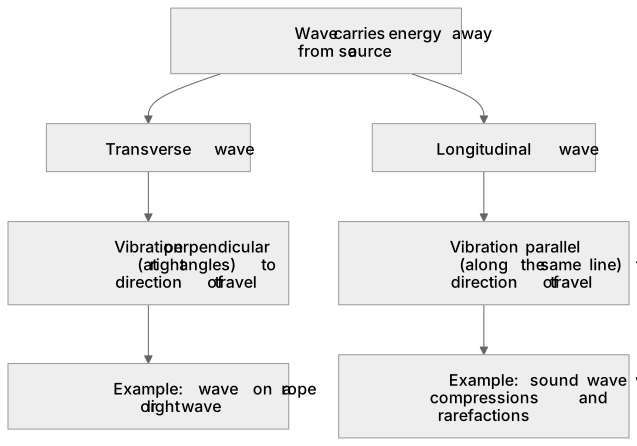
Both transverse and longitudinal waves carry energy away from a source, but they differ in how the particles or fields vibrate relative to the direction the wave travels. In a transverse wave the vibration is at right angles (perpendicular) to the direction of travel, so a wave on a rope moves along the rope while each point of the rope moves up and down. In a longitudinal wave the vibration is along the same line as the direction of travel, so in a sound wave the air particles oscillate back and forth parallel to the direction the sound moves, forming compressions and rarefactions. The key comparison is therefore the angle between vibration and travel: perpendicular for transverse, parallel for longitudinal.
What earns the marks
- States that in a transverse wave the vibration is perpendicular (at right angles) to the direction of travel.
- States that in a longitudinal wave the vibration is parallel (along the same line) to the direction of travel.
- Identifies a sound wave as longitudinal and a wave on a rope or a light wave as transverse.
- Describes the direction of energy transfer as along the direction of travel for both wave types.
Common mistakes and how to put them right
Confuses the two types.
Put it right: Transverse means vibration is perpendicular to travel and longitudinal means vibration is parallel to travel.
Claims that longitudinal waves have no vibration.
Put it right: State that particles vibrate back and forth along the travel direction.
Says sound travels as a transverse wave.
Put it right: Identify sound in air as a longitudinal wave with compressions and rarefactions.
Exam tips
- Read the question carefully to see whether it asks about direction of travel, direction of vibration or both, and answer each part.
- Use the words perpendicular and parallel explicitly rather than vague phrases such as 'side to side'.
- Link each definition to a named example, such as a rope wave for transverse and a sound wave for longitudinal.
Try the lesson
The start of the Wave behaviour: describe differences between transverse and longitudinal waves (to include: direction of travel and direction of vibration) lesson, made from checked teaching notes for this specification point.
Have a go first
In a transverse wave, how does the direction in which the particles vibrate compare with the direction in which the wave travels?
Listen
Both transverse and longitudinal waves carry energy away from a source, but they differ in how the particles or fields vibrate relative to the direction the wave travels. In a transverse wave the vibration is at right angles (perpendicular) to the direction of travel, so a wave on a rope moves along the rope while each point of the rope moves up and down. In a longitudinal wave the vibration is along the same line as the direction of travel, so in a sound wave the air particles oscillate back and forth parallel to the direction the sound moves, forming compressions and rarefactions. The key comparison is therefore the angle between vibration and travel: perpendicular for transverse, parallel for longitudinal. A strong answer earns marks for these points. States that in a transverse wave the vibration is perpendicular (at right angles) to the direction of travel. States that in a longitudinal wave the vibration is parallel (along the same line) to the direction of travel. Identifies a sound wave as longitudinal and a wave on a rope or a light wave as transverse. Describes the direction of energy transfer as along the direction of travel for both wave types. Exam tip: Read the question carefully to see whether it asks about direction of travel, direction of vibration or both, and answer each part.
See it
Key words
Say what each word means before you turn the card.
Transverse waves
Try answering aloud or in your head before turning the card.
Longitudinal waves
Try answering aloud or in your head before turning the card.
Direction of vibration relative to direction of travel
Try answering aloud or in your head before turning the card.
Energy transfer by waves
Try answering aloud or in your head before turning the card.
See every definition
- Transverse waves
- Waves in which the vibration is at right angles (perpendicular) to the direction of travel.
- Longitudinal waves
- Waves in which the vibration is along the same line as the direction of travel.
- Direction of vibration relative to direction of travel
- The angle between vibration and travel: perpendicular for transverse, parallel for longitudinal.
- Energy transfer by waves
- Both transverse and longitudinal waves carry energy away from a source, along the direction of travel.
Label the diagram
Some boxes have lost their names. Pick the right name for each number.
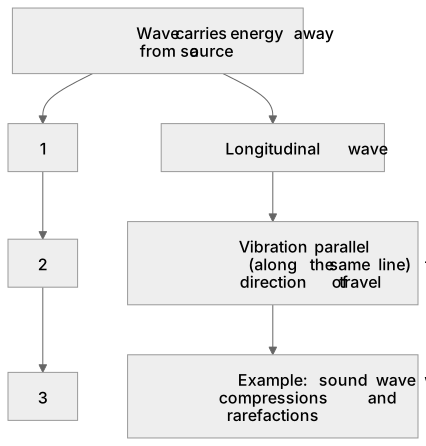
1Box 1
2Box 2
3Box 3
There is more to this lesson
The full lesson goes on to check your understanding and help you earn the marks. Create a free account to carry on, with your progress saved.
A week of Premium from your first lesson · Then the free plan continues · No card, no charge
Test your understanding of Wave behaviour: describe differences between transverse and longitudinal waves (to include: direction of travel and direction of vibration)
Active recall beats re-reading. Take an instant quiz now to test what you’ve learned and lock it into long-term memory.
A week of Premium from your first lesson · Then the free plan continues · No card, no charge