OCR · GCSE · Physics
Course version: J249 · Version from Sept 2018
Show how changes, in velocity, frequency and wavelength, in transmission…
Full specification wording
Wave behaviour: show how changes, in velocity, frequency and wavelength, in transmission of sound waves from one medium to another, are inter-related (content found only in the physics separate science qualification)
This statement applies only to the physics separate science qualification, so treat it as separate-science content even though the row is tagged for both tiers.
Checked against the OCR J249 specification (opens in a new tab) on .
- Point 7 of 12
- 4 key terms
Study notes
From the checked teaching notes for this specification point.
The idea
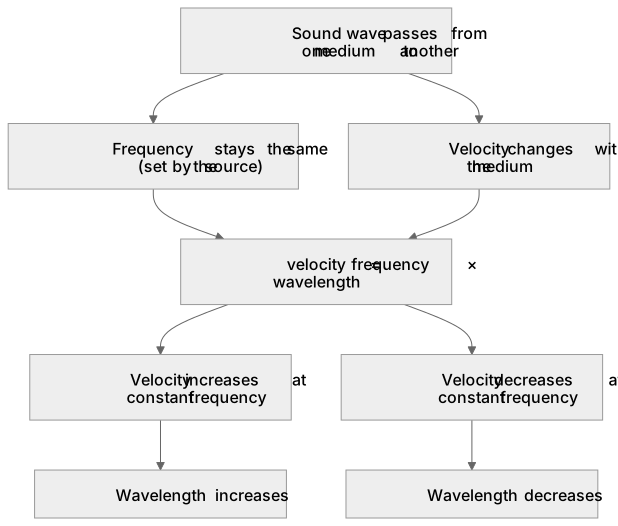
This statement applies only to the physics separate science qualification, so treat it as separate-science content even though the row is tagged for both tiers. When a sound wave passes from one medium into another, its frequency stays the same because it is set by the source, but its velocity (speed) changes with the medium. Because velocity = frequency × wavelength, a change in velocity at constant frequency must be matched by a change in wavelength: if the sound speeds up, the wavelength increases; if it slows down, the wavelength decreases. For example, sound travels faster in steel than in air, so at the same frequency its wavelength is longer in steel. Use v = f × λ to show the relationship and keep frequency fixed when comparing media.
What earns the marks
- States that the frequency of a sound wave stays the same when it passes from one medium to another.
- States that the velocity of the sound wave changes when it enters a different medium.
- Uses the relationship velocity = frequency × wavelength to link the three quantities.
- Explains that at constant frequency an increase in velocity produces a corresponding increase in wavelength.
Common mistakes and how to put them right
Assumes frequency changes between media.
Put it right: State that frequency is set by the source and stays constant.
Treats velocity and wavelength as independent.
Put it right: Link them through velocity = frequency × wavelength at fixed frequency.
Applies this content to combined-science learners.
Put it right: Recognise it as physics separate-science content only.
Exam tips
- Write down v = f × λ and substitute values to show how a change in v at constant f changes λ.
- State explicitly that frequency is unchanged before comparing velocities and wavelengths in two media.
- Check units: velocity in m/s, frequency in Hz and wavelength in m before calculating.
Try the lesson
The start of the Wave behaviour: show how changes, in velocity, frequency and wavelength, in transmission of sound waves from one medium to another, are inter-related (content found only in the physics separate science qualification) lesson, made from checked teaching notes for this specification point.
Have a go first
A sound wave passes from air into water. The frequency of the wave stays the same. What happens to its wavelength if its velocity increases?
Listen
This statement applies only to the physics separate science qualification, so treat it as separate-science content even though the row is tagged for both tiers. When a sound wave passes from one medium into another, its frequency stays the same because it is set by the source, but its velocity (speed) changes with the medium. Because velocity = frequency × wavelength, a change in velocity at constant frequency must be matched by a change in wavelength: if the sound speeds up, the wavelength increases; if it slows down, the wavelength decreases. For example, sound travels faster in steel than in air, so at the same frequency its wavelength is longer in steel. Use v = f × λ to show the relationship and keep frequency fixed when comparing media. A strong answer earns marks for these points. States that the frequency of a sound wave stays the same when it passes from one medium to another. States that the velocity of the sound wave changes when it enters a different medium. Uses the relationship velocity = frequency × wavelength to link the three quantities. Explains that at constant frequency an increase in velocity produces a corresponding increase in wavelength. Exam tip: Write down v = f × λ and substitute values to show how a change in v at constant f changes λ.
See it
Key words
Say what each word means before you turn the card.
frequency
Try answering aloud or in your head before turning the card.
velocity
Try answering aloud or in your head before turning the card.
velocity = frequency × wavelength
Try answering aloud or in your head before turning the card.
wavelength
Try answering aloud or in your head before turning the card.
See every definition
- frequency
- Stays the same when a sound wave passes from one medium into another because it is set by the source.
- velocity
- Changes with the medium when a sound wave passes from one medium into another.
- velocity = frequency × wavelength
- The relationship used to link the three quantities and to show how a change in velocity at constant frequency changes wavelength.
- wavelength
- Increases if the sound speeds up and decreases if it slows down, at constant frequency.
Label the diagram
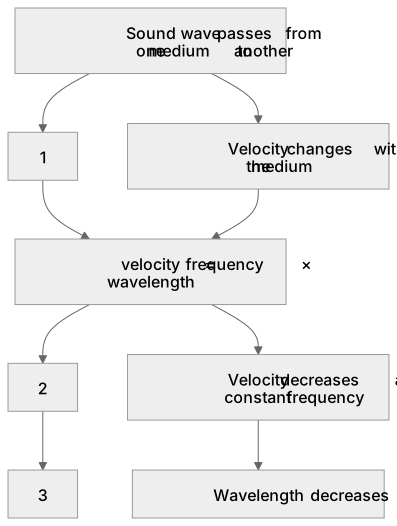
Some boxes have lost their names. Pick the right name for each number.
1Box 1
2Box 2
3Box 3
There is more to this lesson
The full lesson goes on to check your understanding and help you earn the marks. Create a free account to carry on, with your progress saved.
A week of Premium from your first lesson · Then the free plan continues · No card, no charge
Test your understanding of Wave behaviour: show how changes, in velocity, frequency and wavelength, in transmission of sound waves from one medium to another, are inter-related (content found only in the physics separate science qualification)
Active recall beats re-reading. Take an instant quiz now to test what you’ve learned and lock it into long-term memory.
A week of Premium from your first lesson · Then the free plan continues · No card, no charge