OCR · GCSE · Physics
Course version: J249 · Version from Sept 2018
Describe, with examples, processes which convert wave disturbances between…
Full specification wording
Wave behaviour: describe, with examples, processes which convert wave disturbances between sound waves and vibrations in solids (to include: knowledge of a simple structure of the parts of the ear is expected) (content found only in the physics separate science qualification) (Higher tier only)
Sound waves in air are pressure disturbances, and they can be converted into vibrations in solids and back again.
Checked against the OCR J249 specification (opens in a new tab) on .
- Point 9 of 12
- 4 key terms
Study notes
From the checked teaching notes for this specification point.
The idea
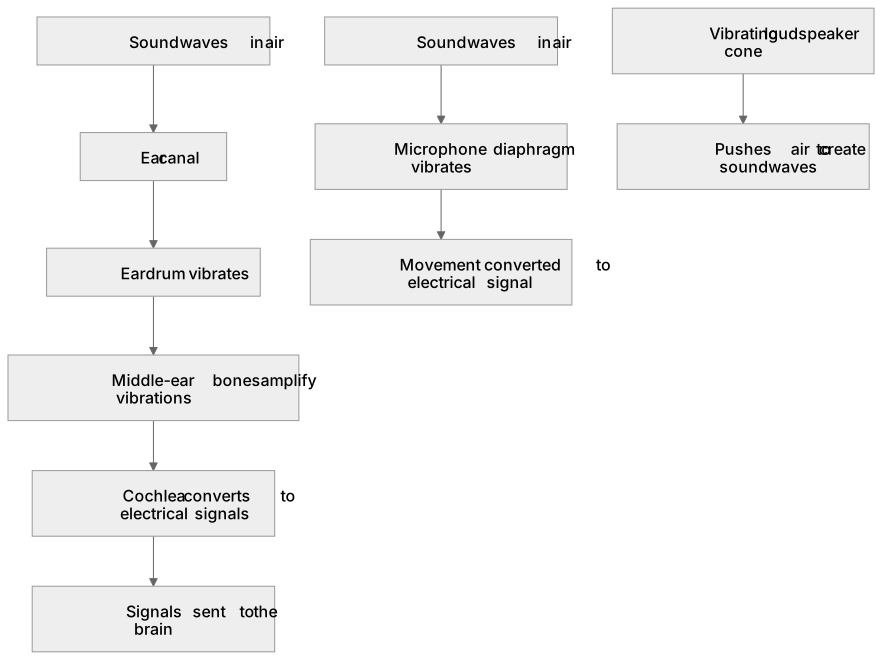
Sound waves in air are pressure disturbances, and they can be converted into vibrations in solids and back again. In the ear, sound waves travel along the ear canal and strike the eardrum, a thin membrane that vibrates. These vibrations pass through the small bones of the middle ear, which amplify them, and reach the cochlea, where they are converted into electrical signals sent to the brain. A microphone works similarly: sound waves vibrate a diaphragm, and the movement is converted into an electrical signal. The reverse happens in a loudspeaker, where a vibrating cone in a solid structure pushes air to create sound waves. The key idea is that a wave in one medium causes a solid to vibrate, and that vibration can be turned back into a wave.
What earns the marks
- Describes how sound waves in air cause a solid such as the eardrum or a microphone diaphragm to vibrate.
- Identifies the eardrum, middle-ear bones and cochlea as parts of the ear involved in converting sound to vibrations and then to signals.
- Explains that vibrations in a solid can be converted back into sound waves, as in a loudspeaker cone.
- Gives a named example of the conversion, such as hearing via the ear or a microphone and loudspeaker system.
Common mistakes and how to put them right
States that sound travels through the ear as light or electricity.
Put it right: Keep the sequence as sound wave, vibration in solid, then signal to the brain.
Omits the eardrum and treats the ear as a single structure.
Put it right: Name the eardrum, middle-ear bones and cochlea in order.
Claims a loudspeaker absorbs sound.
Put it right: Describe it as converting vibrations in a solid into sound waves in air.
Exam tips
- Trace the path of sound through the ear in order before selecting an option.
- Match each named part to its role in converting between sound waves and vibrations.
- Check whether the question asks about sound to vibration or vibration to sound before answering.
Try the lesson
The start of the Wave behaviour: describe, with examples, processes which convert wave disturbances between sound waves and vibrations in solids (to include: knowledge of a simple structure of the parts of the ear is expected) (content found only in the physics separate science qualification) (Higher tier only) lesson, made from checked teaching notes for this specification point.
Have a go first
A sound wave travelling through the air reaches a person's ear. Which sequence correctly describes how the sound wave is converted into a vibration that the ear can detect?
Listen
Sound waves in air are pressure disturbances, and they can be converted into vibrations in solids and back again. In the ear, sound waves travel along the ear canal and strike the eardrum, a thin membrane that vibrates. These vibrations pass through the small bones of the middle ear, which amplify them, and reach the cochlea, where they are converted into electrical signals sent to the brain. A microphone works similarly: sound waves vibrate a diaphragm, and the movement is converted into an electrical signal. The reverse happens in a loudspeaker, where a vibrating cone in a solid structure pushes air to create sound waves. The key idea is that a wave in one medium causes a solid to vibrate, and that vibration can be turned back into a wave. A strong answer earns marks for these points. Describes how sound waves in air cause a solid such as the eardrum or a microphone diaphragm to vibrate. Identifies the eardrum, middle-ear bones and cochlea as parts of the ear involved in converting sound to vibrations and then to signals. Explains that vibrations in a solid can be converted back into sound waves, as in a loudspeaker cone. Gives a named example of the conversion, such as hearing via the ear or a microphone and loudspeaker system. Exam tip: Trace the path of sound through the ear in order before selecting an option.
See it
Key words
Say what each word means before you turn the card.
Eardrum
Try answering aloud or in your head before turning the card.
Cochlea
Try answering aloud or in your head before turning the card.
Microphone
Try answering aloud or in your head before turning the card.
Loudspeaker
Try answering aloud or in your head before turning the card.
See every definition
- Eardrum
- A thin membrane in the ear that sound waves strike and cause to vibrate.
- Cochlea
- Part of the ear where vibrations are converted into electrical signals sent to the brain.
- Microphone
- A device in which sound waves vibrate a diaphragm and the movement is converted into an electrical signal.
- Loudspeaker
- A device in which a vibrating cone in a solid structure pushes air to create sound waves.
There is more to this lesson
The full lesson goes on to check your understanding and help you earn the marks. Create a free account to carry on, with your progress saved.
A week of Premium from your first lesson · Then the free plan continues · No card, no charge
Test your understanding of Wave behaviour: describe, with examples, processes which convert wave disturbances between sound waves and vibrations in solids (to include: knowledge of a simple structure of the parts of the ear is expected) (content found only in the physics separate science qualification) (Higher tier only)
Active recall beats re-reading. Take an instant quiz now to test what you’ve learned and lock it into long-term memory.
A week of Premium from your first lesson · Then the free plan continues · No card, no charge