OCR · GCSE · Physics
Course version: J249 · Version from Sept 2018
Describe the effects of reflection, transmission, and absorption of waves…
Full specification wording
Wave behaviour: describe the effects of reflection, transmission, and absorption of waves at material interface (to include: examples such as ultrasound and sonar) (content found only in the physics separate science qualification)
At a boundary between two materials, an incident wave can be reflected, transmitted or absorbed, and usually a mixture of all three happens.
Checked against the OCR J249 specification (opens in a new tab) on .
- Point 8 of 12
- 4 key terms
Study notes
From the checked teaching notes for this specification point.
The idea
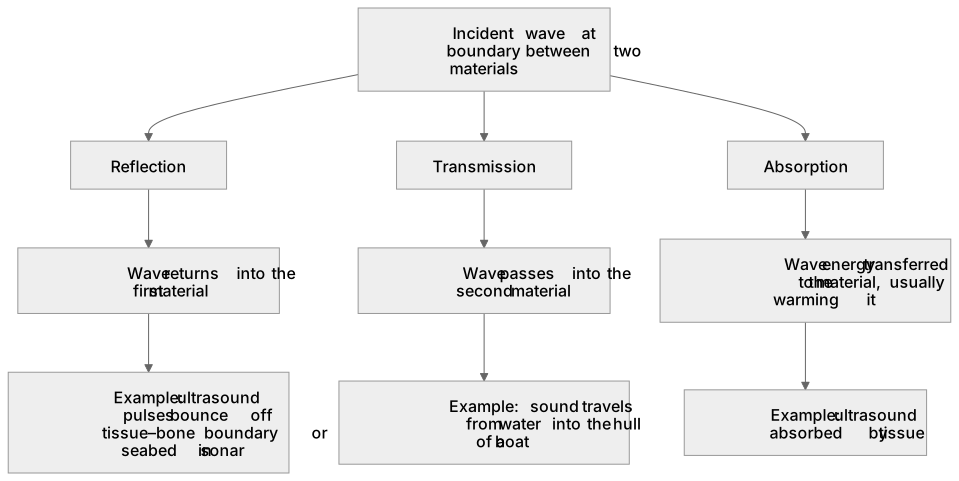
At a boundary between two materials, an incident wave can be reflected, transmitted or absorbed, and usually a mixture of all three happens. Reflection sends the wave back into the first material, as when ultrasound pulses bounce off the boundary between soft tissue and bone or off the seabed in sonar. Transmission lets the wave pass into the second material, often with a change of speed and direction, as sound travels from water into the hull of a boat. Absorption transfers the wave's energy to the material, usually warming it, as when ultrasound is absorbed by tissue. The proportions depend on the materials and the wave, which is why sonar relies on strong reflection at the water–seabed interface and why gel improves transmission between a transducer and skin.
What earns the marks
- States that reflection returns the wave into the material it came from at the interface.
- States that transmission passes the wave through the interface into the second material.
- States that absorption transfers wave energy to the material, often raising its temperature.
- Applies the ideas to ultrasound or sonar, for example pulses reflecting from the seabed or from a tissue boundary.
Common mistakes and how to put them right
Confuses transmission with absorption.
Put it right: Keep transmission as the wave passing through the boundary and absorption as energy taken in by the material.
Claims that a wave is only ever reflected or only ever transmitted.
Put it right: Recognise that a mixture of reflection, transmission and absorption usually occurs.
Describes sonar as absorption of sound by the seabed.
Put it right: Treat sonar as reflection of ultrasound pulses returning to the detector.
Exam tips
- Read the question for which effect is being asked about before choosing an option.
- Link each effect to a named example such as ultrasound scanning or sonar rather than a vague statement.
- Eliminate options that say a wave is completely stopped at every interface, since some energy is usually transmitted.
Try the lesson
The start of the Wave behaviour: describe the effects of reflection, transmission, and absorption of waves at material interface (to include: examples such as ultrasound and sonar) (content found only in the physics separate science qualification) lesson, made from checked teaching notes for this specification point.
Have a go first
A fishing boat uses sonar to find shoals of fish. A sound pulse is sent downwards and bounces off a shoal, returning to the boat. What happens to the sound wave when it hits the shoal?
Listen
At a boundary between two materials, an incident wave can be reflected, transmitted or absorbed, and usually a mixture of all three happens. Reflection sends the wave back into the first material, as when ultrasound pulses bounce off the boundary between soft tissue and bone or off the seabed in sonar. Transmission lets the wave pass into the second material, often with a change of speed and direction, as sound travels from water into the hull of a boat. Absorption transfers the wave's energy to the material, usually warming it, as when ultrasound is absorbed by tissue. The proportions depend on the materials and the wave, which is why sonar relies on strong reflection at the water–seabed interface and why gel improves transmission between a transducer and skin. A strong answer earns marks for these points. States that reflection returns the wave into the material it came from at the interface. States that transmission passes the wave through the interface into the second material. States that absorption transfers wave energy to the material, often raising its temperature. Applies the ideas to ultrasound or sonar, for example pulses reflecting from the seabed or from a tissue boundary. Exam tip: Read the question for which effect is being asked about before choosing an option.
See it
Key words
Say what each word means before you turn the card.
Reflection
Try answering aloud or in your head before turning the card.
Transmission
Try answering aloud or in your head before turning the card.
Absorption
Try answering aloud or in your head before turning the card.
Sonar
Try answering aloud or in your head before turning the card.
See every definition
- Reflection
- Sends the wave back into the first material at the boundary, as when ultrasound pulses bounce off the boundary between soft tissue and bone or off the seabed in sonar.
- Transmission
- Lets the wave pass into the second material at the boundary, often with a change of speed and direction, as sound travels from water into the hull of a boat.
- Absorption
- Transfers the wave's energy to the material, usually warming it, as when ultrasound is absorbed by tissue.
- Sonar
- Relies on strong reflection at the water–seabed interface, with ultrasound pulses reflecting from the seabed and returning to the detector.
Label the diagram
Some boxes have lost their names. Pick the right name for each number.
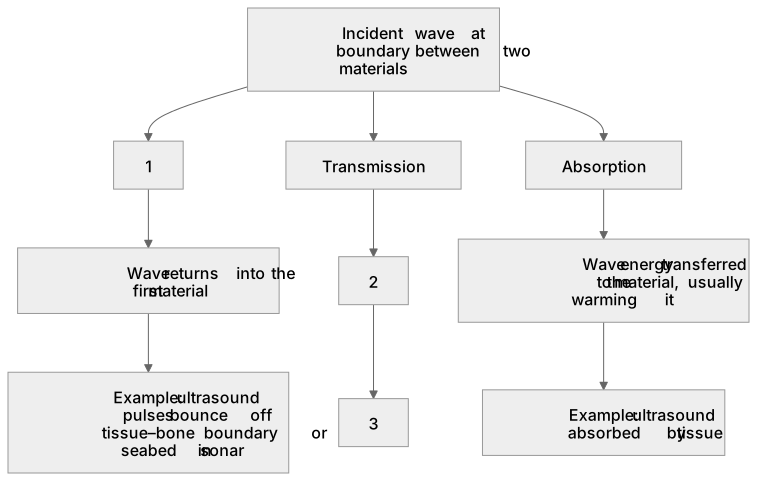
1Box 1
2Box 2
3Box 3
There is more to this lesson
The full lesson goes on to check your understanding and help you earn the marks. Create a free account to carry on, with your progress saved.
A week of Premium from your first lesson · Then the free plan continues · No card, no charge
Test your understanding of Wave behaviour: describe the effects of reflection, transmission, and absorption of waves at material interface (to include: examples such as ultrasound and sonar) (content found only in the physics separate science qualification)
Active recall beats re-reading. Take an instant quiz now to test what you’ve learned and lock it into long-term memory.
A week of Premium from your first lesson · Then the free plan continues · No card, no charge