OCR · GCSE · Physics
Wave Speed
Master OCR GCSE Physics Wave Speed (4.3) with this comprehensive guide. We break down the two essential equations, v = fλ and v = x/t, explain the critical ripple tank practical, and provide examiner-level insights to help you secure every possible mark.
- 10 min read
- 3 worked examples
- 5 practice questions
- 6 key terms
Study Notes
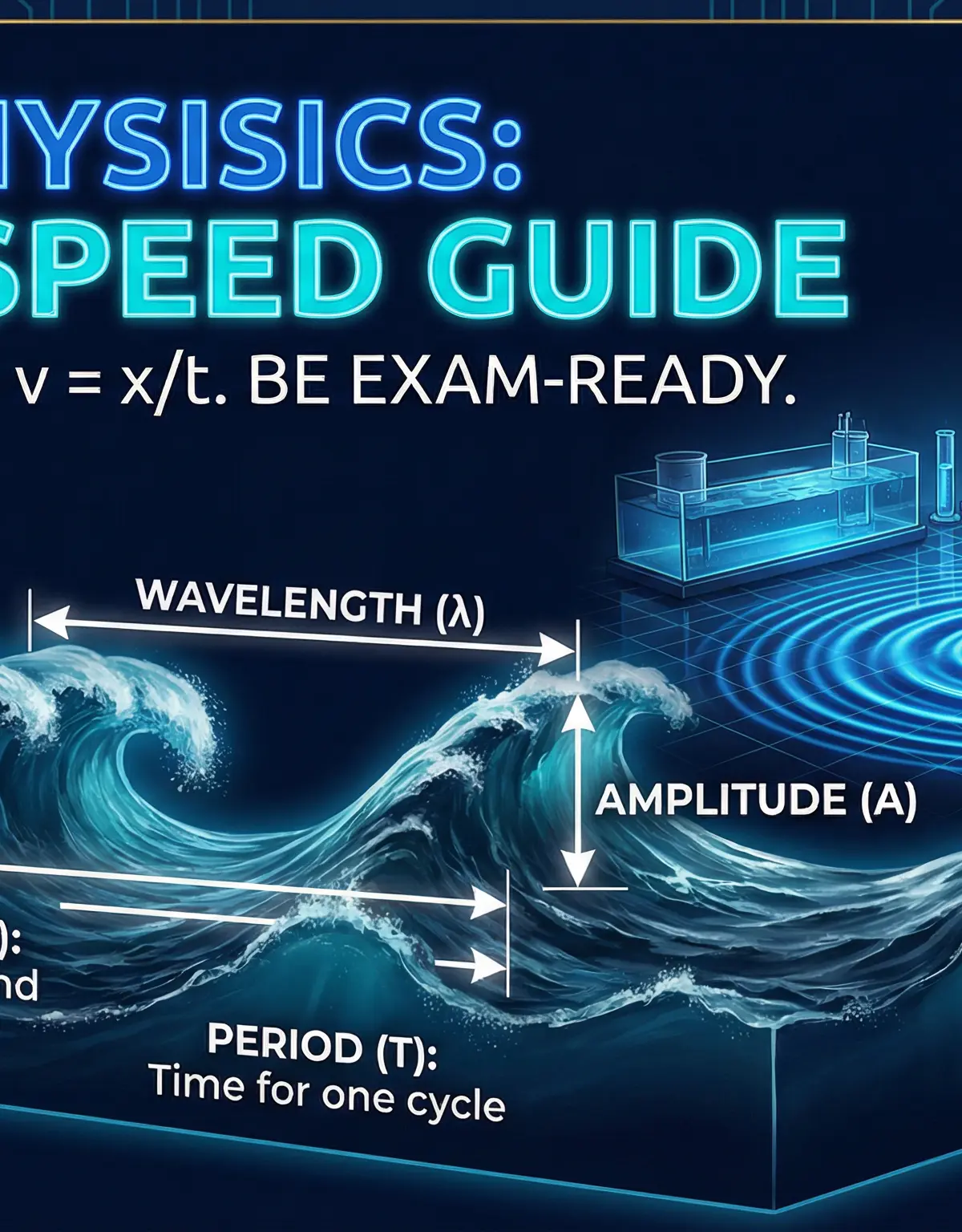
Overview
Wave Speed (OCR GCSE Physics 4.3) is a fundamental concept that bridges the theoretical understanding of waves with practical, real-world applications. This topic is a cornerstone of the waves module and is frequently tested in exams, carrying significant mark weightings across all three Assessment Objectives: AO1 (30%), AO2 (40%), and AO3 (30%). A solid grasp of wave speed is essential not just for this module, but for understanding related concepts in light, sound, and the electromagnetic spectrum. Examiners assess this topic through a combination of calculation questions, requiring confident application of the two key wave speed equations, and descriptive questions, often focusing on the methodology of required practicals like the ripple tank experiment (PAG P8). Candidates who can fluently switch between the v = fλ and v = x/t equations, handle unit conversions flawlessly, and describe experimental procedures with precision are those who achieve the highest marks. This guide will equip you with the knowledge, techniques, and exam strategies to excel.
Key Concepts
Concept 1: Defining Wave Speed Precisely
In physics, a precise definition is crucial for earning marks. Wave speed (v) is formally defined as the distance travelled by a wavefront per unit of time. It is not enough to simply state it is "how fast a wave moves." Examiners are looking for the specific language of "distance per unit time." The standard unit for wave speed is metres per second (m/s). The speed of a wave is determined by the properties of the medium it is travelling through, not by the frequency or amplitude of the wave itself. For example, sound travels at approximately 330 m/s in air at room temperature, but over four times faster in water (around 1500 m/s). This is because the particles in a liquid are much closer together than in a gas, allowing the vibrations to be passed along more efficiently. Light and other electromagnetic waves travel at approximately 3 × 10⁸ m/s in a vacuum. These reference values are your sanity-check benchmarks: if you calculate a wave speed for sound in air and get 3000 m/s, something has gone wrong — almost certainly a unit conversion error.
Concept 2: The Two Wave Speed Equations
Candidates must be proficient in using two different equations to calculate wave speed. The context of the question will determine which one is appropriate.
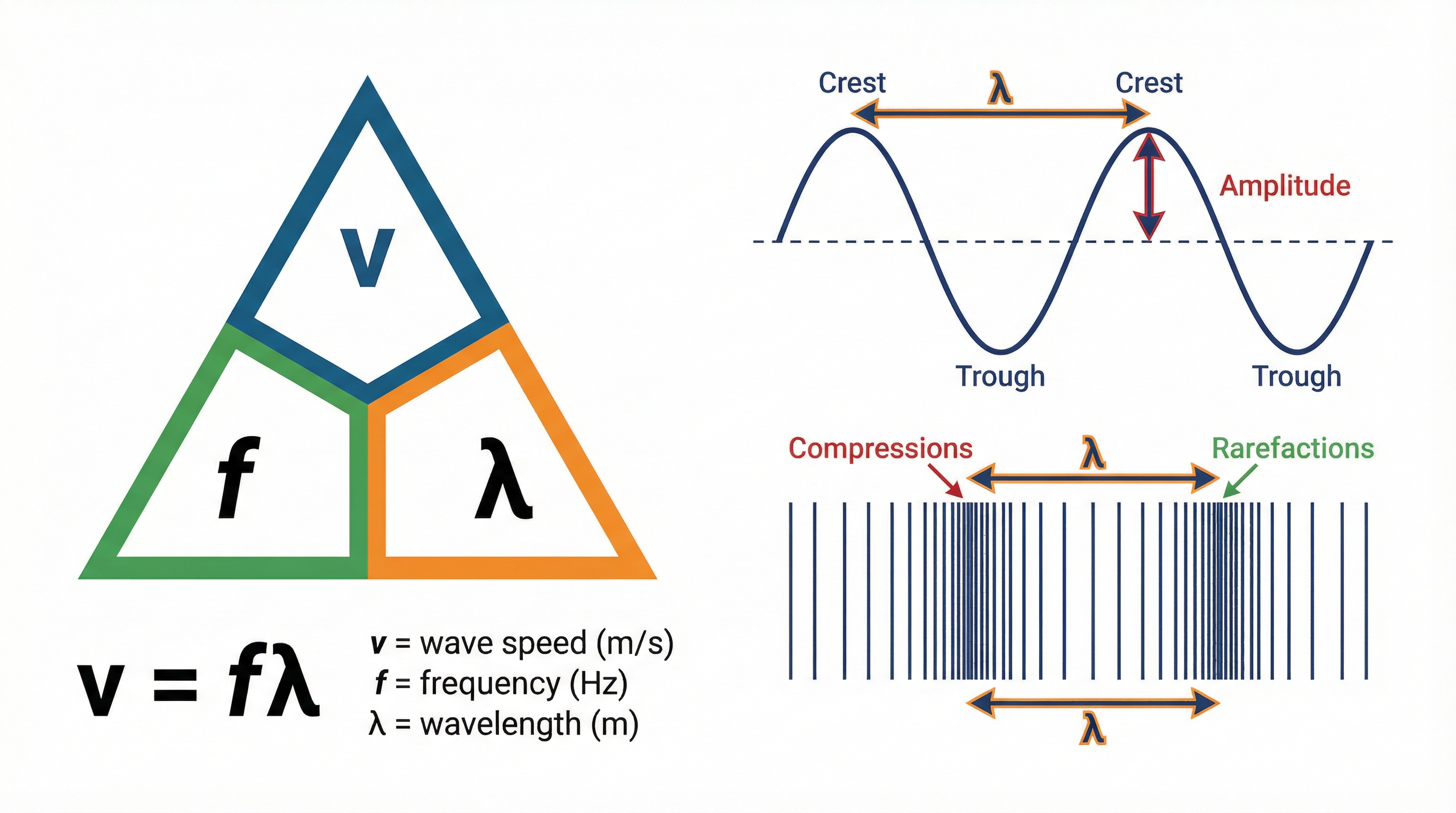
Equation 1: The Wave Equation — v = fλThis is the primary equation for this topic and is provided on the OCR formula sheet. It links wave speed (v) to frequency (f) and wavelength (λ). Each symbol represents a measurable property of the wave.
- v (Wave Speed): Measured in metres per second (m/s). This is the speed at which the wave pattern propagates through the medium.
- f (Frequency): The number of complete waves passing a given point per second. Measured in Hertz (Hz). One hertz means one complete wave per second.
- λ (Wavelength): The distance between two corresponding points on adjacent waves, such as crest to crest or trough to trough. Measured in metres (m).
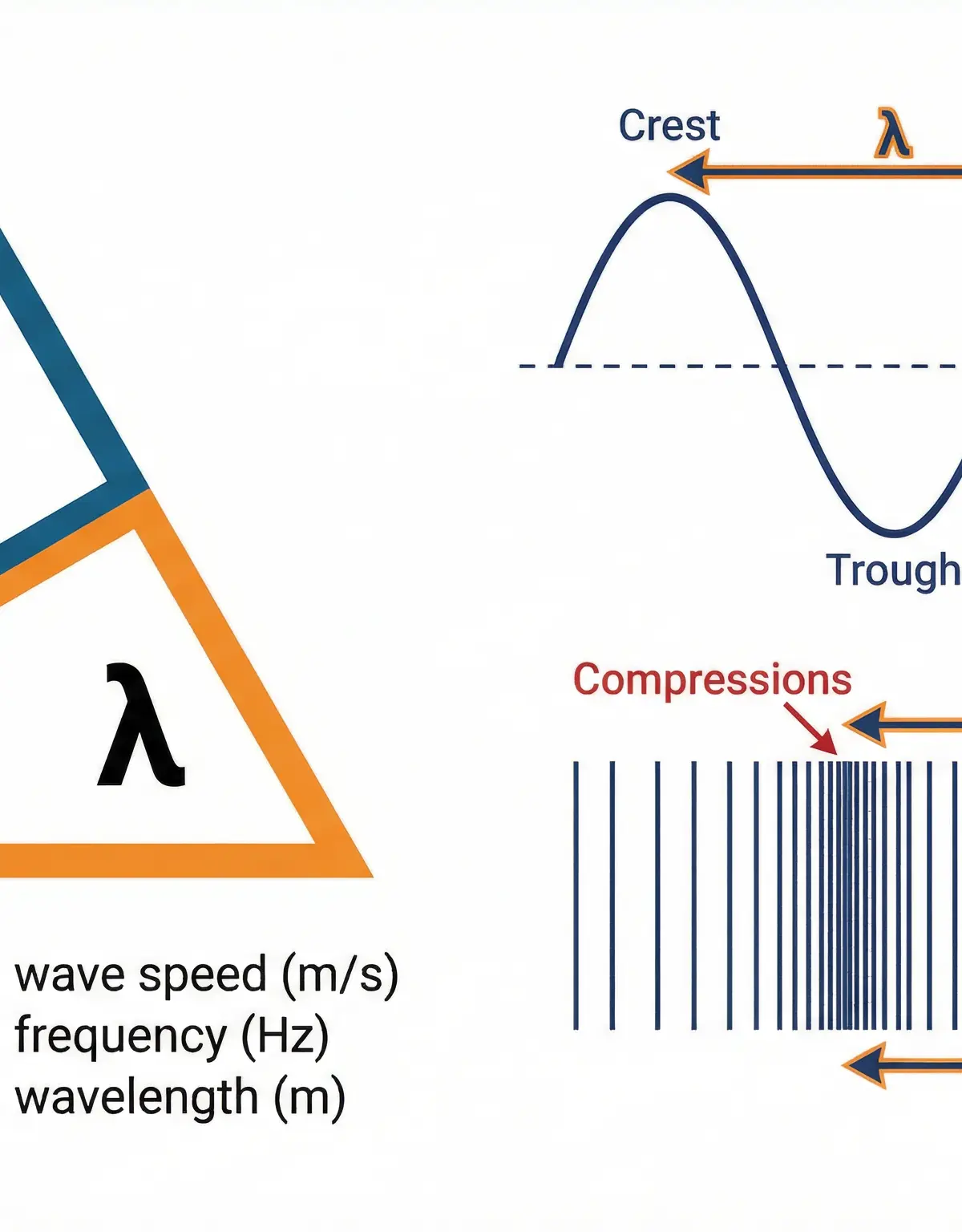
This equation is given to you on the OCR formula sheet, so you do not need to memorise it — but you absolutely must be able to use it, rearrange it, and apply it correctly. To find frequency, rearrange to f = v/λ. To find wavelength, rearrange to λ = v/f. The formula triangle is a powerful tool: place v at the top, and f and λ at the bottom. Cover the quantity you want to find, and the remaining symbols show you the operation.
Equation 2: The Distance-Time Equation — v = x/tThis is the general equation for speed, which can also be applied to waves. It is used when you are given information about how far a wave has travelled and how long it took. You must memorise this equation as it is not given on the formula sheet.
- v (Wave Speed): Measured in metres per second (m/s).
- x (Distance): The total distance travelled by the wave. Measured in metres (m).
- t (Time): The time taken for the wave to travel that distance. Measured in seconds (s).
Often, higher-tier questions will require candidates to use both equations in a multi-step calculation. For instance, you might use v = x/t to find the speed of a wave first, and then use that value in v = fλ to determine its frequency or wavelength. Recognising when a question requires two steps is a key skill that separates candidates who achieve the highest grades.
Concept 3: Transverse and Longitudinal Waves
Wave speed applies to both types of waves, and candidates must understand the distinction. In a transverse wave, the oscillations of the medium are perpendicular (at right angles) to the direction of wave travel. Light waves and water surface waves are transverse. In a longitudinal wave, the oscillations are parallel to the direction of wave travel, creating compressions and rarefactions. Sound waves are longitudinal. The wavelength of a longitudinal wave is measured from one compression to the next, or from one rarefaction to the next. Both types of waves obey v = fλ.
Concept 4: The Relationship Between Period and Frequency
Candidates are sometimes given the time period (T) of a wave rather than its frequency. The period is the time taken for one complete wave to pass a point, measured in seconds. It is the reciprocal of frequency: f = 1/T. This is a critical relationship that must be memorised. For example, if a wave has a period of 0.02 s, its frequency is 1 ÷ 0.02 = 50 Hz. Confusing T and f is one of the most common mistakes in wave speed calculations.
Mathematical/Scientific Relationships
The core relationships are the two equations for wave speed. It is essential that candidates can not only apply these but also rearrange them correctly.
Using the v = fλ Formula Triangle:
- To find Wave Speed (v): Cover v. You are left with f × λ. So, v = fλ.
- To find Frequency (f): Cover f. You are left with v over λ. So, f = v/λ.
- To find Wavelength (λ): Cover λ. You are left with v over f. So, λ = v/f.
Formulas Summary Table:
| Formula | Use When | Given on Formula Sheet? |
|---|---|---|
| v = fλ | Given frequency and wavelength | Yes — must memorise |
| v = x/t | Given distance and time | No — must memorise |
| f = 1/T | Given time period | No — must memorise |
| t = x/v | Finding time from distance and speed | No — rearrangement |
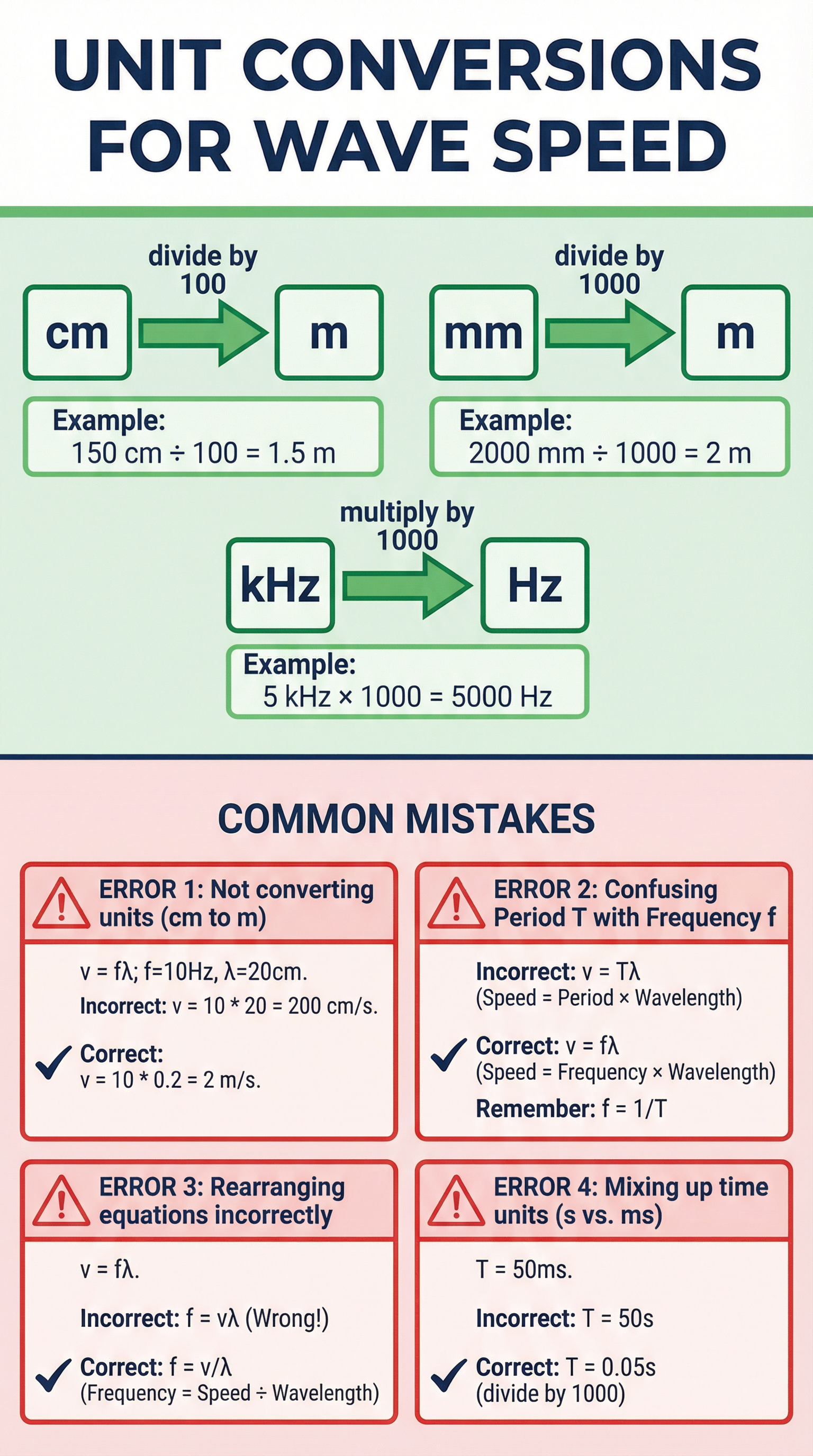
Unit Conversions: A Common PitfallExaminers frequently provide values in non-standard units to test a candidate's attention to detail. Failure to convert these correctly is one of the most common reasons for losing marks.
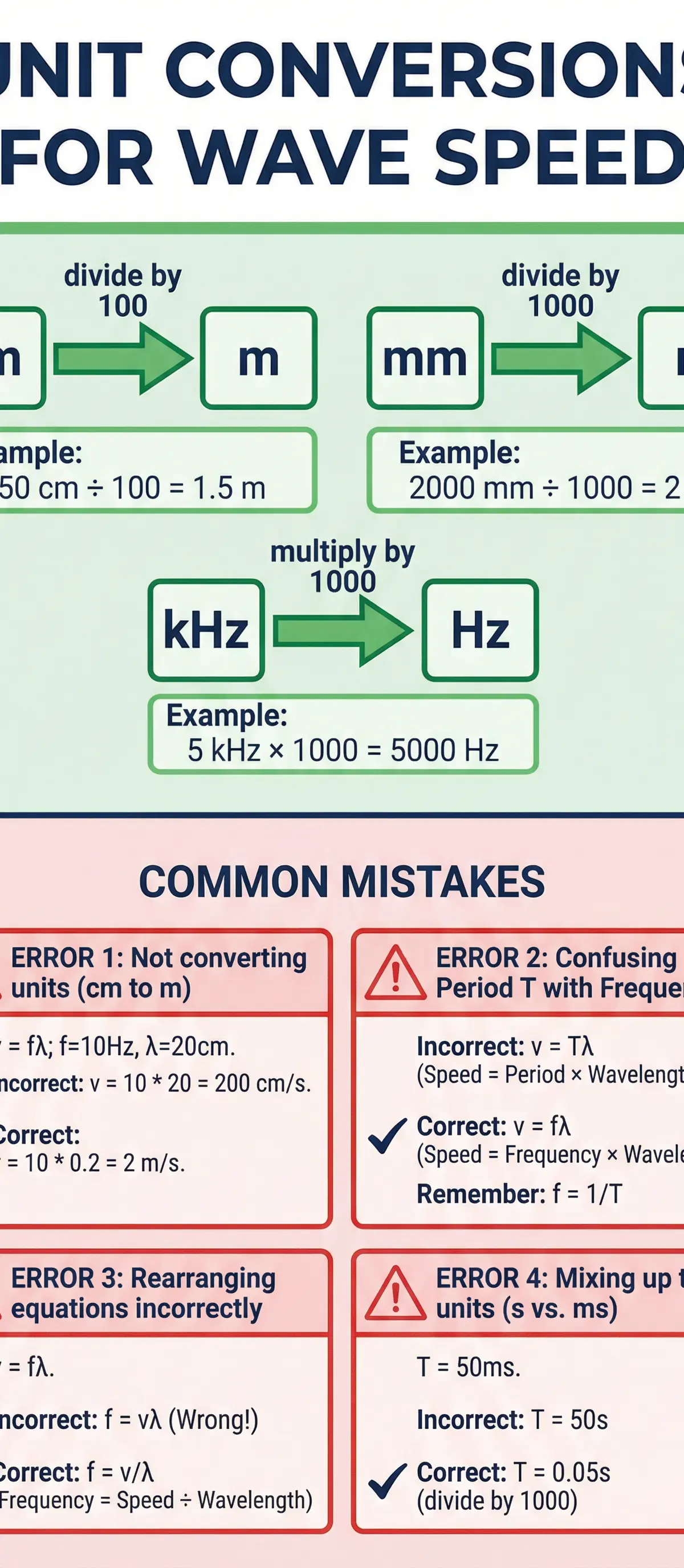
- Wavelength: Often given in centimetres (cm) or millimetres (mm). You MUST convert to metres (m) before calculating.
- cm to m: divide by 100 (e.g., 50 cm = 0.50 m)
- mm to m: divide by 1000 (e.g., 200 mm = 0.20 m)
- Frequency: May be given in kilohertz (kHz) or megahertz (MHz).
- kHz to Hz: multiply by 1000 (e.g., 10 kHz = 10,000 Hz = 1 × 10⁴ Hz)
- MHz to Hz: multiply by 1,000,000 (e.g., 2 MHz = 2,000,000 Hz = 2 × 10⁶ Hz)
Practical Applications
Required Practical (PAG P8): Measuring Wave Speed in Water and Solids
This practical is a core part of the specification and is frequently examined in both Foundation and Higher tier papers. Candidates must know the methods for measuring the speed of waves in a ripple tank (for water waves) and using sound waves in a solid rod. Examiners award marks for naming specific apparatus, describing how to take accurate measurements, and explaining how to reduce uncertainty.
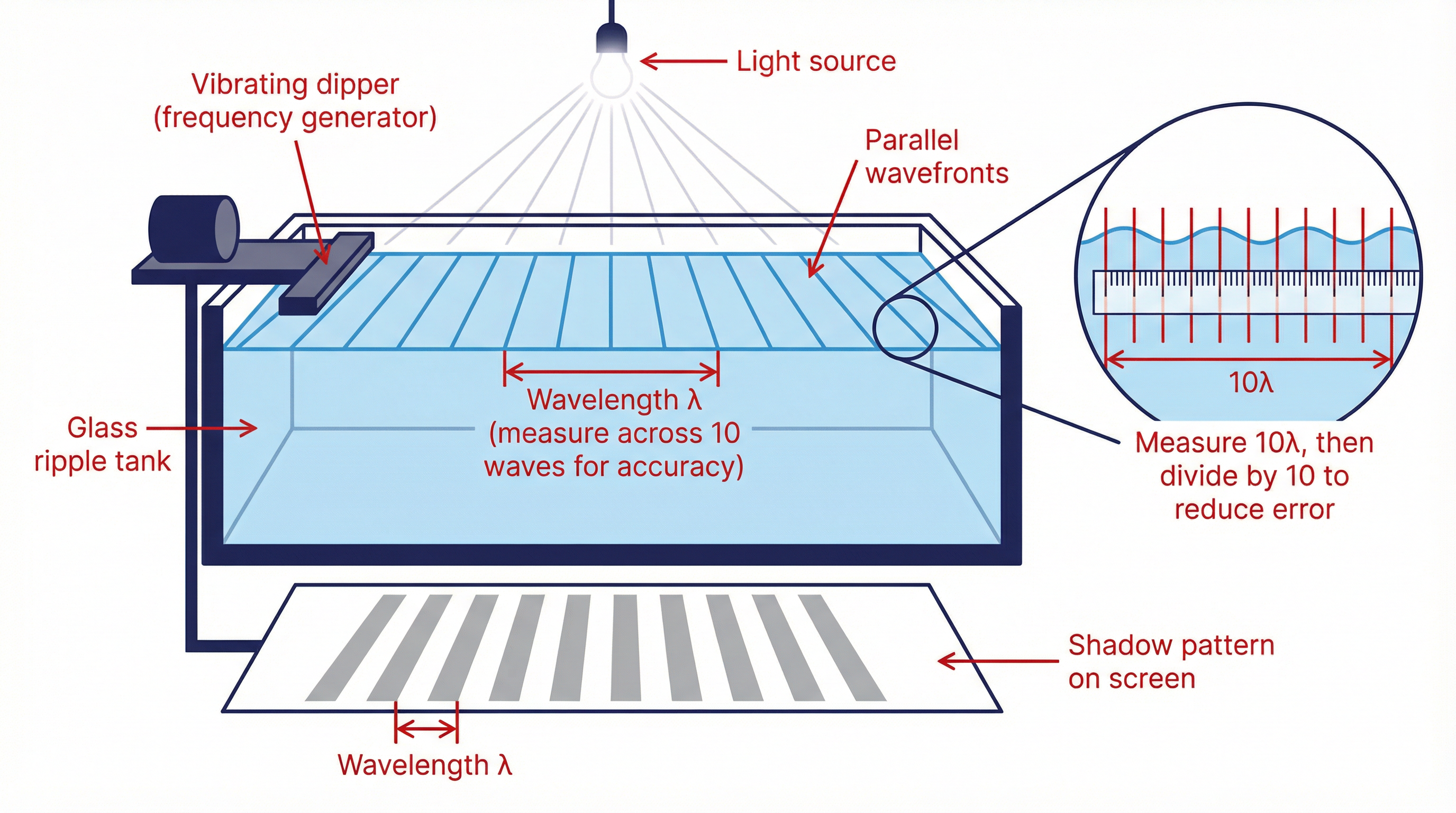
**Method 1: Ripple Tank (Water Waves)**This experiment uses the equation v = fλ.
Apparatus:
- Ripple tank with a shallow, clear base
- Vibrating dipper (or bar) connected to a frequency generator
- Stroboscope (optional, but useful for "freezing" the waves to measure wavelength)
- Light source (lamp) positioned above the tank
- White screen or paper positioned below the tank
- Metre ruler
Method:
- Set up the apparatus with the lamp above the ripple tank and the screen below it. The wavefronts will cast shadow patterns on the screen.
- Set the frequency generator to a known, sensible frequency (e.g., 10 Hz). This sets the frequency (f) of the waves.
- To measure the wavelength (λ), do NOT measure a single wave. Instead, place the metre ruler on the screen and measure the total length of 10 consecutive waves (i.e., the distance from the first crest shadow to the eleventh crest shadow).
- Calculate the wavelength of one wave by dividing this total length by 10. This technique reduces random error and increases the precision of your result.
- Calculate the wave speed using the formula v = fλ, ensuring your wavelength is in metres.
- Repeat the experiment with different frequencies and calculate a mean value for the wave speed to improve reliability.
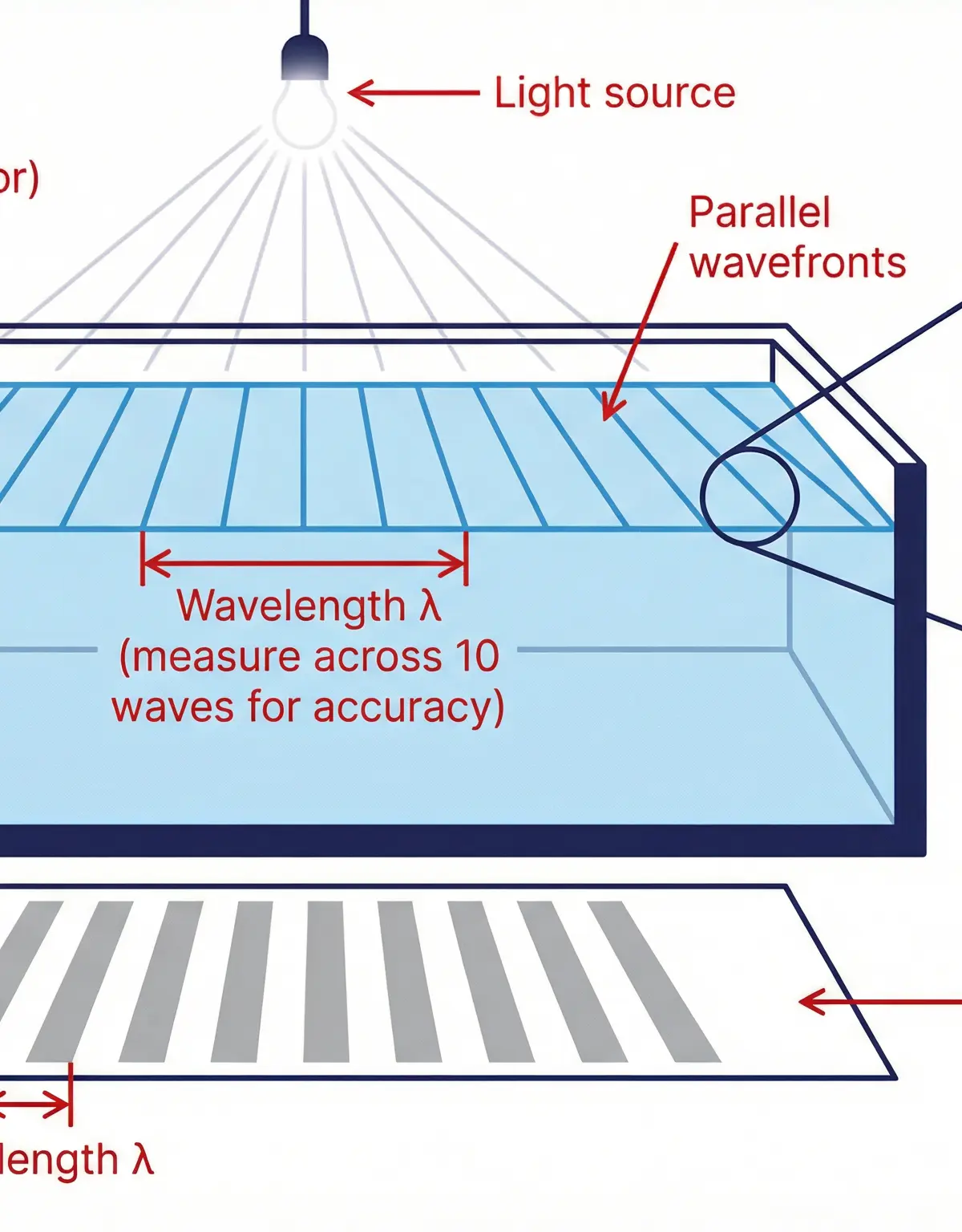
Why measure 10 wavelengths? Because the percentage uncertainty in your measurement is much smaller. If you measure one wavelength and you are 1 mm out, that is a large percentage error. If you measure 10 wavelengths and you are 1 mm out, the error in each individual wavelength is only 0.1 mm. Examiners will award a specific mark for this technique.
Method 2: Sound Waves in a Solid RodThis experiment uses the equation v = x/t.
Apparatus:
- Long metal rod (e.g., 1 m long)
- Hammer
- Two microphones connected to a high-speed digital timer or oscilloscope
Method:
- Place the two microphones a known, large distance apart along the metal rod. Measure this distance (x) with a metre ruler.
- Connect the microphones to the timer/oscilloscope. The first microphone starts the timer, and the second one stops it.
- Strike one end of the rod sharply with the hammer.
- The sound wave travels through the rod and is detected by each microphone in turn. The timer records the time taken (t) for the wave to travel the distance between the microphones.
- Calculate the wave speed using the formula v = x/t.
- Repeat the measurement several times and calculate a mean time to reduce the impact of random errors.
Graph and Data SkillsIn some exam questions, candidates may be asked to plot a graph of wave speed data or interpret an oscilloscope trace. Key skills include:
- Reading the time-base of an oscilloscope to determine the period (T) of a wave, then calculating f = 1/T.
- Plotting frequency (x-axis) against wave speed (y-axis) and recognising that for a given medium, wave speed is constant regardless of frequency.
- Identifying anomalous results and explaining why they should be excluded from the mean.
Visual Resources
3 diagrams and illustrations
Interactive Diagrams
2 interactive diagrams to visualise key concepts
Conceptual Flow Outline
Flowchart showing the decision-making process for choosing the correct wave speed equation.
Diagram could not be rendered
Sequence diagram illustrating the impact of the common mistake of not converting wavelength units from cm to m.
Worked Examples
3 worked examples — open one to explore the question and available guidance.
Practice Questions
Test your understanding — click to reveal model answers
State the two main equations used to calculate wave speed.
Hint: One involves frequency and the other involves distance.
A sound wave has a wavelength of 60 cm and a frequency of 550 Hz. Calculate the speed of the sound wave.
Hint: Remember to convert the wavelength to the standard unit for distance before you calculate.
During a thunderstorm, an observer sees a lightning flash and hears the thunder 4.5 seconds later. The speed of sound in air is 340 m/s. Calculate the distance from the observer to the lightning strike.
Hint: Which of the two speed equations should you use here? You are given time and speed.
Explain why measuring the length of 10 waves and dividing by 10 is a more accurate method for finding the wavelength than measuring just one wave.
Hint: Think about the effect of measurement errors.
Waves on the sea have a frequency of 0.25 Hz and a wavelength of 12 m. A boat is 3.0 km away from the shore. Calculate the time it will take for a wave to travel from the boat to the shore.
Hint: This is a multi-step problem. First find the speed, then use the speed to find the time. Watch your units!
Test your understanding of Wave Speed
Active recall beats re-reading. Take an instant quiz now to test what you’ve learned and lock it into long-term memory.
7 days Premium · Then free forever · No card, no charge