OCR · GCSE · Physics
Weight
This guide provides a comprehensive, exam-focused breakdown of Weight for OCR GCSE Physics (2.2). It clarifies the crucial difference between mass and weight, explains the W=mg relationship, and provides exam techniques to help you secure maximum marks on this fundamental topic.
- 5 min read
- 3 worked examples
- 5 practice questions
- 6 key terms
Study Notes

Overview
Weight is a fundamental concept in physics, representing the force of gravity on an object. For your OCR GCSE Physics exam, a precise understanding of weight, and how it differs from mass, is essential for securing high marks in the Forces topic (P2). Examiners frequently test the distinction between mass (a scalar measure of matter) and weight (a vector force), and your ability to apply the core equation W = m × g across different gravitational contexts is crucial. This topic is not just about calculation; it’s about clear, precise explanation. Expect questions that ask you to describe why an astronaut’s weight changes on the Moon, or to identify the centre of mass as the point where weight acts. Mastering this topic provides a solid foundation for understanding more complex force interactions later in the course.
Key Concepts
Concept 1: The Crucial Difference Between Mass and Weight
This is the single most important concept in this topic, and a frequent source of lost marks. Candidates must be able to distinguish clearly between these two quantities.
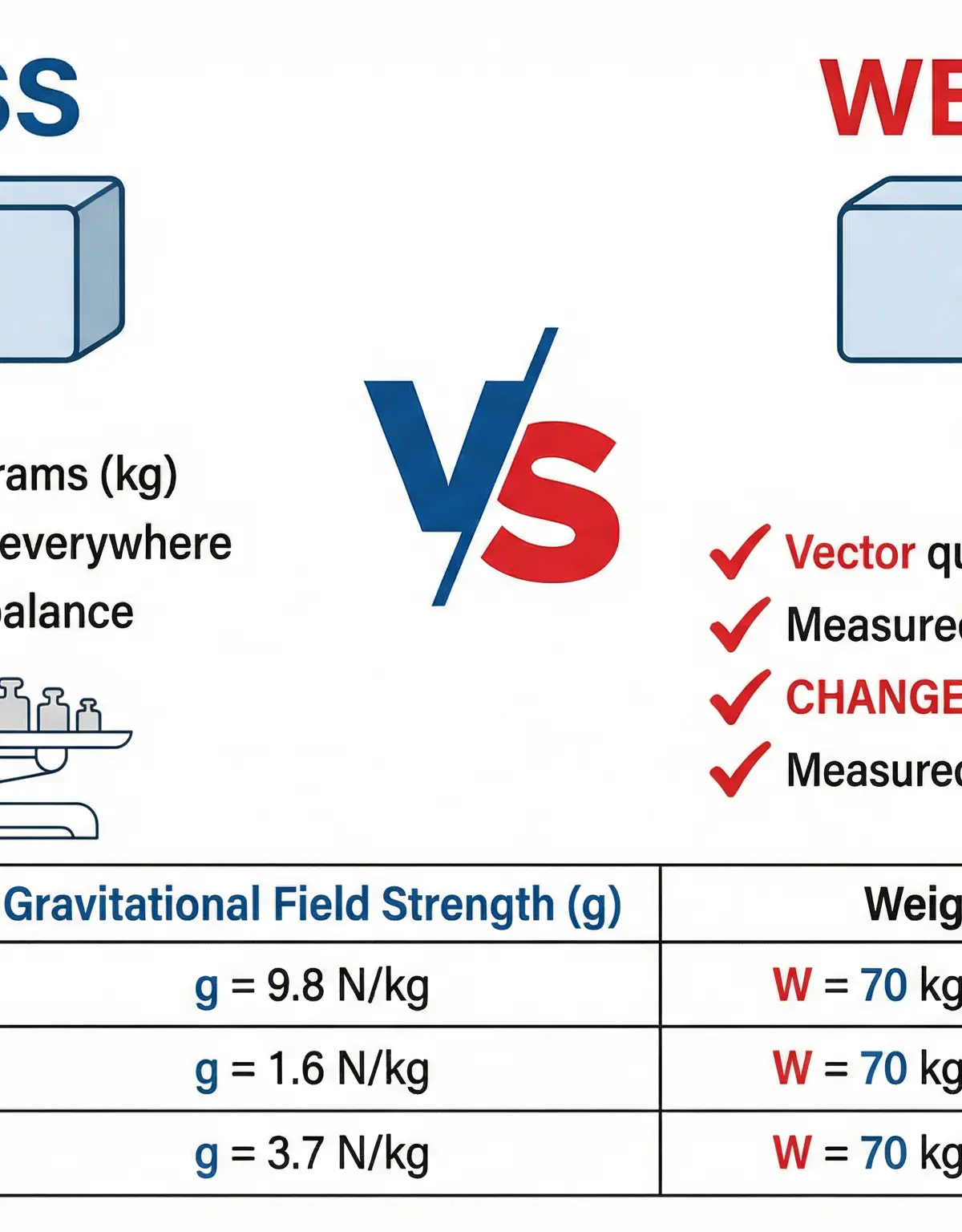
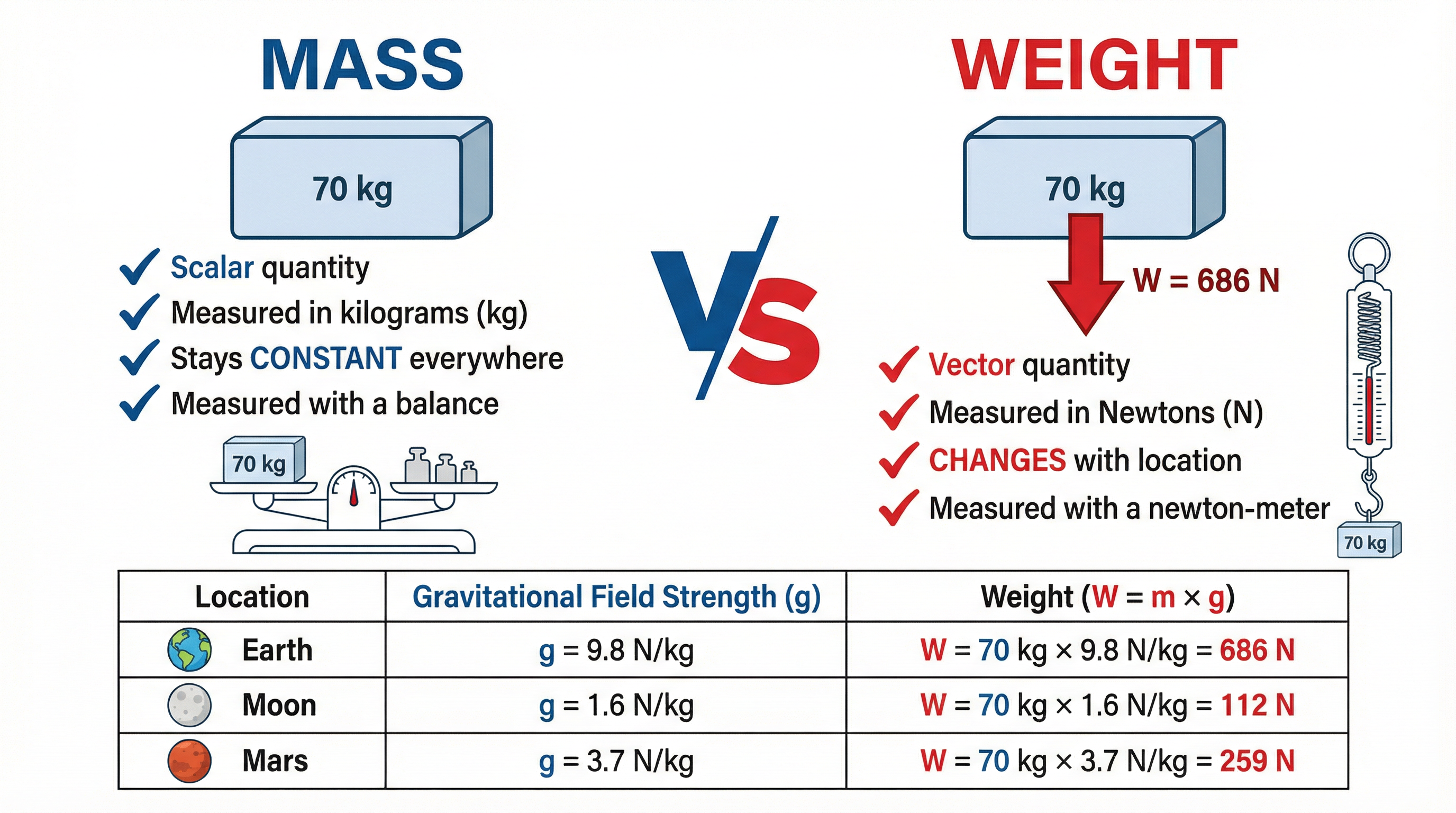
Mass is the measure of the amount of ‘stuff’ (or matter) in an object. It is a scalar quantity, meaning it only has a magnitude. The standard unit for mass is the kilogram (kg). Crucially, an object’s mass is constant and does not change, regardless of its location in the universe. An astronaut with a mass of 75 kg on Earth will have a mass of 75 kg on the Moon, on Mars, and in deep space.
Weight, on the other hand, is the force of gravity acting on an object’s mass. As it is a force, its unit is the Newton (N). Weight is a vector quantity, meaning it has both magnitude and direction. The direction is always vertically downwards, towards the centre of the gravitational field (e.g., the centre of the Earth). Unlike mass, an object’s weight can change significantly depending on the strength of the local gravitational field.
Concept 2: Gravitational Field Strength (g)
Every object with mass creates a gravitational field around it. Gravitational field strength, represented by the symbol ‘g’, is a measure of the force exerted per unit mass at a specific point in that field. Its unit is Newtons per kilogram (N/kg). You can think of ‘g’ as an indicator of how strong gravity is in a particular location. For GCSE purposes, you should know the approximate value for Earth:
-
g on Earth ≈ 9.8 N/kgExaminers will provide the value of ‘g’ for other celestial bodies in the question, such as:
-
g on the Moon ≈ 1.6 N/kg
-
g on Mars ≈ 3.7 N/kgBecause the Moon has a much smaller mass than the Earth, its gravitational field is weaker, hence the lower value of ‘g’. This is why an object’s weight is less on the Moon.
Concept 3: The Centre of Mass
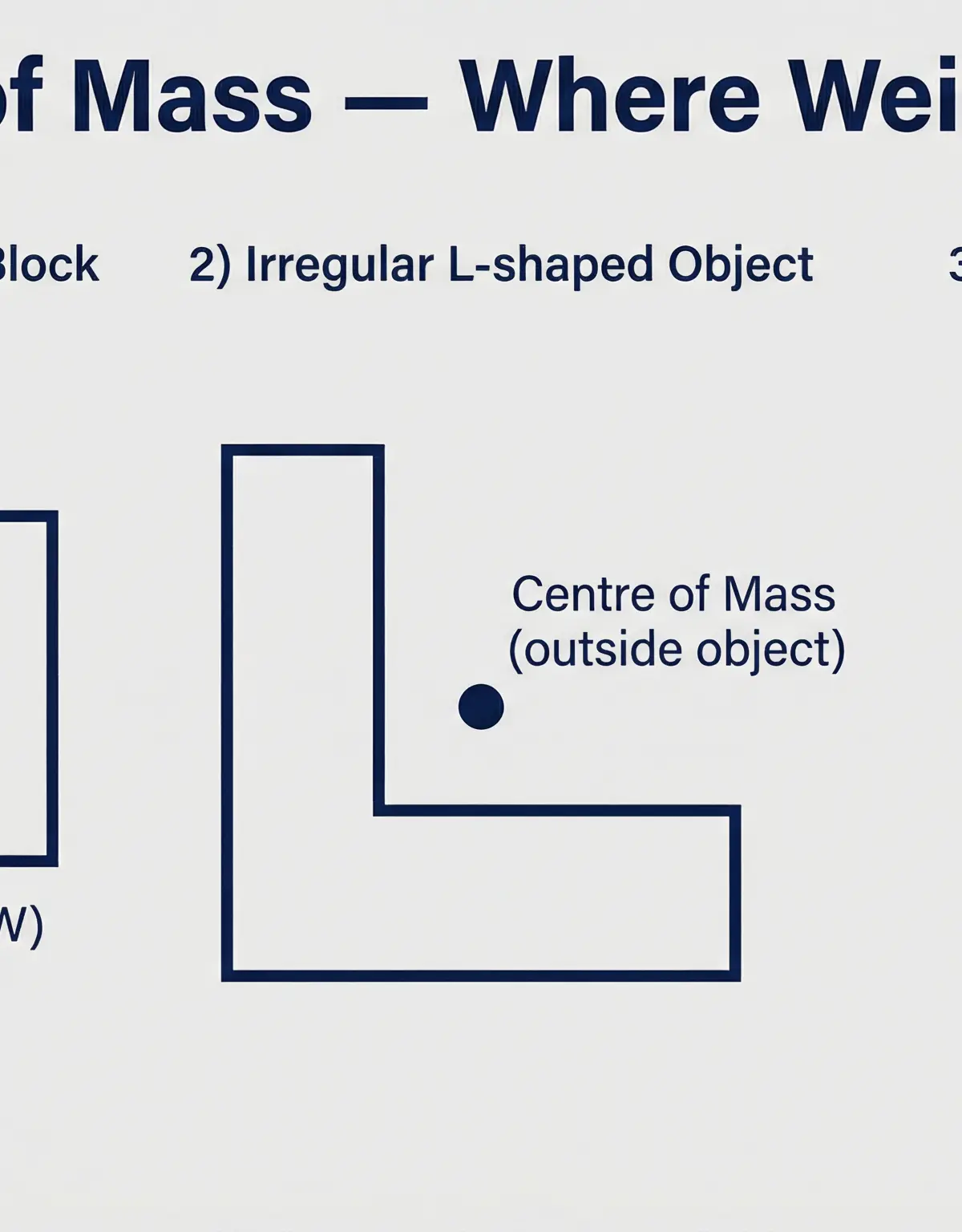
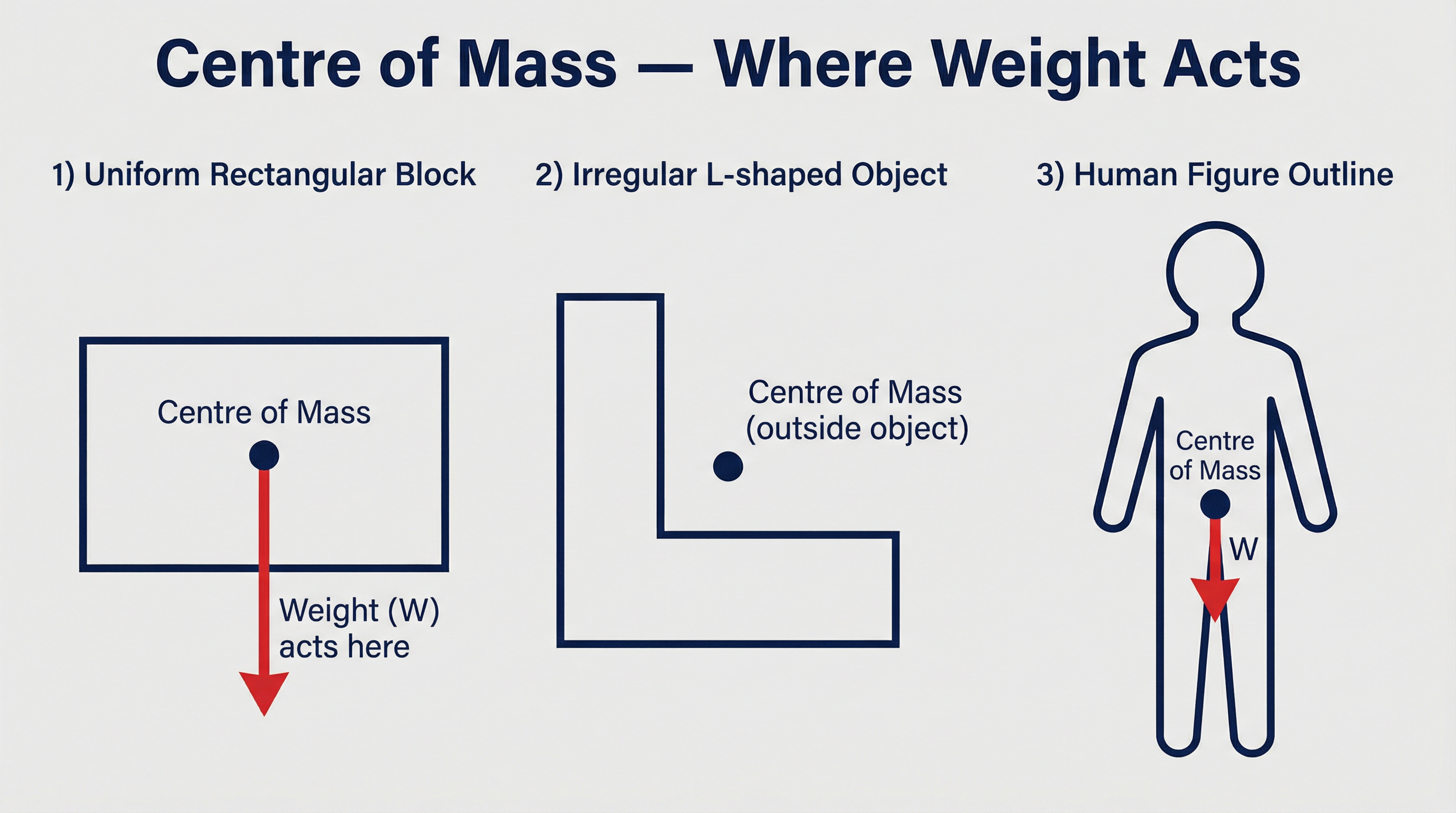
The weight of an object does not act from all parts of the object at once. For the purpose of physics calculations and diagrams, we consider the entire weight of an object to act from a single point: the centre of mass. This is the point at which the mass of the object may be thought of as being concentrated. For a uniform, symmetrical object (like a ruler or a solid sphere), the centre of mass is at its geometric centre. For an irregular object, the position of the centre of mass has to be found by experiment. It is important to note that for some objects, the centre of mass may even lie outside the physical body of the object itself.
Mathematical/Scientific Relationships
The core relationship you must memorise and be able to apply is the weight equation.
Weight = Mass × Gravitational Field Strength
W = m × g
- W: Weight, measured in Newtons (N). (Must memorise)
- m: Mass, measured in kilograms (kg). (Must memorise)
- g: Gravitational Field Strength, measured in Newtons per kilogram (N/kg). **(Given on formula sheet)**This formula can be rearranged to find mass (m = W/g) or gravitational field strength (g = W/m). Credit is often given for correctly rearranging the formula.
Unit Conversions
A very common exam trap is to provide mass in grams (g) instead of kilograms (kg). The formula W = m × g will only work if mass is in kg. You must be vigilant and convert units before substituting.
- To convert grams (g) to kilograms (kg), you must divide by 1000.
Example: A rock has a mass of 500 g. What is its mass in kg?
- 500 g / 1000 = 0.5 kg. This is the value you would use in the weight equation.
Visual Resources
2 diagrams and illustrations
Interactive Diagrams
2 interactive diagrams to visualise key concepts
Conceptual Flow Outline
A flowchart showing the critical step of checking and converting units before calculating weight.
Conceptual Flow Outline
A concept map illustrating that an object’s mass remains constant between the Earth and Moon, while its weight changes significantly.
Worked Examples
3 worked examples — open one to explore the question and available guidance.
Practice Questions
Test your understanding — click to reveal model answers
State the standard units for mass and weight.
Hint: One is a measure of matter, the other is a force.
A rover on Mars has a mass of 180 kg. The gravitational field strength on Mars is 3.7 N/kg. Calculate the weight of the rover.
Hint: Use the standard formula. The mass is already in the correct unit.
Explain why a 1 kg bag of feathers has the same mass as a 1 kg bag of steel, but a different volume.
Hint: This question links mass to the concept of density.
An object has a weight of 78.4 N on Earth (g = 9.8 N/kg). What would be its weight on a planet where the gravitational field strength is three times that of Earth?
Hint: This is a proportional reasoning question. You can solve it in two steps, or by using ratios.
Describe an experiment to find the centre of mass of an irregular plane lamina (a flat, irregular shape).
Hint: Think about using a pin, a plumb line, and a pencil.
Test your understanding of Weight
Active recall beats re-reading. Take an instant quiz now to test what you’ve learned and lock it into long-term memory.
7 days Premium · Then free forever · No card, no charge