OCR · GCSE · Physics
Wind Power
Master OCR GCSE Physics Topic 5.10: Wind Power. This guide breaks down the essential energy transfers, calculations, and evaluation skills you need to secure top marks, showing you exactly how to think like an examiner."
- 6 min read
- 3 worked examples
- 5 practice questions
Study Notes
Overview
Wind Power is a critical component of the OCR GCSE Physics specification (P5.10), falling under the broader theme of Energy Resources. Examiners favour this topic as it perfectly blends pure physics principles, such as energy transfers and power calculations, with the crucial skill of evaluating real-world technologies. You will be expected to not only describe how a wind turbine generates electricity but also to critically assess its role in the UK’s energy mix. Typical exam questions range from short-answer definitions to long-form 6-mark evaluations comparing wind to fossil or nuclear power stations. Mastering the arguments for and against wind power, and the specific language examiners look for, is the key to success.
Key Concepts
1. The Energy Transfer Chain
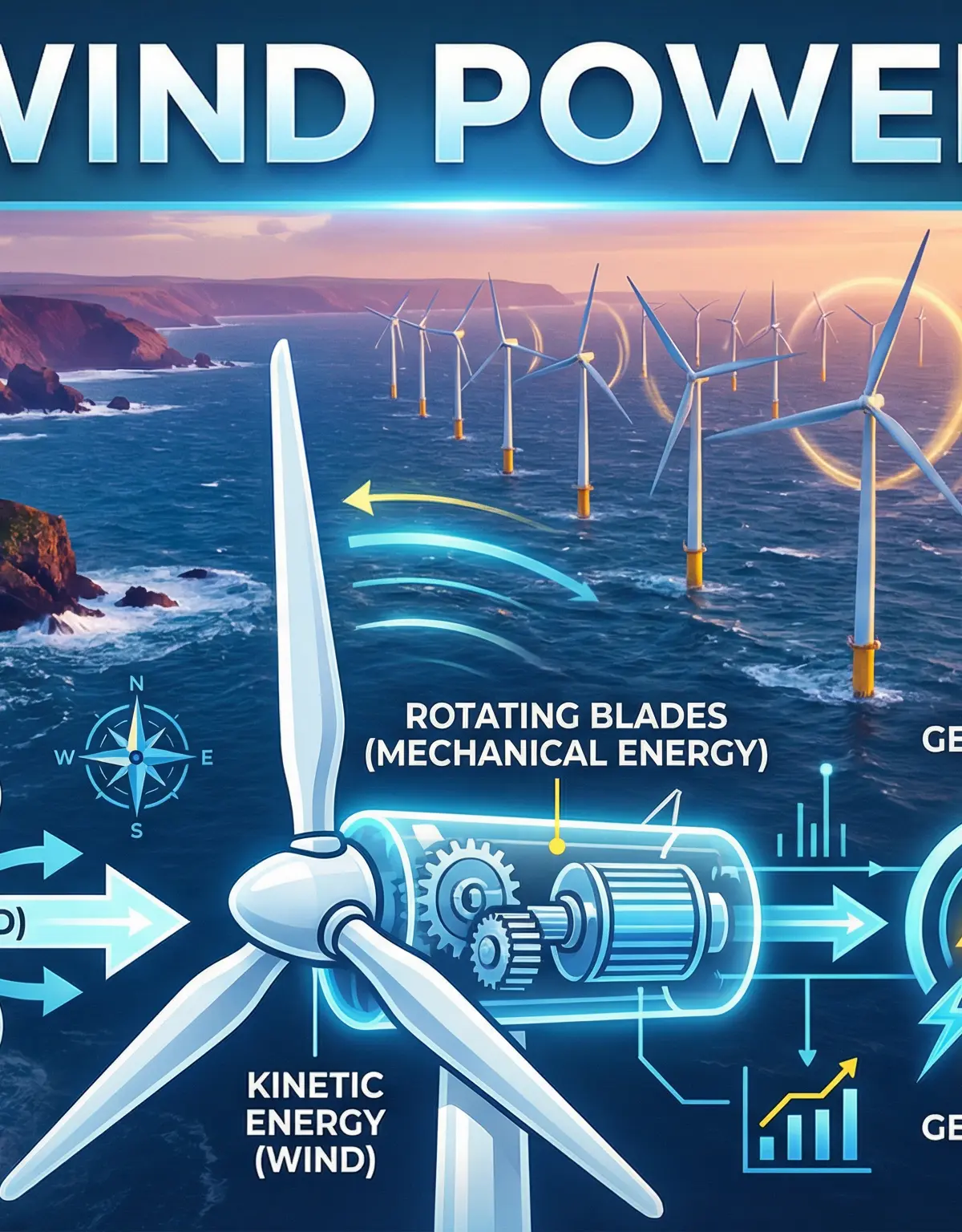
This is the absolute foundation of the topic. You must be able to state, in order, the useful energy transfers that occur to generate electricity from wind. The core principle is the conversion of the kinetic energy of moving air into electrical energy via a generator.
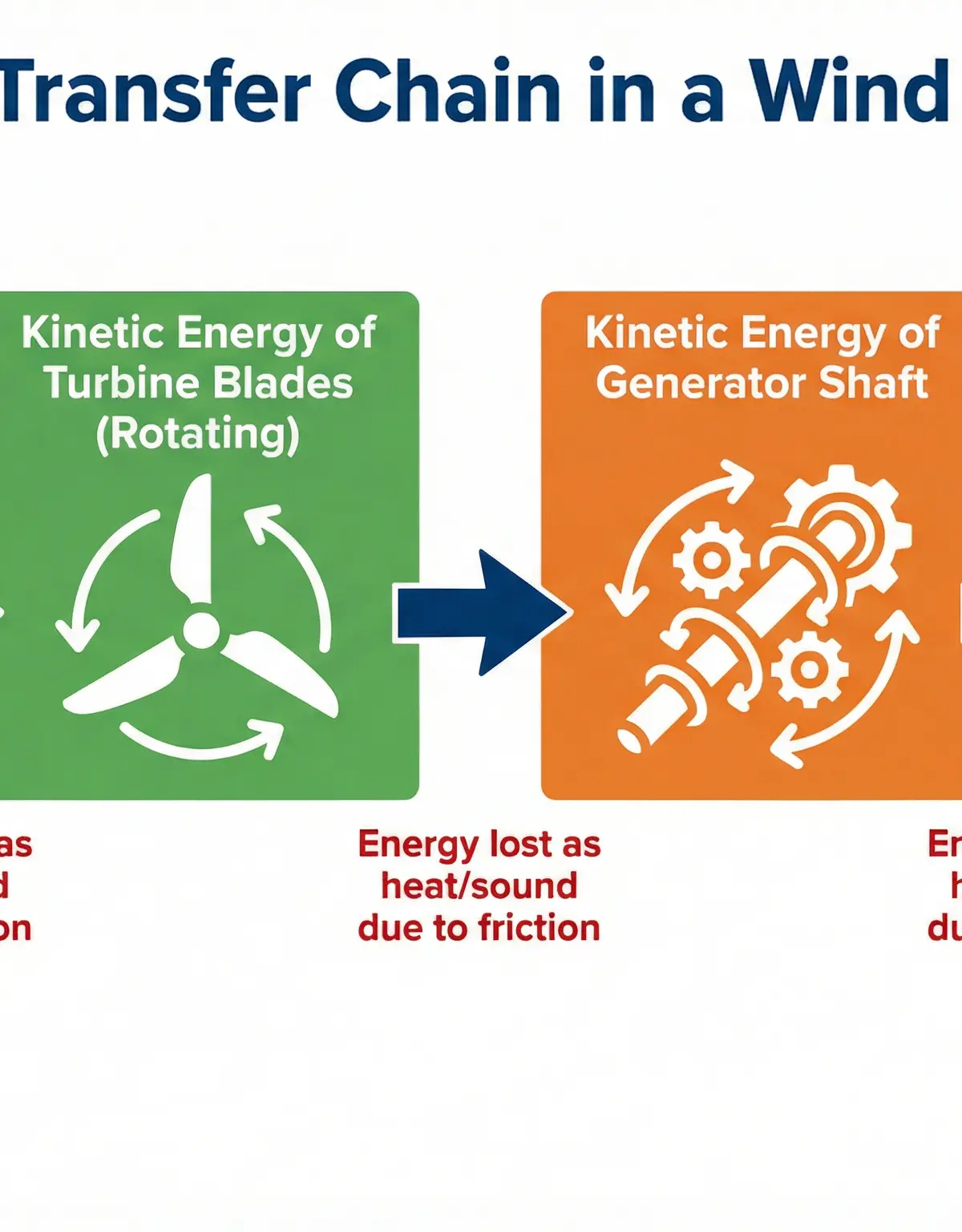
- Stage 1: Kinetic Energy of Wind: The process starts with air in motion. The wind possesses kinetic energy because its particles have mass and velocity.
- Stage 2: Kinetic Energy of Turbine Blades: As the wind pushes against the aerofoil-shaped blades, it exerts a force, causing them to rotate. The kinetic energy is transferred from the wind to the blades.
- Stage 3: Kinetic Energy of the Generator: The rotating blades are connected to a shaft, which spins a generator. This is the crucial step where mechanical rotation is used to induce an electric current.
- Stage 4: Electrical Energy: Inside the generator, the principle of electromagnetic induction converts the kinetic energy of rotation into electrical energy, which can then be stepped up in voltage and transmitted to the National Grid.
At each stage, some energy is wasted, primarily as heat and sound due to friction in the moving parts. This is why no turbine can be 100% efficient.
2. Reliability and Intermittency
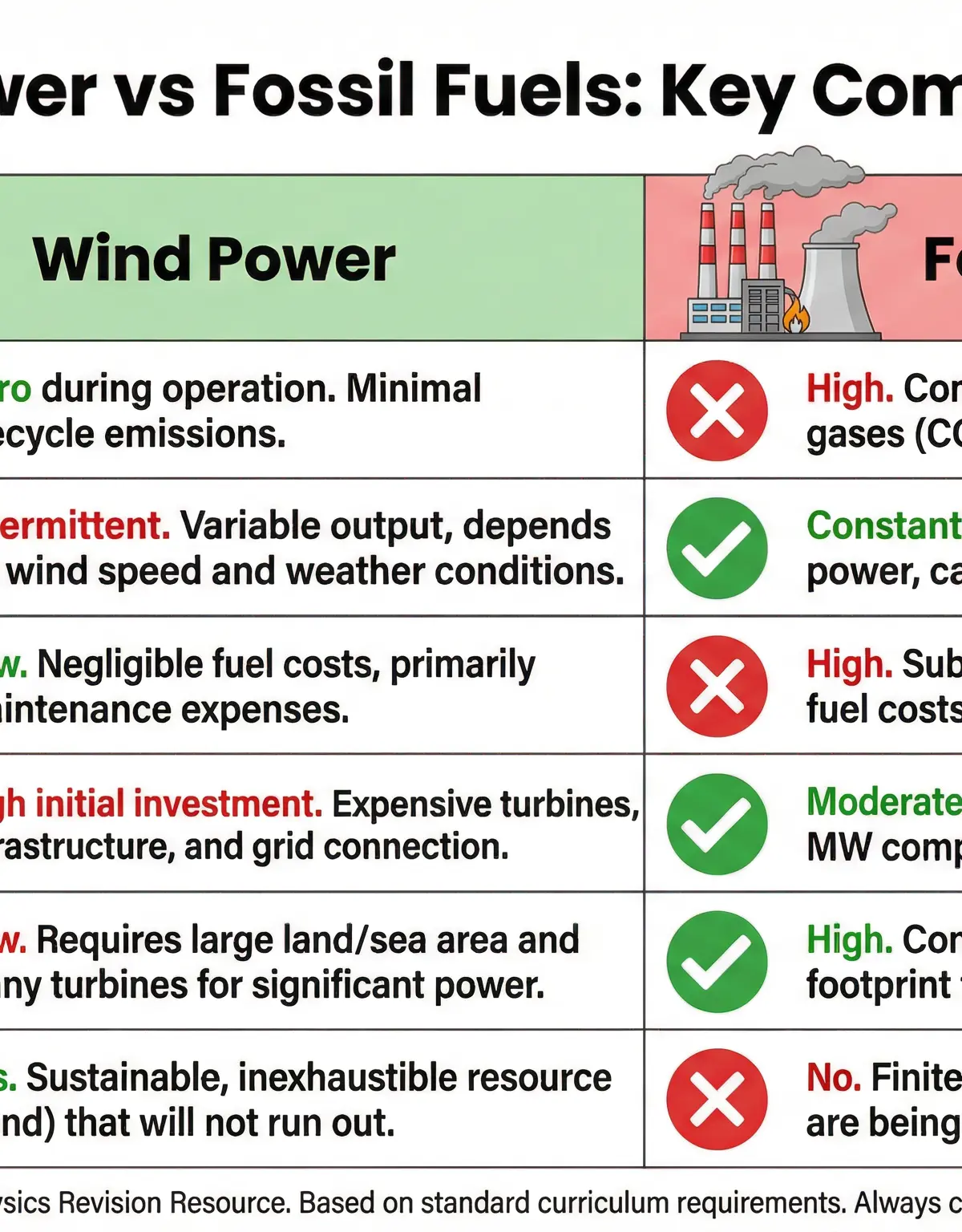
This is the single most important concept for evaluation questions. Wind power is an intermittent energy resource. This means its output is variable and cannot be guaranteed to match demand.
- Why it's unreliable: Wind speed fluctuates constantly. If the wind is too weak, the blades won't turn. If it's too strong (during a storm), the turbines are shut down to prevent damage. This means wind cannot be relied upon to provide a constant, steady supply of electricity.
- Base Load vs. Peak Load: Power stations are categorised by their role. Base-load stations (like nuclear or large coal plants) run continuously to meet the minimum level of national electricity demand. Wind cannot fulfil this role. It is used to supplement the grid when conditions are favourable, reducing the need for other power stations.
- The Need for Backup: Because of intermittency, a country relying heavily on wind power must have backup power stations ready to start up quickly when wind output drops. These are often gas-fired power stations, which can be turned on and off much faster than nuclear or coal plants.
3. Environmental Impact & Social Factors
Examiners expect a balanced view. You must distinguish between different types of pollution.
- Atmospheric Pollution: During operation, wind turbines produce zero carbon dioxide (CO2) or other greenhouse gases like sulfur dioxide (SO2). This is their primary environmental advantage over fossil fuels. You MUST use the phrase 'during operation' to earn the mark, as manufacturing and installation do have a carbon footprint.
- Visual Pollution: Many people consider large wind farms to be an eyesore, spoiling natural landscapes. This is a subjective argument but is credited in exams.
- Noise Pollution: The rotating blades create a low-frequency 'whooshing' sound. While modern designs are quieter, this can be a nuisance for residents living close to onshore wind farms.
- Habitat Disruption: The construction of wind farms, particularly offshore, can disrupt ecosystems. There are also concerns about bird and bat mortality from collisions with rotating blades.
Mathematical/Scientific Relationships
Power, Energy, and Time (Must Memorise)
This is a fundamental equation in physics.
[ P = \frac{E}{t} ]
- P = Power (in Watts, W, or Kilowatts, kW)
- E = Energy transferred (in Joules, J, or Kilojoules, kJ)
- t = time (in seconds, s)
Examiner Tip: A common mistake is failing to convert time from hours or minutes into seconds. 1 hour = 3600 seconds.
Efficiency (Must Memorise)
Efficiency measures how good a device is at converting input energy into useful output energy.
[ ext{Efficiency} = \frac{ ext{Useful Power Output}}{ ext{Total Power Input}} imes 100% ]
Or, in terms of energy:
[ ext{Efficiency} = \frac{ ext{Useful Energy Output}}{ ext{Total Energy Input}} imes 100% ]
- For a wind turbine, the 'Useful Output' is the electrical energy generated. The 'Total Input' is the kinetic energy of the wind hitting the blades.
- No device is 100% efficient; energy is always lost to the surroundings (e.g., as heat or sound).
Practical Applications
- Onshore Wind Farms: Sited on hills and open plains to take advantage of higher wind speeds. They are cheaper to build and maintain than offshore farms.
- Offshore Wind Farms: Built in the sea, where winds are generally stronger and more consistent. They have less visual and noise impact on residents but are significantly more expensive to construct and service.
- National Grid: Wind power is fed into the National Grid, a network of cables and transformers that distributes electricity across the country. The variable nature of wind power presents a challenge for grid balancing, requiring grid operators to have other power sources ready to compensate for changes in wind output."
Worked Examples
3 worked examples — open one to explore the question and available guidance.
Practice Questions
Test your understanding — click to reveal model answers
State two environmental problems caused by wind farms, other than the emission of greenhouse gases.
Hint: Think about the impact on the landscape and local wildlife.
A wind turbine has an efficiency of 40%. The total kinetic energy of the wind hitting the blades in one minute is 300 MJ. Calculate the useful electrical energy output in this minute.
Hint: Use the efficiency formula. Remember to convert the efficiency percentage to a decimal for calculation.
Explain why a wind farm with a total maximum power output of 500 MW cannot be considered a direct replacement for a 500 MW gas-fired power station.
Hint: Focus on the difference in reliability and the role each type of power station plays in the grid.
Describe the advantages of locating a wind farm offshore rather than onshore.
Hint: Consider wind speed and public opinion.
A single wind turbine produces 45,000 kJ of energy in 30 seconds. Calculate its power output in kW.
Hint: Use P=E/t and then convert your final answer from W to kW.
Test your understanding of Wind Power
Active recall beats re-reading. Take an instant quiz now to test what you’ve learned and lock it into long-term memory.
7 days Premium · Then free forever · No card, no charge