AQA · A-Level · Psychology
Course version: 7182-2025 · Exams from 2027
Explanations for gambling addiction: learning theory as applied to…
Full specification wording
Addiction: Explanations for gambling addiction: learning theory as applied to gambling, including reference to partial and variable reinforcement; cognitive theory as applied to gambling, including reference to cognitive bias.
Gambling is the awkward case for learning theory: gamblers lose far more often than they win, yet the behaviour is unusually hard to extinguish.
Checked against the AQA 7182-2025 specification (opens in a new tab) on .
- Point 4 of 6
- 4 key terms
Study notes
From the checked teaching notes for this specification point.
The idea
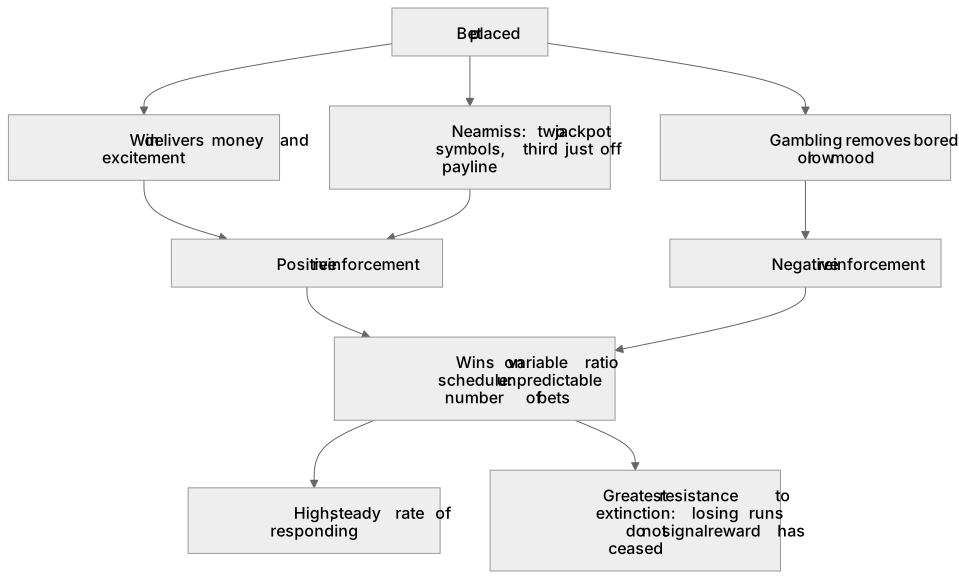
Gambling is the awkward case for learning theory: gamblers lose far more often than they win, yet the behaviour is unusually hard to extinguish. The answer is the reinforcement schedule. Wins arrive on a variable ratio schedule, unpredictably after a varying number of bets, and Skinner showed that this schedule produces high, steady responding and the greatest resistance to extinction of all, because no run of losses tells the gambler the reward has stopped coming. Near misses reinforce too, being processed almost like wins. Cognitive theory explains the beliefs that keep the schedule working: the gambler’s fallacy that a loss makes a win due, an illusion of control from choosing numbers, and a recall bias that remembers wins vividly and losses barely. Griffiths (1994) had 60 fruit-machine players think aloud; regular gamblers produced far more irrational verbalisations.
What earns the marks
- Operant conditioning: a win delivers money and excitement immediately after the bet, positively reinforcing gambling; for some, gambling also removes boredom or low mood, negatively reinforcing it.
- Partial reinforcement: only some responses are rewarded, and partially reinforced behaviour is far more resistant to extinction than continuously reinforced behaviour.
- Near misses: two jackpot symbols and a third just off the payline are processed as near-wins and reinforce continued play despite being losses.
- Cognitive bias, gambler’s fallacy: believing independent events are linked, so a run of losses means a win is "due".
- Cognitive bias, illusion of control: believing skill, ritual or choosing one’s own numbers influences a chance outcome.
- Cognitive bias, recall and attributional bias: wins are remembered and attributed to skill, losses are minimised, forgotten or blamed on bad luck, so experience never corrects the belief.
Common mistakes and how to put them right
Describing partial reinforcement as "sometimes being rewarded" without saying why that matters.
Put it right: The creditworthy point is resistance to extinction, so a losing streak does not stop the behaviour.
Confusing variable ratio with variable interval.
Put it right: Gambling pays after an unpredictable number of bets, not after an unpredictable amount of time.
Explaining the gambler’s fallacy backwards, saying a winner expects to keep winning.
Put it right: The fallacy is that past losses make a future win more likely when the events are independent.
Presenting Griffiths (1994) as showing regular gamblers are more skilful.
Put it right: Objectively the two groups performed similarly; the difference was in how they talked about the machine.
Treating think-aloud verbalisations as proven beliefs, when they may be commentary produced for the researcher rather than the thinking that drives play.
Exam tips
- Use the word "unpredictable" explicitly when explaining variable reinforcement; examiners look for it as the feature that resists extinction.
- A scenario naming someone who "feels a win is due" or "picks their own numbers" is handing you the gambler’s fallacy and the illusion of control. Name the bias, then apply it to that person’s detail.
- If asked to compare the two explanations, make the point that they operate at different levels, the schedule maintaining the behaviour and the biases maintaining the belief, rather than declaring one simply better.
Try the lesson
The start of the Addiction: Explanations for gambling addiction: learning theory as applied to gambling, including reference to partial and variable reinforcement; cognitive theory as applied to gambling, including reference to cognitive bias. lesson, made from checked teaching notes for this specification point.
Have a go first
According to learning theory, which schedule of reinforcement best explains why gambling behaviours, such as playing slot machines, are highly resistant to extinction?
Listen
Gambling is the awkward case for learning theory: gamblers lose far more often than they win, yet the behaviour is unusually hard to extinguish. The answer is the reinforcement schedule. Wins arrive on a variable ratio schedule, unpredictably after a varying number of bets, and Skinner showed that this schedule produces high, steady responding and the greatest resistance to extinction of all, because no run of losses tells the gambler the reward has stopped coming. Near misses reinforce too, being processed almost like wins. Cognitive theory explains the beliefs that keep the schedule working: the gambler’s fallacy that a loss makes a win due, an illusion of control from choosing numbers, and a recall bias that remembers wins vividly and losses barely. Griffiths (1994) had 60 fruit-machine players think aloud; regular gamblers produced far more irrational verbalisations. A strong answer earns marks for these points. Operant conditioning: a win delivers money and excitement immediately after the bet, positively reinforcing gambling; for some, gambling also removes boredom or low mood, negatively reinforcing it. Partial reinforcement: only some responses are rewarded, and partially reinforced behaviour is far more resistant to extinction than continuously reinforced behaviour. Variable reinforcement specifically: wins come after an unpredictable number of bets (variable ratio), which produces a high, steady rate of responding and the strongest resistance to extinction, so losing runs do not signal that reward has ceased. Near misses: two jackpot symbols and a third just off the payline are processed as near-wins and reinforce continued play despite being losses. Exam tip: Use the word "unpredictable" explicitly when explaining variable reinforcement; examiners look for it as the feature that resists extinction.
See it
Key words
Say what each word means before you turn the card.
Variable ratio
Try answering aloud or in your head before turning the card.
Near misses
Try answering aloud or in your head before turning the card.
Gambler’s fallacy
Try answering aloud or in your head before turning the card.
Illusion of control
Try answering aloud or in your head before turning the card.
See every definition
- Variable ratio
- Wins come after an unpredictable number of bets, which produces a high, steady rate of responding and the strongest resistance to extinction.
- Near misses
- Two jackpot symbols and a third just off the payline are processed as near-wins and reinforce continued play despite being losses.
- Gambler’s fallacy
- Believing independent events are linked, so a run of losses means a win is due.
- Illusion of control
- Believing skill, ritual or choosing one’s own numbers influences a chance outcome.
Label the diagram
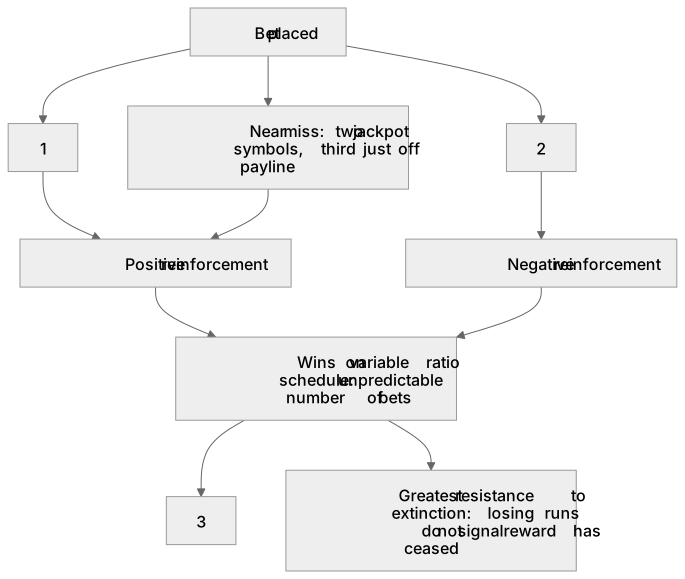
Some boxes have lost their names. Pick the right name for each number.
1Box 1
2Box 2
3Box 3
There is more to this lesson
The full lesson goes on to check your understanding and help you earn the marks. Create a free account to carry on, with your progress saved.
A week of Premium from your first lesson · Then the free plan continues · No card, no charge
Test your understanding of Addiction: Explanations for gambling addiction: learning theory as applied to gambling, including reference to partial and variable reinforcement; cognitive theory as applied to gambling, including reference to cognitive bias.
Active recall beats re-reading. Take an instant quiz now to test what you’ve learned and lock it into long-term memory.
A week of Premium from your first lesson · Then the free plan continues · No card, no charge