AQA · A-Level · Psychology
Course version: 7182-2025 · Exams from 2027
Reducing addiction: drug therapy; behavioural interventions, including…
Full specification wording
Addiction: Reducing addiction: drug therapy; behavioural interventions, including aversion therapy and covert sensitisation; cognitive behaviour therapy.
Three routes, each attacking a different part of the problem.
Checked against the AQA 7182-2025 specification (opens in a new tab) on .
- Point 5 of 6
- 4 key terms
Study notes
From the checked teaching notes for this specification point.
The idea
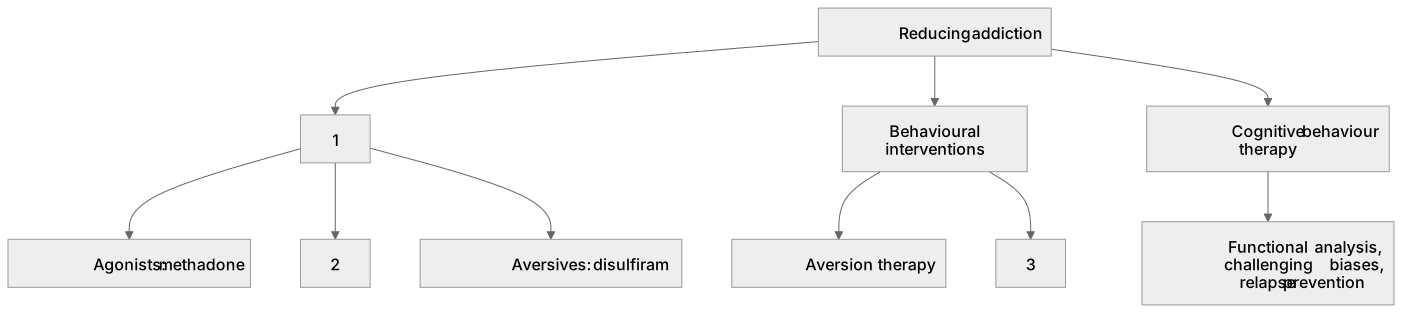
Three routes, each attacking a different part of the problem. Drugs work on the chemistry: agonists such as methadone occupy the same receptors as heroin more slowly and safely, antagonists such as naltrexone block the receptors so a relapse produces no high, and aversives such as disulfiram stop alcohol being fully broken down, so drinking brings nausea and vomiting. Aversion therapy is classical conditioning, pairing the substance with a genuinely unpleasant experience until it provokes disgust on its own. Covert sensitisation does the same in imagination, the client rehearsing a vivid scene of vomiting over themselves, which avoids the ethical objections to an emetic or a shock. Cognitive behaviour therapy targets the beliefs, challenging the gambler’s biases and rehearsing relapse prevention: Petry et al. (2006) found eight CBT sessions beat Gamblers Anonymous referral alone.
What earns the marks
- Drug therapy, agonists: methadone substitutes for heroin at the same receptor sites, satisfying the craving with a controlled dose that allows stabilisation and gradual reduction.
- Drug therapy, antagonists: naltrexone blocks opioid receptors so the drug produces no reward, breaking the reinforcement link.
- Drug therapy, aversives: disulfiram prevents the full breakdown of alcohol, so drinking causes an immediate build-up of acetaldehyde and severe nausea, flushing and vomiting.
- Nicotine replacement therapy delivers nicotine without the tar and the smoking ritual, reducing withdrawal while the behavioural habit is tackled separately.
- Covert sensitisation: the same pairing carried out in imagination, the therapist guiding a vivid aversive scene, so no drug or shock is administered and dropout and ethical objections are reduced.
- Cognitive behaviour therapy: functional analysis of triggers, challenging cognitive biases such as the illusion of control, plus skills training and relapse prevention planning.
- Evidence: Petry et al. (2006) randomised 231 pathological gamblers and found those given eight sessions of CBT alongside Gamblers Anonymous referral showed significantly better outcomes than referral alone.
Common mistakes and how to put them right
Confusing agonists with antagonists.
Put it right: An agonist activates the receptor as a substitute (methadone); an antagonist blocks it so use brings no reward (naltrexone).
Describing covert sensitisation as a mild form of aversion therapy.
Put it right: The difference is that the aversive experience is imagined rather than actually experienced, which is the whole point of it.
Calling disulfiram a punishment.
Put it right: It works as classical conditioning, pairing alcohol with an unconditioned nausea response, and the term matters when the question asks for the mechanism.
Evaluating all three therapies with one generic line about side effects.
Put it right: Each has its own weakness: relapse after withdrawal of the drug, poor durability for aversion, and dropout for CBT.
Exam tips
- If the question asks about one named therapy, resist writing about the other two; only the named one earns AO1, and the rest is wasted time.
- In an applied question, prescribe for the person in the stem. A gambler with strong cognitive distortions points to CBT; someone in acute opioid withdrawal points to methadone, and saying why that fits is the AO2.
- Ethics is a genuine AO3 line for aversion therapy, but make it specific: informed consent and protection from harm when an emetic or shock is used, and note that covert sensitisation was designed to answer exactly that.
Try the lesson
The start of the Addiction: Reducing addiction: drug therapy; behavioural interventions, including aversion therapy and covert sensitisation; cognitive behaviour therapy. lesson, made from checked teaching notes for this specification point.
Have a go first
Which of the following best describes the process of covert sensitisation as a behavioural intervention for addiction?
Listen
Three routes, each attacking a different part of the problem. Drugs work on the chemistry: agonists such as methadone occupy the same receptors as heroin more slowly and safely, antagonists such as naltrexone block the receptors so a relapse produces no high, and aversives such as disulfiram stop alcohol being fully broken down, so drinking brings nausea and vomiting. Aversion therapy is classical conditioning, pairing the substance with a genuinely unpleasant experience until it provokes disgust on its own. Covert sensitisation does the same in imagination, the client rehearsing a vivid scene of vomiting over themselves, which avoids the ethical objections to an emetic or a shock. Cognitive behaviour therapy targets the beliefs, challenging the gambler’s biases and rehearsing relapse prevention: Petry et al. (2006) found eight CBT sessions beat Gamblers Anonymous referral alone. A strong answer earns marks for these points. Drug therapy, agonists: methadone substitutes for heroin at the same receptor sites, satisfying the craving with a controlled dose that allows stabilisation and gradual reduction. Drug therapy, antagonists: naltrexone blocks opioid receptors so the drug produces no reward, breaking the reinforcement link. Drug therapy, aversives: disulfiram prevents the full breakdown of alcohol, so drinking causes an immediate build-up of acetaldehyde and severe nausea, flushing and vomiting. Nicotine replacement therapy delivers nicotine without the tar and the smoking ritual, reducing withdrawal while the behavioural habit is tackled separately. Exam tip: If the question asks about one named therapy, resist writing about the other two; only the named one earns AO1, and the rest is wasted time.
See it

Key words
Say what each word means before you turn the card.
Agonists
Try answering aloud or in your head before turning the card.
Antagonists
Try answering aloud or in your head before turning the card.
Aversives
Try answering aloud or in your head before turning the card.
Covert sensitisation
Try answering aloud or in your head before turning the card.
See every definition
- Agonists
- Drugs such as methadone that occupy the same receptors as heroin more slowly and safely, satisfying the craving with a controlled dose.
- Antagonists
- Drugs such as naltrexone that block the receptors so a relapse produces no high, breaking the reinforcement link.
- Aversives
- Drugs such as disulfiram that stop alcohol being fully broken down, so drinking brings nausea and vomiting.
- Covert sensitisation
- The same pairing carried out in imagination, the therapist guiding a vivid aversive scene, so no drug or shock is administered.
Label the diagram
Some boxes have lost their names. Pick the right name for each number.
1Box 1
2Box 2
3Box 3
There is more to this lesson
The full lesson goes on to check your understanding and help you earn the marks. Create a free account to carry on, with your progress saved.
A week of Premium from your first lesson · Then the free plan continues · No card, no charge
Test your understanding of Addiction: Reducing addiction: drug therapy; behavioural interventions, including aversion therapy and covert sensitisation; cognitive behaviour therapy.
Active recall beats re-reading. Take an instant quiz now to test what you’ve learned and lock it into long-term memory.
A week of Premium from your first lesson · Then the free plan continues · No card, no charge