AQA · A-Level · Psychology
Course version: 7182-2025 · Exams from 2027
The application of Prochaska’s six-stage model of behaviour change.
Full specification wording
Addiction: The application of Prochaska’s six-stage model of behaviour change.
Prochaska’s six-stage model explains how individuals overcome addiction through a cyclical process.
Checked against the AQA 7182-2025 specification (opens in a new tab) on .
- Point 6 of 6
Study notes
From the checked teaching notes for this specification point.
The idea
Prochaska’s six-stage model explains how individuals overcome addiction through a cyclical process. The stages are pre-contemplation (no intention to change), contemplation (aware of the problem but uncommitted), preparation (intending to act soon), action (modifying behaviour), maintenance (preventing relapse), and termination (zero temptation). Application involves tailoring interventions to the client's current stage. For example, a smoker in pre-contemplation benefits from education about health risks, whereas someone in the action stage requires behavioural strategies like avoiding triggers. This stage-matched approach increases the effectiveness of addiction treatments by providing targeted, timely support.
What earns the marks
- Identify and define the six stages: pre-contemplation, contemplation, preparation, action, maintenance, and termination.
- Explain that the model is dynamic and cyclical, acknowledging that individuals may move back and forth between stages due to relapse.
- Apply the model to a novel scenario by matching specific therapeutic interventions to the individual's current stage of change.
- Evaluate the model's usefulness, such as its practical application in creating stage-matched interventions that improve treatment outcomes.
- Discuss limitations, such as the arbitrary division between stages or the difficulty in accurately assessing which stage a client is currently in.
Common mistakes and how to put them right
Confusing the contemplation and preparation stages.
Put it right: Ensure contemplation is described as thinking about change without commitment, while preparation involves actively planning to take action within the next month.
Treating the model as a strictly linear process.
Put it right: Describe the model as cyclical, explicitly stating that individuals often relapse and return to earlier stages before achieving termination.
Omitting the termination stage because it is rarely achieved.
Put it right: Include termination as the final stage of the six-stage model, even if noting that many people remain in maintenance permanently.
Exam tips
- When given a stem, look for temporal clues (such as 'planning to quit next week' or 'has been clean for two months') to accurately identify the person's current stage.
- Use the concept of 'stage-matched interventions' to explain why a specific treatment might fail if applied at the wrong time.
- Remember to evaluate the model's cultural validity, noting that its focus on individual decision-making may not apply as effectively in collectivist cultures.
Try the lesson
The start of the Addiction: The application of Prochaska’s six-stage model of behaviour change. lesson, made from checked teaching notes for this specification point.
Have a go first
A smoker acknowledges that their habit is harming their health and intends to quit within the next six months, but they have not yet made any specific plans to do so. According to Prochaska’s six-stage model of behaviour change, which stage is this person currently in?
Listen
Prochaska’s six-stage model explains how individuals overcome addiction through a cyclical process. The stages are pre-contemplation (no intention to change), contemplation (aware of the problem but uncommitted), preparation (intending to act soon), action (modifying behaviour), maintenance (preventing relapse), and termination (zero temptation). Application involves tailoring interventions to the client's current stage. For example, a smoker in pre-contemplation benefits from education about health risks, whereas someone in the action stage requires behavioural strategies like avoiding triggers. This stage-matched approach increases the effectiveness of addiction treatments by providing targeted, timely support. A strong answer earns marks for these points. Identify and define the six stages: pre-contemplation, contemplation, preparation, action, maintenance, and termination. Explain that the model is dynamic and cyclical, acknowledging that individuals may move back and forth between stages due to relapse. Apply the model to a novel scenario by matching specific therapeutic interventions to the individual's current stage of change. Evaluate the model's usefulness, such as its practical application in creating stage-matched interventions that improve treatment outcomes. A common slip: Confusing the contemplation and preparation stages. Instead, Ensure contemplation is described as thinking about change without commitment, while preparation involves actively planning to take action within the next month. Exam tip: When given a stem, look for temporal clues (such as 'planning to quit next week' or 'has been clean for two months') to accurately identify the person's current stage.
See it
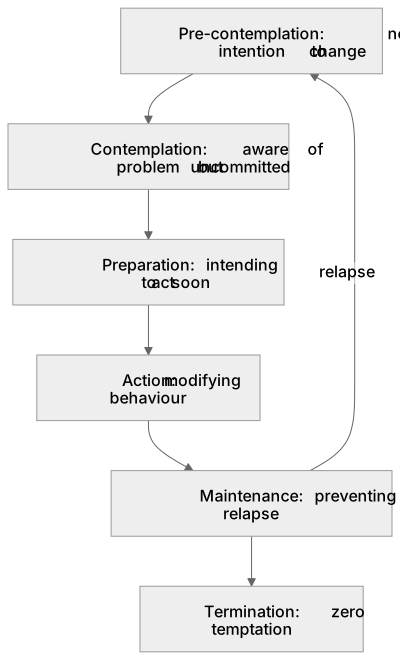
Label the diagram
Some boxes have lost their names. Pick the right name for each number.
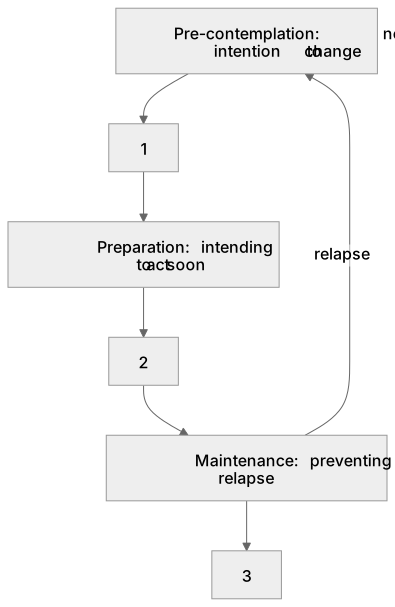
1Box 1
2Box 2
3Box 3
There is more to this lesson
The full lesson goes on to check your understanding and help you earn the marks. Create a free account to carry on, with your progress saved.
A week of Premium from your first lesson · Then the free plan continues · No card, no charge
Test your understanding of Addiction: The application of Prochaska’s six-stage model of behaviour change.
Active recall beats re-reading. Take an instant quiz now to test what you’ve learned and lock it into long-term memory.
A week of Premium from your first lesson · Then the free plan continues · No card, no charge