AQA · A-Level · Psychology
Course version: 7182-2025 · Exams from 2027
Neural and hormonal mechanisms in aggression, including the roles of the…
Full specification wording
Aggression: Neural and hormonal mechanisms in aggression, including the roles of the limbic system, serotonin and testosterone. Genetic factors in aggression, including the MAOA gene.
Aggression is explained by neural and hormonal mechanisms.
Checked against the AQA 7182-2025 specification (opens in a new tab) on .
- Point 1 of 5
- 4 key terms
Study notes
From the checked teaching notes for this specification point.
The idea
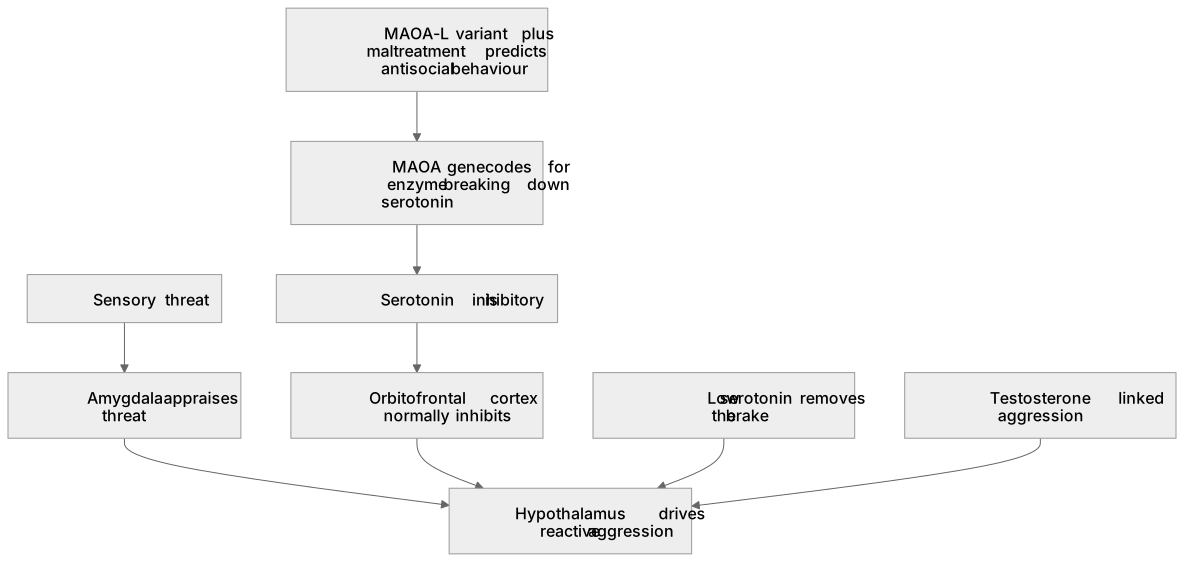
Aggression is explained by neural and hormonal mechanisms. The limbic system, chiefly the amygdala, appraises threat and drives reactive responses: Gospic found unfair offers in the Ultimatum Game produced a fast amygdala reaction. Serotonin is inhibitory, maintaining the orbitofrontal brake, so low levels mean impulsive violence; Virkkunen found lower 5-HIAA in violent offenders. Testosterone correlates with aggression in Dolan's offender patients, though levels also rise after winning. Genetic factors include the MAOA gene. Brunner's Dutch family of 14 men shared a complete MAOA deficiency, and Caspi showed the MAOA-L variant predicted antisocial behaviour only in the maltreated.
What earns the marks
- Limbic system: the amygdala evaluates sensory threat and, with the hypothalamus, drives reactive aggression, while the orbitofrontal cortex normally inhibits it; Gospic's fMRI Ultimatum Game evidence.
- Serotonin: normal levels maintain inhibitory control at the orbitofrontal cortex; low levels remove this brake so impulses go undamped, evidenced by Virkkunen's lower 5-HIAA in impulsive violent offenders.
- Testosterone: an androgen linked to aggression in males, shown by Dolan's correlation in offender patients and by animal castration and reinstatement studies.
- Evaluation: Caspi's gene-environment interaction, where the MAOA-L variant predicted antisocial behaviour only alongside childhood maltreatment.
Common mistakes and how to put them right
Saying testosterone causes aggression when the evidence is correlational, and ignoring that the causal arrow can run backwards because winning a contest raises testosterone.
Calling serotonin the aggression chemical.
Put it right: It is inhibitory, so it is low serotonin that is associated with violence.
Treating the MAOA gene as a direct gene for aggression and leaving out Caspi's finding that maltreatment was needed for the MAOA-L variant's effect to appear.
Naming brain structures without saying what each does, or muddling the limbic system with the frontal cortex that restrains it.
Exam tips
- If the stem gives someone a violent family history, use it: name heritability or the MAOA gene, then state that an environmental trigger such as maltreatment is required.
- When evaluating biological explanations, ensure you move beyond description; use diathesis-stress, animal extrapolation and determinism to build a robust discussion.
- Name the researcher, the sample and the finding: Brunner studied 14 men in one Dutch family with a complete MAOA deficiency.
Try the lesson
The start of the Aggression: Neural and hormonal mechanisms in aggression, including the roles of the limbic system, serotonin and testosterone. Genetic factors in aggression, including the MAOA gene. lesson, made from checked teaching notes for this specification point.
Have a go first
According to neural explanations of aggression, what is the typical function of serotonin in the brain?
Listen
Aggression is explained by neural and hormonal mechanisms. The limbic system, chiefly the amygdala, appraises threat and drives reactive responses: Gospic found unfair offers in the Ultimatum Game produced a fast amygdala reaction. Serotonin is inhibitory, maintaining the orbitofrontal brake, so low levels mean impulsive violence; Virkkunen found lower 5-HIAA in violent offenders. Testosterone correlates with aggression in Dolan's offender patients, though levels also rise after winning. Genetic factors include the MAOA gene. Brunner's Dutch family of 14 men shared a complete MAOA deficiency, and Caspi showed the MAOA-L variant predicted antisocial behaviour only in the maltreated. A strong answer earns marks for these points. Limbic system: the amygdala evaluates sensory threat and, with the hypothalamus, drives reactive aggression, while the orbitofrontal cortex normally inhibits it; Gospic's fMRI Ultimatum Game evidence. Serotonin: normal levels maintain inhibitory control at the orbitofrontal cortex; low levels remove this brake so impulses go undamped, evidenced by Virkkunen's lower 5-HIAA in impulsive violent offenders. Testosterone: an androgen linked to aggression in males, shown by Dolan's correlation in offender patients and by animal castration and reinstatement studies. Genetic factors: twin and adoption studies give a substantial heritability estimate; the MAOA gene codes for the enzyme that breaks down serotonin, and a complete MAOA deficiency ran through 14 men in Brunner's Dutch family. Exam tip: If the stem gives someone a violent family history, use it: name heritability or the MAOA gene, then state that an environmental trigger such as maltreatment is required.
See it
Key words
Say what each word means before you turn the card.
Serotonin
Try answering aloud or in your head before turning the card.
MAOA gene
Try answering aloud or in your head before turning the card.
Testosterone
Try answering aloud or in your head before turning the card.
Limbic system
Try answering aloud or in your head before turning the card.
See every definition
- Serotonin
- An inhibitory neurotransmitter that maintains the orbitofrontal brake, so low levels mean impulsive violence.
- MAOA gene
- Codes for the enzyme that breaks down serotonin; a complete deficiency ran through 14 men in Brunner's Dutch family.
- Testosterone
- An androgen linked to aggression in males, correlating with aggression in Dolan's offender patients, though levels also rise after winning.
- Limbic system
- Chiefly the amygdala, it appraises threat and drives reactive responses, as Gospic found with unfair offers in the Ultimatum Game.
Label the diagram
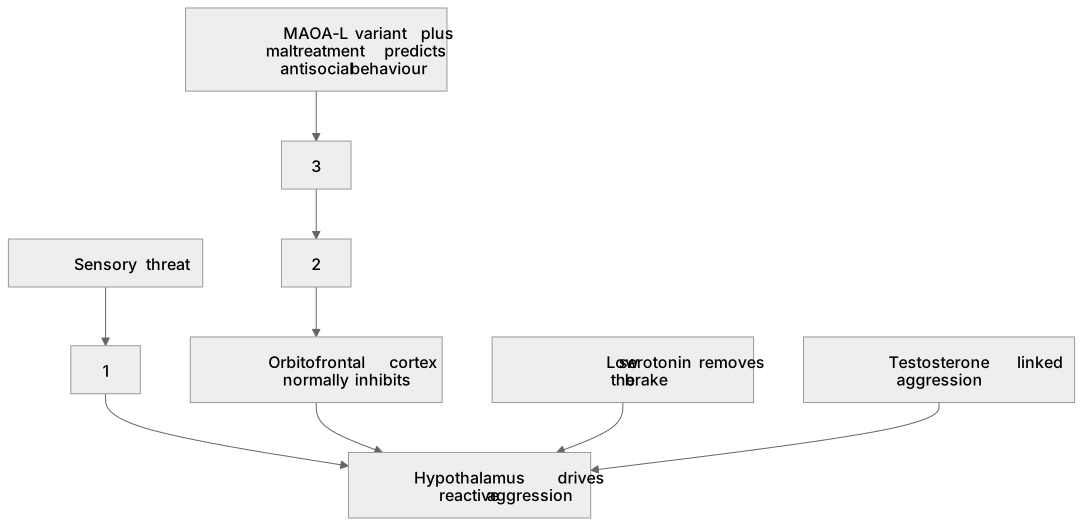
Some boxes have lost their names. Pick the right name for each number.
1Box 1
2Box 2
3Box 3
There is more to this lesson
The full lesson goes on to check your understanding and help you earn the marks. Create a free account to carry on, with your progress saved.
A week of Premium from your first lesson · Then the free plan continues · No card, no charge
Test your understanding of Aggression: Neural and hormonal mechanisms in aggression, including the roles of the limbic system, serotonin and testosterone. Genetic factors in aggression, including the MAOA gene.
Active recall beats re-reading. Take an instant quiz now to test what you’ve learned and lock it into long-term memory.
A week of Premium from your first lesson · Then the free plan continues · No card, no charge