AQA · A-Level · Psychology
Course version: 7182-2025 · Exams from 2027
The ethological explanation of aggression, including reference to innate…
Full specification wording
Aggression: The ethological explanation of aggression, including reference to innate releasing mechanisms and fixed action patterns. Evolutionary explanations of human aggression.
Ethology studies behaviour in the wild and treats aggression as innate and adaptive.
Checked against the AQA 7182-2025 specification (opens in a new tab) on .
- Point 2 of 5
- 4 key terms
Study notes
From the checked teaching notes for this specification point.
The idea
Ethology studies behaviour in the wild and treats aggression as innate and adaptive. Lorenz argued that fights within a species are ritualistic, ending in appeasement displays, so they settle hierarchy and spread animals over territory without killing. The mechanism has two parts: an innate releasing mechanism is a hard-wired circuit tripped by a specific sign stimulus, and it releases a fixed action pattern, a stereotyped, universal sequence that is ballistic once begun. Tinbergen's sticklebacks attacked any wooden model with a red underside, ignored a realistic one without it, and ran the sequence to completion after the rival was removed. Evolutionary accounts add function: Shackelford found mate-retention tactics predicted violence towards wives, cuckoldry being the ancestral cost.
What earns the marks
- Ethology defined: aggression is innate, adaptive and studied in the natural environment, with Lorenz as the named theorist.
- Ritualised aggression: threat displays and appeasement signals limit killing within a species, and the benefits are territorial spread, dominance hierarchy and the survival of the defeated animal.
- Innate releasing mechanism: a sign stimulus activates a built-in neural network that releases the behaviour.
- Fixed action pattern: stereotyped, universal, ballistic, unaffected by learning and triggered by a specific stimulus, demonstrated by Tinbergen's red-bellied stickleback models.
Common mistakes and how to put them right
Blurring the two technical terms.
Put it right: The innate releasing mechanism is the trigger circuit, the fixed action pattern is the behaviour it releases.
Describing Tinbergen's study as being about colour preference rather than about a sign stimulus releasing a stereotyped sequence.
Forgetting that a fixed action pattern is ballistic, so it continues after the stimulus disappears.
Put it right: That detail is often the discriminating mark.
Writing as though evolutionary explanations justify aggression or make it inevitable, when they describe adaptive function only.
Exam tips
- Use both technical terms accurately in the opening sentences of an explain answer, each tied to one animal example, because precise use of the terminology is what the knowledge marks are for.
- Evaluate evolutionary explanations with a named cultural counter-case such as Nisbett rather than the vague claim that they ignore nurture.
- Ethological and evolutionary are separate bullets in the specification; answer the one the question names, because content on the other earns nothing.
Try the lesson
The start of the Aggression: The ethological explanation of aggression, including reference to innate releasing mechanisms and fixed action patterns. Evolutionary explanations of human aggression. lesson, made from checked teaching notes for this specification point.
Have a go first
In the ethological explanation of aggression, what is the function of an innate releasing mechanism (IRM)?
Listen
Ethology studies behaviour in the wild and treats aggression as innate and adaptive. Lorenz argued that fights within a species are ritualistic, ending in appeasement displays, so they settle hierarchy and spread animals over territory without killing. The mechanism has two parts: an innate releasing mechanism is a hard-wired circuit tripped by a specific sign stimulus, and it releases a fixed action pattern, a stereotyped, universal sequence that is ballistic once begun. Tinbergen's sticklebacks attacked any wooden model with a red underside, ignored a realistic one without it, and ran the sequence to completion after the rival was removed. Evolutionary accounts add function: Shackelford found mate-retention tactics predicted violence towards wives, cuckoldry being the ancestral cost. A strong answer earns marks for these points. Ethology defined: aggression is innate, adaptive and studied in the natural environment, with Lorenz as the named theorist. Ritualised aggression: threat displays and appeasement signals limit killing within a species, and the benefits are territorial spread, dominance hierarchy and the survival of the defeated animal. Innate releasing mechanism: a sign stimulus activates a built-in neural network that releases the behaviour. Fixed action pattern: stereotyped, universal, ballistic, unaffected by learning and triggered by a specific stimulus, demonstrated by Tinbergen's red-bellied stickleback models. Exam tip: Use both technical terms accurately in the opening sentences of an explain answer, each tied to one animal example, because precise use of the terminology is what the knowledge marks are for.
See it
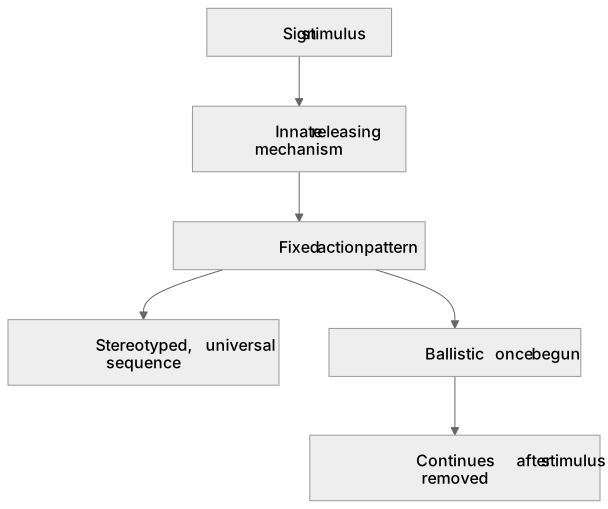
Key words
Say what each word means before you turn the card.
Innate releasing mechanism
Try answering aloud or in your head before turning the card.
Fixed action pattern
Try answering aloud or in your head before turning the card.
Ritualised aggression
Try answering aloud or in your head before turning the card.
Sign stimulus
Try answering aloud or in your head before turning the card.
See every definition
- Innate releasing mechanism
- A hard-wired circuit that is tripped by a specific sign stimulus and releases a fixed action pattern.
- Fixed action pattern
- A stereotyped, universal sequence that is ballistic once begun, so it runs to completion after the rival is removed.
- Ritualised aggression
- Fights within a species that are ritualistic and end in appeasement displays, settling hierarchy and spreading animals over territory without killing.
- Sign stimulus
- A specific stimulus that activates the innate releasing mechanism and so releases the behaviour.
Label the diagram
Some boxes have lost their names. Pick the right name for each number.
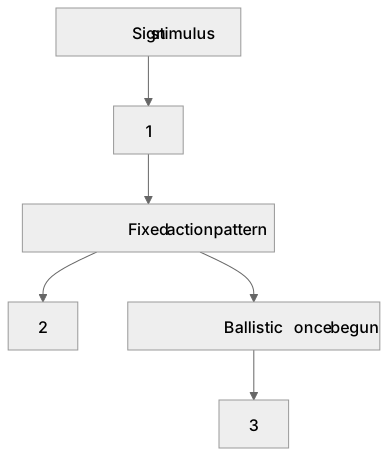
1Box 1
2Box 2
3Box 3
There is more to this lesson
The full lesson goes on to check your understanding and help you earn the marks. Create a free account to carry on, with your progress saved.
A week of Premium from your first lesson · Then the free plan continues · No card, no charge
Test your understanding of Aggression: The ethological explanation of aggression, including reference to innate releasing mechanisms and fixed action patterns. Evolutionary explanations of human aggression.
Active recall beats re-reading. Take an instant quiz now to test what you’ve learned and lock it into long-term memory.
A week of Premium from your first lesson · Then the free plan continues · No card, no charge