AQA · A-Level · Psychology
Course version: 7182-2025 · Exams from 2027
Social psychological explanations of human aggression, including the…
Full specification wording
Aggression: Social psychological explanations of human aggression, including the frustration-aggression hypothesis, social learning theory as applied to human aggression, and de-individuation.
Three social accounts.
Checked against the AQA 7182-2025 specification (opens in a new tab) on .
- Point 3 of 5
- 4 key terms
Study notes
From the checked teaching notes for this specification point.
The idea
Three social accounts. Dollard's frustration-aggression hypothesis says a blocked goal creates a drive that must be discharged, often displaced onto a safer target; Geen's participants who were insulted while failing a puzzle gave the strongest shocks. Berkowitz's weapon effect showed cues matter: guns on the table raised the shocks given. Bandura added social learning theory: in 1961, of 72 children, the 24 who watched an adult batter a Bobo doll copied the precise acts. Later, Bandura showed vicarious reinforcement: imitation fell when children saw the model punished. De-individuation is the loss of private self-awareness in a crowd; Zimbardo's hooded women shocked for twice as long as those wearing name tags.
What earns the marks
- Frustration-aggression: a blocked goal produces frustration, frustration produces an aggressive drive, and discharging it is said to be cathartic, with displacement onto an available target.
- De-individuation: anonymity and crowd membership reduce private self-awareness and accountability, shifting behaviour towards local group norms, as in Zimbardo's hooded participants.
Common mistakes and how to put them right
Stating that frustration always leads to aggression as though it were fact.
Put it right: The absolute claim is what the evidence refused, which is why Berkowitz reformulated it as negative affect.
Defining de-individuation as simply being in a crowd, when the explanation requires anonymity and reduced private self-awareness.
Saying the Bobo doll children became violent, rather than that they imitated specific modelled acts towards a toy.
Presenting catharsis as a research finding when it is a claim of the hypothesis that later work contradicts.
Exam tips
- Scenario questions point to one explanation: a crowd in masks vandalising property is de-individuation, a child copying an admired older sibling is social learning; name it, then quote the scenario's own detail as you apply it.
- In a sixteen-mark answer, use the three explanations against each other, for example that social learning explains why aggression is selective and situation-specific while a frustration drive cannot.
- Evaluation scores better when it names the counter-study, such as Johnson and Downing, than when it says the research is mixed.
Try the lesson
The start of the Aggression: Social psychological explanations of human aggression, including the frustration-aggression hypothesis, social learning theory as applied to human aggression, and de-individuation. lesson, made from checked teaching notes for this specification point.
Have a go first
According to the concept of de-individuation, which condition is most likely to increase the likelihood of aggressive behaviour in a crowd?
Listen
Three social accounts. Dollard's frustration-aggression hypothesis says a blocked goal creates a drive that must be discharged, often displaced onto a safer target; Geen's participants who were insulted while failing a puzzle gave the strongest shocks. Berkowitz's weapon effect showed cues matter: guns on the table raised the shocks given. Bandura added social learning theory: in 1961, of 72 children, the 24 who watched an adult batter a Bobo doll copied the precise acts. Later, Bandura showed vicarious reinforcement: imitation fell when children saw the model punished. De-individuation is the loss of private self-awareness in a crowd; Zimbardo's hooded women shocked for twice as long as those wearing name tags. A strong answer earns marks for these points. Frustration-aggression: a blocked goal produces frustration, frustration produces an aggressive drive, and discharging it is said to be cathartic, with displacement onto an available target. Supporting evidence: Geen's insulted condition gave the strongest shocks, and Berkowitz and LePage's weapon effect showed environmental cues increase aggression. Berkowitz later reformulated the hypothesis so that any negative affect can provoke aggression. Social learning theory: observation of a model, vicarious reinforcement, the four mediational processes and self-efficacy, evidenced by imitation of specific acts in Bandura's 1961 Bobo doll study and his 1965 punished-model study. De-individuation: anonymity and crowd membership reduce private self-awareness and accountability, shifting behaviour towards local group norms, as in Zimbardo's hooded participants. Exam tip: Scenario questions point to one explanation: a crowd in masks vandalising property is de-individuation, a child copying an admired older sibling is social learning; name it, then quote the scenario's own detail as you apply it.
See it
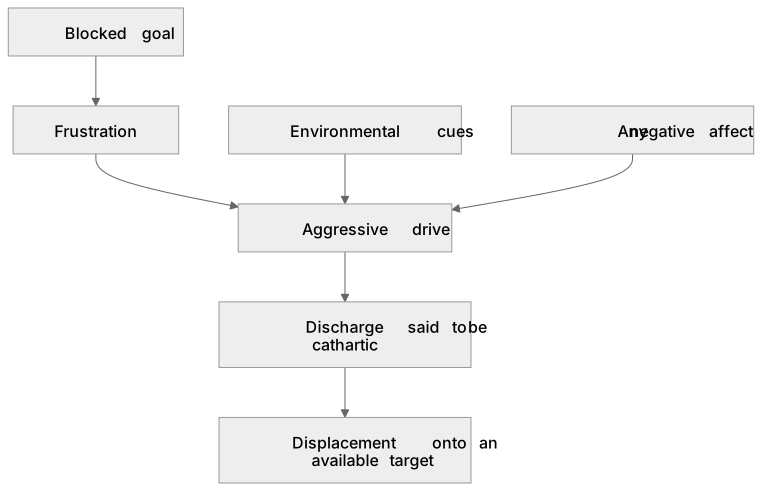
Key words
Say what each word means before you turn the card.
Frustration, drive and displacement
Try answering aloud or in your head before turning the card.
Catharsis and its evidential problems
Try answering aloud or in your head before turning the card.
Environmental cues and the weapon effect
Try answering aloud or in your head before turning the card.
Observational learning and vicarious reinforcement
Try answering aloud or in your head before turning the card.
See every definition
- Frustration, drive and displacement
- A blocked goal produces frustration, frustration produces an aggressive drive, and discharging it is said to be cathartic, with displacement onto an available target.
- Catharsis and its evidential problems
- Discharging the aggressive drive is said to be cathartic, but venting raises later aggression, so catharsis is unsupported.
- Environmental cues and the weapon effect
- Berkowitz and LePage's weapon effect showed environmental cues increase aggression, as guns on the table raised the shocks given.
- Observational learning and vicarious reinforcement
- Observation of a model and vicarious reinforcement are shown by imitation of specific acts in Bandura's 1961 Bobo doll study and his 1965 punished-model study.
Label the diagram
Some boxes have lost their names. Pick the right name for each number.
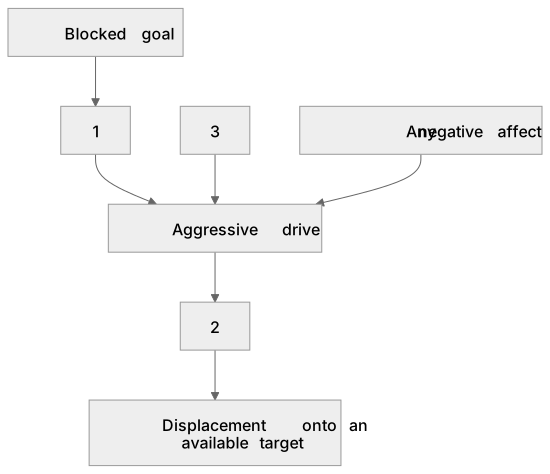
1Box 1
2Box 2
3Box 3
There is more to this lesson
The full lesson goes on to check your understanding and help you earn the marks. Create a free account to carry on, with your progress saved.
A week of Premium from your first lesson · Then the free plan continues · No card, no charge
Test your understanding of Aggression: Social psychological explanations of human aggression, including the frustration-aggression hypothesis, social learning theory as applied to human aggression, and de-individuation.
Active recall beats re-reading. Take an instant quiz now to test what you’ve learned and lock it into long-term memory.
A week of Premium from your first lesson · Then the free plan continues · No card, no charge