AQA · A-Level · Psychology
Course version: 7182-2025 · Exams from 2027
Humanistic Psychology: free will, self-actualisation and Maslow’s…
Full specification wording
Approaches in Psychology: Humanistic Psychology: free will, self-actualisation and Maslow’s hierarchy of needs, congruence, the role of conditions of worth.
Humanistic psychology asserts that humans possess free will and are active agents in their development.
Checked against the AQA 7182-2025 specification (opens in a new tab) on .
- Point 6 of 7
- 4 key terms
Study notes
From the checked teaching notes for this specification point.
The idea
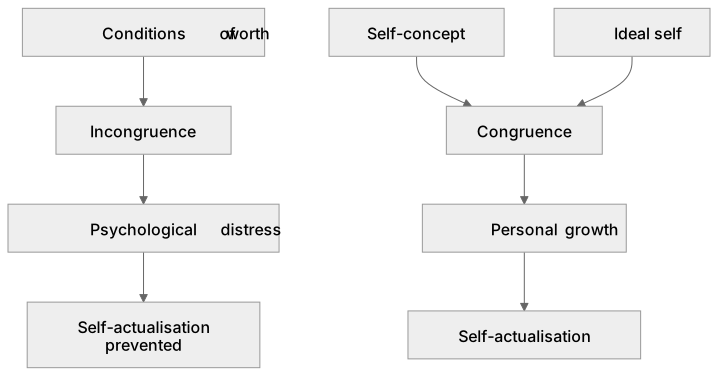
Humanistic psychology asserts that humans possess free will and are active agents in their development. The ultimate goal is self-actualisation, the innate drive to achieve one's full potential. This is mapped in Maslow’s hierarchy of needs, where basic physiological and safety needs must be met before progressing to psychological needs and self-actualisation. Carl Rogers argued that personal growth requires congruence, where an individual's self-concept closely aligns with their ideal self. Growth is hindered by conditions of worth, which are the expectations placed on an individual by others to earn positive regard. These conditions create incongruence, preventing self-actualisation and causing psychological distress.
What earns the marks
- Explain free will as the ability to make choices that are not determined by biological or external forces, which is central to the humanistic approach.
- Describe Maslow's hierarchy of needs, detailing the progression from deficiency needs to growth needs.
- Define self-actualisation as the innate tendency to achieve one's full potential and become the best one can possibly be.
- Explain congruence as the degree of similarity between a person's self-concept and their ideal self, which is necessary for personal growth.
- Describe conditions of worth as the boundaries or limits placed on parents' love for their children, which can lead to incongruence and low self-esteem.
Common mistakes and how to put them right
Claiming that self-actualisation is a permanent state once reached.
Put it right: Explain that self-actualisation is an ongoing process of growth, and individuals can move up and down the hierarchy based on life circumstances.
Confusing the self-concept with the ideal self.
Put it right: Clarify that the self-concept is how we currently perceive ourselves, whereas the ideal self is the person we wish to be.
Stating that conditions of worth are positive motivators.
Put it right: Emphasise that conditions of worth are negative because they make love conditional, fostering incongruence and hindering self-actualisation.
Exam tips
- When evaluating the humanistic approach, use its holistic nature as a strength, contrasting it with the reductionism of the biological or behaviourist approaches.
- Link conditions of worth directly to Rogerian therapy, explaining how the therapist provides unconditional positive regard to counteract them.
- Be prepared to discuss the cultural bias of Maslow's hierarchy, noting that concepts like self-actualisation are highly associated with individualist cultures rather than collectivist ones.
Try the lesson
The start of the Approaches in Psychology: Humanistic Psychology: free will, self-actualisation and Maslow’s hierarchy of needs, congruence, the role of conditions of worth. lesson, made from checked teaching notes for this specification point.
Have a go first
In Humanistic Psychology, what term is used to describe the state where an individual's concept of self broadly matches their ideal self?
Listen
Humanistic psychology asserts that humans possess free will and are active agents in their development. The ultimate goal is self-actualisation, the innate drive to achieve one's full potential. This is mapped in Maslow’s hierarchy of needs, where basic physiological and safety needs must be met before progressing to psychological needs and self-actualisation. Carl Rogers argued that personal growth requires congruence, where an individual's self-concept closely aligns with their ideal self. Growth is hindered by conditions of worth, which are the expectations placed on an individual by others to earn positive regard. These conditions create incongruence, preventing self-actualisation and causing psychological distress. A strong answer earns marks for these points. Explain free will as the ability to make choices that are not determined by biological or external forces, which is central to the humanistic approach. Describe Maslow's hierarchy of needs, detailing the progression from deficiency needs to growth needs. Define self-actualisation as the innate tendency to achieve one's full potential and become the best one can possibly be. Explain congruence as the degree of similarity between a person's self-concept and their ideal self, which is necessary for personal growth. A common slip: Claiming that self-actualisation is a permanent state once reached. Instead, Explain that self-actualisation is an ongoing process of growth, and individuals can move up and down the hierarchy based on life circumstances. Exam tip: When evaluating the humanistic approach, use its holistic nature as a strength, contrasting it with the reductionism of the biological or behaviourist approaches.
See it
Key words
Say what each word means before you turn the card.
Free will
Try answering aloud or in your head before turning the card.
Self-actualisation
Try answering aloud or in your head before turning the card.
Congruence
Try answering aloud or in your head before turning the card.
Conditions of worth
Try answering aloud or in your head before turning the card.
See every definition
- Free will
- The ability to make choices that are not determined by biological or external forces, which is central to the humanistic approach.
- Self-actualisation
- The innate tendency to achieve one's full potential and become the best one can possibly be.
- Congruence
- The degree of similarity between a person's self-concept and their ideal self, which is necessary for personal growth.
- Conditions of worth
- The boundaries or limits placed on parents' love for their children, which can lead to incongruence and low self-esteem.
Label the diagram
Some boxes have lost their names. Pick the right name for each number.
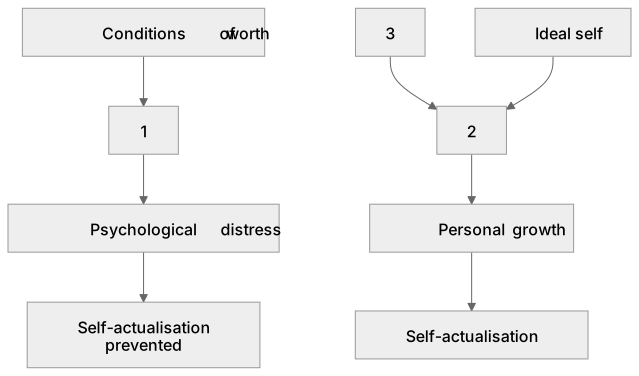
1Box 1
2Box 2
3Box 3
There is more to this lesson
The full lesson goes on to check your understanding and help you earn the marks. Create a free account to carry on, with your progress saved.
A week of Premium from your first lesson · Then the free plan continues · No card, no charge
Test your understanding of Approaches in Psychology: Humanistic Psychology: free will, self-actualisation and Maslow’s hierarchy of needs, congruence, the role of conditions of worth.
Active recall beats re-reading. Take an instant quiz now to test what you’ve learned and lock it into long-term memory.
A week of Premium from your first lesson · Then the free plan continues · No card, no charge