AQA · A-Level · Psychology
Course version: 7182-2025 · Exams from 2027
The psychodynamic approach: the role of the unconscious, the structure of…
Full specification wording
Approaches in Psychology: The psychodynamic approach: the role of the unconscious, the structure of personality, that is Id, Ego and Superego, defence mechanisms including repression, denial and displacement, psychosexual stages.
Freud argued that most of the mind is unconscious, a store of repressed conflict that leaks out in dreams.
Checked against the AQA 7182-2025 specification (opens in a new tab) on .
- Point 5 of 7
- 4 key terms
Study notes
From the checked teaching notes for this specification point.
The idea
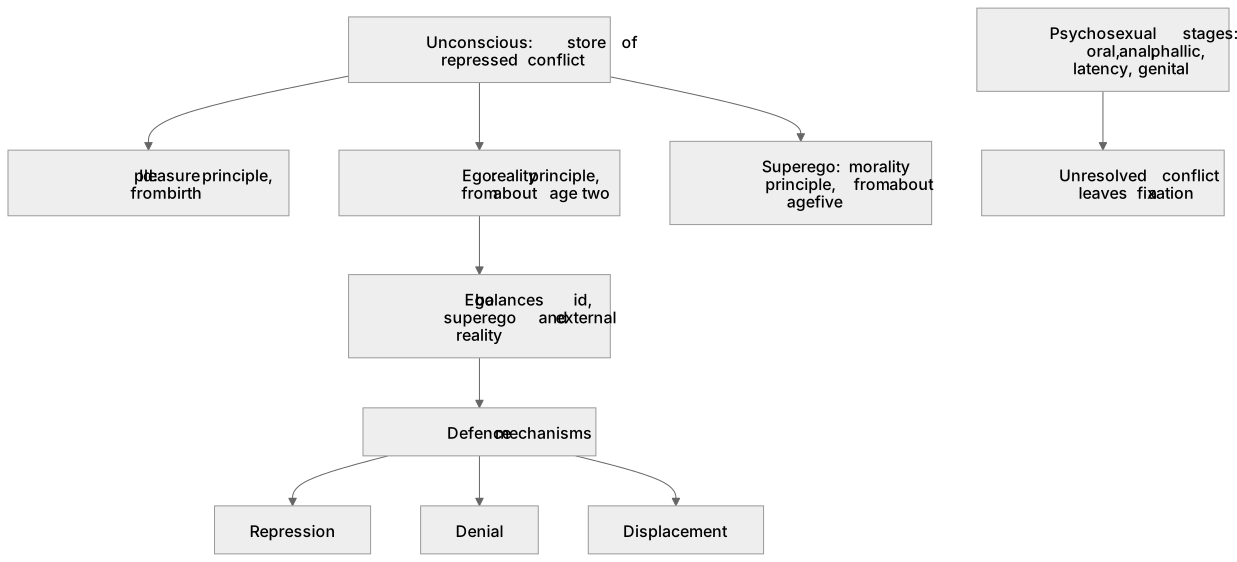
Freud argued that most of the mind is unconscious, a store of repressed conflict that leaks out in dreams. Personality has three parts. The id is present at birth, entirely unconscious, and demands immediate pleasure. The superego forms around age five by identification with the same-sex parent, punishing with guilt. The ego works on the reality principle, managing the war between them using defence mechanisms: repression pushes a distressing memory out of awareness, denial refuses to accept an external reality, and displacement redirects a feeling onto a safer target. Personality develops through the psychosexual stages: oral, anal, phallic, latency and genital. Unresolved conflict leaves a fixation carried into adult behaviour. Freud used Little Hans, a boy with a horse phobia, as evidence for the Oedipus complex in the phallic stage.
What earns the marks
- The unconscious as the driving force behind behaviour, holding repressed material that surfaces indirectly in dreams or parapraxes.
- Tripartite personality: id on the pleasure principle from birth, ego on the reality principle from about the age of two, superego on the morality principle from about the age of five.
- The ego's task of balancing the demands of id, superego and external reality, which is what defence mechanisms exist to do.
- Repression, denial and displacement defined separately and correctly, each with its own example.
- The five psychosexual stages in order, each with its conflict, and fixation explained as the adult consequence of unresolved conflict.
- Evaluation: explanatory power and the founding of psychoanalysis, against unfalsifiable concepts, an evidence base of single case studies such as Little Hans's childhood phobia, and psychic determinism.
Common mistakes and how to put them right
Describing defence mechanisms as conscious coping strategies.
Put it right: They operate unconsciously, which is precisely why they distort reality.
Giving denial and repression the same example.
Put it right: Denial refuses an external fact, repression buries an internal memory.
Leaving out that the superego forms at the end of the phallic stage through identification with the same-sex parent, which is the link between the stages and personality.
Confusing Little Hans's childhood phobia (which Freud interpreted as evidence for the Oedipus complex) with an adult fixation.
Exam tips
- Scenario questions almost always plant a defence mechanism, so lift the phrase from the stem, name the mechanism and then explain it.
- Use falsifiability as an argument rather than a label: say what observation could ever show the theory to be wrong.
- Do not spend an answer on the Oedipus complex when the question asks about the structure of personality; each carries its own marks.
Try the lesson
The start of the Approaches in Psychology: The psychodynamic approach: the role of the unconscious, the structure of personality, that is Id, Ego and Superego, defence mechanisms including repression, denial and displacement, psychosexual stages. lesson, made from checked teaching notes for this specification point.
Have a go first
According to the psychodynamic approach, which component of the personality operates entirely on the pleasure principle?
Listen
Freud argued that most of the mind is unconscious, a store of repressed conflict that leaks out in dreams. Personality has three parts. The id is present at birth, entirely unconscious, and demands immediate pleasure. The superego forms around age five by identification with the same-sex parent, punishing with guilt. The ego works on the reality principle, managing the war between them using defence mechanisms: repression pushes a distressing memory out of awareness, denial refuses to accept an external reality, and displacement redirects a feeling onto a safer target. Personality develops through the psychosexual stages: oral, anal, phallic, latency and genital. Unresolved conflict leaves a fixation carried into adult behaviour. Freud used Little Hans, a boy with a horse phobia, as evidence for the Oedipus complex in the phallic stage. A strong answer earns marks for these points. The unconscious as the driving force behind behaviour, holding repressed material that surfaces indirectly in dreams or parapraxes. Tripartite personality: id on the pleasure principle from birth, ego on the reality principle from about the age of two, superego on the morality principle from about the age of five. The ego's task of balancing the demands of id, superego and external reality, which is what defence mechanisms exist to do. Repression, denial and displacement defined separately and correctly, each with its own example. Exam tip: Scenario questions almost always plant a defence mechanism, so lift the phrase from the stem, name the mechanism and then explain it.
See it
Key words
Say what each word means before you turn the card.
The unconscious mind
Try answering aloud or in your head before turning the card.
Id, ego and superego
Try answering aloud or in your head before turning the card.
Defence mechanisms
Try answering aloud or in your head before turning the card.
Psychosexual stages and fixation
Try answering aloud or in your head before turning the card.
See every definition
- The unconscious mind
- Most of the mind, a store of repressed conflict that leaks out in dreams.
- Id, ego and superego
- The three parts of personality: the id demands immediate pleasure, the superego punishes with guilt, and the ego manages the war between them.
- Defence mechanisms
- Ways the ego manages the war between id and superego, including repression, denial and displacement.
- Psychosexual stages and fixation
- Personality develops through the oral, anal, phallic, latency and genital stages, and unresolved conflict leaves a fixation carried into adult behaviour.
Label the diagram
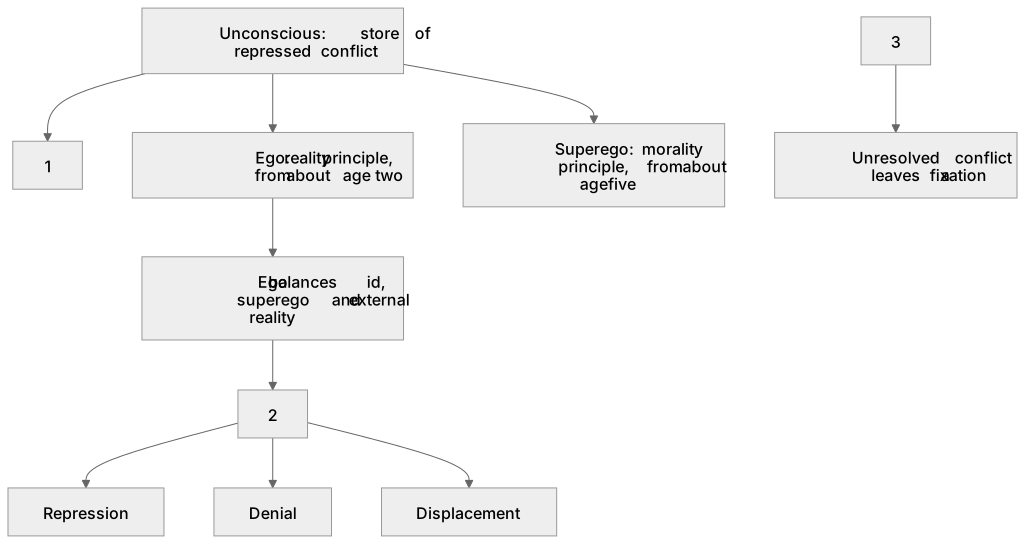
Some boxes have lost their names. Pick the right name for each number.
1Box 1
2Box 2
3Box 3
There is more to this lesson
The full lesson goes on to check your understanding and help you earn the marks. Create a free account to carry on, with your progress saved.
A week of Premium from your first lesson · Then the free plan continues · No card, no charge
Test your understanding of Approaches in Psychology: The psychodynamic approach: the role of the unconscious, the structure of personality, that is Id, Ego and Superego, defence mechanisms including repression, denial and displacement, psychosexual stages.
Active recall beats re-reading. Take an instant quiz now to test what you’ve learned and lock it into long-term memory.
A week of Premium from your first lesson · Then the free plan continues · No card, no charge