AQA · A-Level · Psychology
Course version: 7182-2025 · Exams from 2027
Learning approaches: i) the behaviourist approach, including classical…
Full specification wording
Approaches in Psychology: Learning approaches: i) the behaviourist approach, including classical conditioning and Pavlov’s research, operant conditioning, types of reinforcement and Skinner’s research; ii) social learning theory including imitation, identification, vicarious reinforcement, the role of mediational processes and Bandura’s research.
Behaviourism explains learning through observable interactions.
Checked against the AQA 7182-2025 specification (opens in a new tab) on .
- Point 2 of 7
- 4 key terms
Study notes
From the checked teaching notes for this specification point.
The idea
Behaviourism explains learning through observable interactions. Classical conditioning (Pavlov’s dogs) is learning by association, pairing a neutral stimulus with an unconditioned stimulus to create a conditioned response. Operant conditioning (Skinner’s rats) shapes behaviour via consequences: positive reinforcement, negative reinforcement and punishment. Social learning theory (SLT) extends this to observational learning. Bandura’s Bobo doll study showed children imitating aggressive models. SLT emphasises identification with role models and vicarious reinforcement (observing others rewarded). Crucially, SLT incorporates mediational processes (attention, retention, reproduction, motivation) occurring between stimulus and response.
What earns the marks
- Accurately define classical conditioning as learning through association and operant conditioning as learning through consequences.
- Distinguish between positive reinforcement (adding a pleasant stimulus) and negative reinforcement (removing an unpleasant stimulus) in Skinner's research.
- Explain the four mediational processes in SLT: attention, retention, motor reproduction, and motivation.
- Describe how vicarious reinforcement increases the likelihood of imitation, referencing Bandura's findings on observed rewards.
Common mistakes and how to put them right
Confusing negative reinforcement with punishment.
Put it right: Negative reinforcement increases a behaviour by removing something unpleasant, whereas punishment decreases a behaviour.
Using the terms unconditioned stimulus and conditioned stimulus interchangeably.
Put it right: The unconditioned stimulus naturally produces the response before conditioning occurs.
Exam tips
- When describing Pavlov's research, clearly outline the sequence of before, during, and after conditioning using the correct terminology (NS, UCS, UCR, CS, CR).
- Use Bandura's Bobo doll experiment to illustrate both imitation and the effect of vicarious reinforcement on children's aggressive behaviour.
- Compare the behaviourist approach and SLT by highlighting their different stances on the role of internal mental processes.
Try the lesson
The start of the Approaches in Psychology: Learning approaches: i) the behaviourist approach, including classical conditioning and Pavlov’s research, operant conditioning, types of reinforcement and Skinner’s research; ii) social learning theory including imitation, identification, vicarious reinforcement, the role of mediational processes and Bandura’s research. lesson, made from checked teaching notes for this specification point.
Have a go first
In Pavlov's research on classical conditioning, what was the role of the bell before conditioning took place?
Listen
Behaviourism explains learning through observable interactions. Classical conditioning (Pavlov’s dogs) is learning by association, pairing a neutral stimulus with an unconditioned stimulus to create a conditioned response. Operant conditioning (Skinner’s rats) shapes behaviour via consequences: positive reinforcement, negative reinforcement and punishment. Social learning theory (SLT) extends this to observational learning. Bandura’s Bobo doll study showed children imitating aggressive models. SLT emphasises identification with role models and vicarious reinforcement (observing others rewarded). Crucially, SLT incorporates mediational processes (attention, retention, reproduction, motivation) occurring between stimulus and response. A strong answer earns marks for these points. Accurately define classical conditioning as learning through association and operant conditioning as learning through consequences. Distinguish between positive reinforcement (adding a pleasant stimulus) and negative reinforcement (removing an unpleasant stimulus) in Skinner's research. Explain the four mediational processes in SLT: attention, retention, motor reproduction, and motivation. Describe how vicarious reinforcement increases the likelihood of imitation, referencing Bandura's findings on observed rewards. Exam tip: When describing Pavlov's research, clearly outline the sequence of before, during, and after conditioning using the correct terminology (NS, UCS, UCR, CS, CR).
See it

Watch it explained
What is the one idea the video explains? Say it in a sentence.
Read the described scene instead
This lesson covers the behaviourist approach and social learning theory. Both explain learning through environmental influences, but they differ on whether internal mental processes matter. We'll look at classical conditioning, operant conditioning, and observational learning. Classical conditioning is learning by association. Before conditioning, food is an unconditioned stimulus that naturally produces salivation, an unconditioned response. A neutral stimulus, such as a bell, does not. During conditioning, the bell is paired with food. After conditioning, the bell alone becomes a conditioned stimulus and produces a conditioned response. Operant conditioning is learning through consequences. Skinner's research with rats showed that behaviour can be shaped by reinforcement. Positive reinforcement adds a pleasant stimulus, increasing behaviour. Negative reinforcement removes an unpleasant stimulus, also increasing behaviour. Punishment decreases behaviour. Social learning theory extends behaviourism to observational learning. Children may imitate aggressive models, as Bandura's Bobo doll study showed. Imitation is more likely when a child identifies with a role model. Vicarious reinforcement occurs when others are observed being rewarded, increasing the chance of imitation. Unlike traditional behaviourism, SLT includes mediational processes between stimulus and response. These are attention, retention, motor reproduction, and motivation. Attention is noticing the model. Retention is remembering the behaviour. Motor reproduction is being able to perform it. Motivation is the reason to imitate, including vicarious reinforcement. A common mistake is confusing negative reinforcement with punishment. Negative reinforcement increases behaviour by removing something unpleasant; punishment decreases behaviour. Also, do not use unconditioned and conditioned stimulus interchangeably. The unconditioned stimulus naturally produces the response before conditioning. And when evaluating SLT, explicitly mention mediational processes to show its cognitive difference from behaviourism. To recap: behaviourism explains learning through association and consequences. Classical conditioning pairs a neutral stimulus with an unconditioned stimulus. Operant conditioning uses reinforcement and punishment. Social learning theory adds imitation, identification, vicarious reinforcement, and mediational processes. These approaches also raise issues of environmental determinism, scientific methodology, nature versus nurture, and reductionism.
Key words
Say what each word means before you turn the card.
Classical conditioning
Try answering aloud or in your head before turning the card.
Operant conditioning
Try answering aloud or in your head before turning the card.
Vicarious reinforcement
Try answering aloud or in your head before turning the card.
Mediational processes
Try answering aloud or in your head before turning the card.
See every definition
- Classical conditioning
- Learning by association, pairing a neutral stimulus with an unconditioned stimulus to create a conditioned response.
- Operant conditioning
- Learning through consequences, shaping behaviour via positive reinforcement, negative reinforcement and punishment.
- Vicarious reinforcement
- Observing others rewarded, which increases the likelihood of imitation.
- Mediational processes
- Attention, retention, reproduction and motivation, occurring between stimulus and response.
Label the diagram
Some boxes have lost their names. Pick the right name for each number.
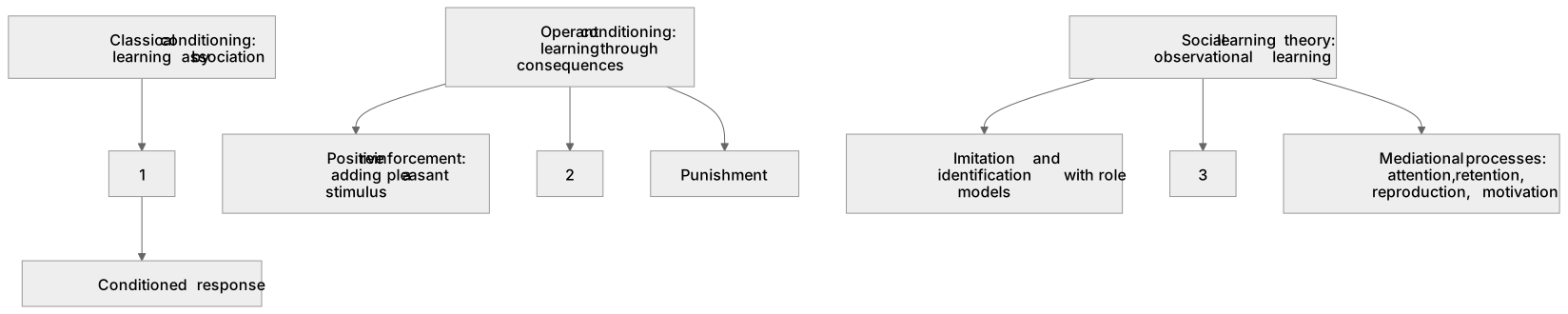
1Box 1
2Box 2
3Box 3
There is more to this lesson
The full lesson goes on to check your understanding and help you earn the marks. Create a free account to carry on, with your progress saved.
A week of Premium from your first lesson · Then the free plan continues · No card, no charge
Test your understanding of Approaches in Psychology: Learning approaches: i) the behaviourist approach, including classical conditioning and Pavlov’s research, operant conditioning, types of reinforcement and Skinner’s research; ii) social learning theory including imitation, identification, vicarious reinforcement, the role of mediational processes and Bandura’s research.
Active recall beats re-reading. Take an instant quiz now to test what you’ve learned and lock it into long-term memory.
A week of Premium from your first lesson · Then the free plan continues · No card, no charge