AQA · A-Level · Psychology
Course version: 7182-2025 · Exams from 2027
The cognitive approach: the study of internal mental processes, the role…
Full specification wording
Approaches in Psychology: The cognitive approach: the study of internal mental processes, the role of schema, the use of models to explain and make inferences about mental processes.
The cognitive approach argues that internal mental processes must be studied scientifically.
Checked against the AQA 7182-2025 specification (opens in a new tab) on .
- Point 3 of 7
- 4 key terms
Study notes
From the checked teaching notes for this specification point.
The idea
The cognitive approach argues that internal mental processes must be studied scientifically. Because processes like memory and perception cannot be observed directly, psychologists make inferences about them based on behaviour. A central concept is the schema: a mental framework of beliefs developed through experience that organises information. Schemas allow rapid cognitive processing, preventing us from being overwhelmed, but can also distort interpretations. Cognitive psychologists use theoretical models, such as the multi-store model of memory, and computer models, which compare the mind to a computer (with input, processing and output stages), to explain and test these unobservable mental processes.
What earns the marks
- Define inference as the process of drawing conclusions about unobservable mental processes based on observed behaviour.
- Explain the role of schemas as mental structures that organise knowledge and guide cognitive processing and behaviour.
- Distinguish between theoretical models (like flowcharts representing memory) and computer models (analogies of human cognition to software).
- Evaluate the cognitive approach by discussing its reliance on controlled laboratory experiments to infer mental processes.
Common mistakes and how to put them right
Stating that cognitive psychologists directly observe mental processes.
Put it right: They actually observe behaviour and make inferences about the underlying processes.
Describing schemas only negatively (e.g., causing prejudice).
Put it right: Schemas must also be explained as useful cognitive shortcuts that process large volumes of information quickly.
Confusing theoretical models with computer models.
Put it right: Theoretical models are abstract representations (like the working memory model), whereas computer models involve programming computers to simulate human cognition.
Exam tips
- Use the multi-store model of memory as a concrete example when explaining how theoretical models represent internal mental processes.
- Explicitly define the term 'inference' when discussing how cognitive psychologists study unobservable processes like thinking and memory.
- Discuss both the advantages (rapid processing) and disadvantages (perceptual distortions) of schemas to provide a balanced explanation.
Try the lesson
The start of the Approaches in Psychology: The cognitive approach: the study of internal mental processes, the role of schema, the use of models to explain and make inferences about mental processes. lesson, made from checked teaching notes for this specification point.
Have a go first
Which of the following best describes how cognitive psychologists use theoretical models to investigate human behaviour?
Listen
The cognitive approach argues that internal mental processes must be studied scientifically. Because processes like memory and perception cannot be observed directly, psychologists make inferences about them based on behaviour. A central concept is the schema: a mental framework of beliefs developed through experience that organises information. Schemas allow rapid cognitive processing, preventing us from being overwhelmed, but can also distort interpretations. Cognitive psychologists use theoretical models, such as the multi-store model of memory, and computer models, which compare the mind to a computer (with input, processing and output stages), to explain and test these unobservable mental processes. A strong answer earns marks for these points. Define inference as the process of drawing conclusions about unobservable mental processes based on observed behaviour. Explain the role of schemas as mental structures that organise knowledge and guide cognitive processing and behaviour. Distinguish between theoretical models (like flowcharts representing memory) and computer models (analogies of human cognition to software). Evaluate the cognitive approach by discussing its reliance on controlled laboratory experiments to infer mental processes. Exam tip: Use the multi-store model of memory as a concrete example when explaining how theoretical models represent internal mental processes.
See it
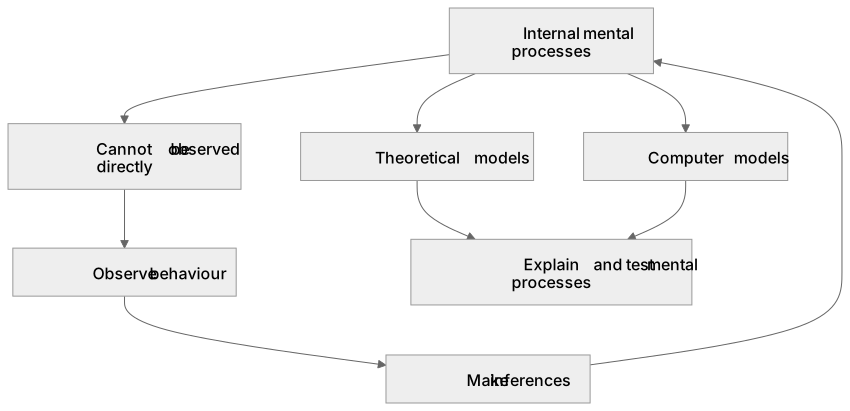
Key words
Say what each word means before you turn the card.
Internal mental processes
Try answering aloud or in your head before turning the card.
Schema
Try answering aloud or in your head before turning the card.
Inference
Try answering aloud or in your head before turning the card.
Computer models
Try answering aloud or in your head before turning the card.
See every definition
- Internal mental processes
- Processes such as memory and perception that cannot be observed directly, so psychologists make inferences about them based on behaviour.
- Schema
- A mental framework of beliefs developed through experience that organises information, allowing rapid cognitive processing but also distorting interpretations.
- Inference
- The process of drawing conclusions about unobservable mental processes based on observed behaviour.
- Computer models
- Models that compare the mind to a computer, with input, processing and output stages, used to explain and test unobservable mental processes.
Label the diagram
Some boxes have lost their names. Pick the right name for each number.
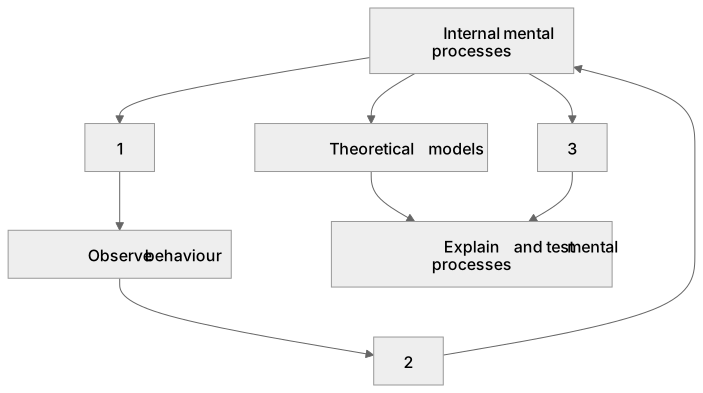
1Box 1
2Box 2
3Box 3
There is more to this lesson
The full lesson goes on to check your understanding and help you earn the marks. Create a free account to carry on, with your progress saved.
A week of Premium from your first lesson · Then the free plan continues · No card, no charge
Test your understanding of Approaches in Psychology: The cognitive approach: the study of internal mental processes, the role of schema, the use of models to explain and make inferences about mental processes.
Active recall beats re-reading. Take an instant quiz now to test what you’ve learned and lock it into long-term memory.
A week of Premium from your first lesson · Then the free plan continues · No card, no charge