AQA · A-Level · Psychology
Course version: 7182-2025 · Exams from 2027
Ainsworth’s ‘Strange Situation’. Types of attachment: secure,…
Full specification wording
Attachment: Ainsworth’s ‘Strange Situation’. Types of attachment: secure, insecure-avoidant and insecure-resistant. Cultural variations in attachment, including van Ijzendoorn.
A controlled observation built to measure attachment quality.
Checked against the AQA 7182-2025 specification (opens in a new tab) on .
- Point 3 of 5
- 4 key terms
Study notes
From the checked teaching notes for this specification point.
The idea
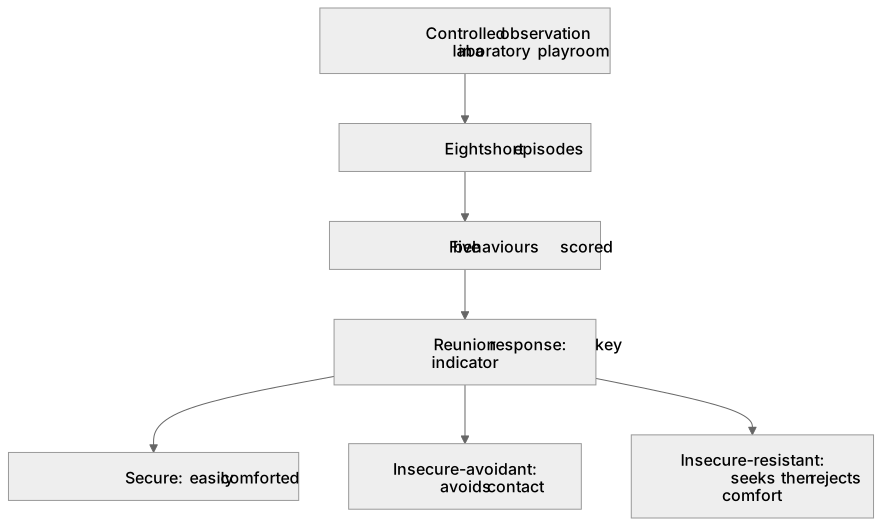
A controlled observation built to measure attachment quality. A baby and carer enter an unfamiliar playroom for eight short episodes behind a two-way mirror, with a stranger entering and the carer leaving and returning twice. Observers score five behaviours: proximity seeking, secure-base exploration, stranger anxiety, separation anxiety and, most telling, the reunion response. Ainsworth found roughly 66% secure (explores, easily comforted), 22% insecure-avoidant (little distress, ignores the carer on return) and 12% insecure-resistant (distressed, seeks then rejects comfort). Van Ijzendoorn and Kroonenberg meta-analysed 32 studies in eight countries: secure led everywhere, avoidant peaked in Germany, resistant in Japan, and variation within countries was about 1.5 times that between them.
What earns the marks
- Procedure identified as a controlled observation in a laboratory playroom, with eight episodes of about three minutes.
- The five behavioural categories scored, with reunion behaviour named as the key indicator.
- Secure attachment described: moderate separation and stranger anxiety, uses carer as a secure base, easily comforted on reunion.
- Insecure-avoidant described: low stranger and separation anxiety, avoids contact at reunion.
- Insecure-resistant described: high anxiety, resists comfort and shows conflicting approach and rejection at reunion.
- Ainsworth's proportions quoted for the three types.
- Van Ijzendoorn and Kroonenberg's meta-analysis: 32 studies, eight countries, secure most common in every sample, most avoidant in Germany, most resistant in Japan.
- The within-culture variation finding, and the conclusion that child-rearing practices, not nationality, drive the differences.
- Evaluation: high inter-rater reliability, imposed etic and culture-bound criteria, and the disorganised type added by Main and Solomon.
Common mistakes and how to put them right
Treating the Strange Situation as an experiment and naming an independent variable, when it is a controlled observation.
Describing insecure-resistant as avoidant and the reverse.
Put it right: The resistant baby wants contact and then fights it.
Reporting cultural variations as differences between countries when the study's own finding is that variation within a country is larger.
Writing that Japanese infants are insecure, rather than that a procedure built on Western child-rearing misclassifies them.
Listing percentages with no comment on what they show, which scores knowledge but no evaluation.
Exam tips
- Reunion behaviour is the discriminator - say what the baby does when the carer comes back for every type you name.
- For a scenario, match the described behaviour to a type and justify it with the specific behaviour in the stem, not with a definition.
- Cultural variation questions reward the imposed etic argument by name, plus one concrete example such as Takahashi's Japanese sample.
- Quote the proportions to one figure each; approximate numbers used accurately are credited, invented precision is not.
Try the lesson
The start of the Attachment: Ainsworth’s ‘Strange Situation’. Types of attachment: secure, insecure-avoidant and insecure-resistant. Cultural variations in attachment, including van Ijzendoorn. lesson, made from checked teaching notes for this specification point.
Have a go first
In Ainsworth's 'Strange Situation', which behaviour is most characteristic of an infant with an insecure-avoidant attachment type when their caregiver returns to the room?
Listen
A controlled observation built to measure attachment quality. A baby and carer enter an unfamiliar playroom for eight short episodes behind a two-way mirror, with a stranger entering and the carer leaving and returning twice. Observers score five behaviours: proximity seeking, secure-base exploration, stranger anxiety, separation anxiety and, most telling, the reunion response. Ainsworth found roughly 66% secure (explores, easily comforted), 22% insecure-avoidant (little distress, ignores the carer on return) and 12% insecure-resistant (distressed, seeks then rejects comfort). Van Ijzendoorn and Kroonenberg meta-analysed 32 studies in eight countries: secure led everywhere, avoidant peaked in Germany, resistant in Japan, and variation within countries was about 1.5 times that between them. A strong answer earns marks for these points. Procedure identified as a controlled observation in a laboratory playroom, with eight episodes of about three minutes. The five behavioural categories scored, with reunion behaviour named as the key indicator. Secure attachment described: moderate separation and stranger anxiety, uses carer as a secure base, easily comforted on reunion. Insecure-avoidant described: low stranger and separation anxiety, avoids contact at reunion. Exam tip: Reunion behaviour is the discriminator - say what the baby does when the carer comes back for every type you name.
See it
Key words
Say what each word means before you turn the card.
Controlled observation and behavioural categories
Try answering aloud or in your head before turning the card.
Secure, insecure-avoidant and insecure-resistant types
Try answering aloud or in your head before turning the card.
Reunion behaviour as the key indicator
Try answering aloud or in your head before turning the card.
Cultural variations and within-culture variation
Try answering aloud or in your head before turning the card.
See every definition
- Controlled observation and behavioural categories
- A baby and carer enter an unfamiliar playroom for eight short episodes behind a two-way mirror, and observers score five behaviours.
- Secure, insecure-avoidant and insecure-resistant types
- Secure explores and is easily comforted, insecure-avoidant shows little distress and ignores the carer on return, insecure-resistant is distressed and seeks then rejects comfort.
- Reunion behaviour as the key indicator
- The reunion response is the most telling of the five behaviours scored, showing what the baby does when the carer comes back.
- Cultural variations and within-culture variation
- Secure led everywhere, avoidant peaked in Germany and resistant in Japan, and variation within countries was about 1.5 times that between them.
Label the diagram
Some boxes have lost their names. Pick the right name for each number.
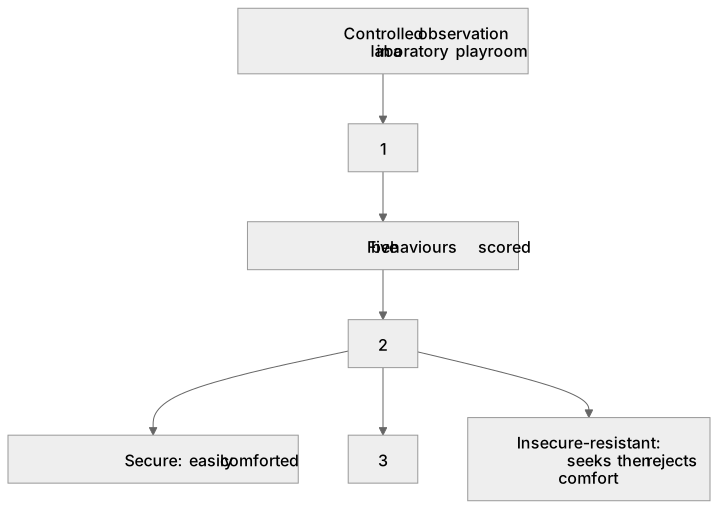
1Box 1
2Box 2
3Box 3
There is more to this lesson
The full lesson goes on to check your understanding and help you earn the marks. Create a free account to carry on, with your progress saved.
A week of Premium from your first lesson · Then the free plan continues · No card, no charge
Test your understanding of Attachment: Ainsworth’s ‘Strange Situation’. Types of attachment: secure, insecure-avoidant and insecure-resistant. Cultural variations in attachment, including van Ijzendoorn.
Active recall beats re-reading. Take an instant quiz now to test what you’ve learned and lock it into long-term memory.
A week of Premium from your first lesson · Then the free plan continues · No card, no charge