AQA · A-Level · Psychology
Course version: 7182-2025 · Exams from 2027
Explanations of attachment: learning theory and Bowlby’s monotropic…
Full specification wording
Attachment: Explanations of attachment: learning theory and Bowlby’s monotropic theory. The concepts of a critical period and an internal working model.
Two rival accounts explain why babies bond.
Checked against the AQA 7182-2025 specification (opens in a new tab) on .
- Point 2 of 5
- 4 key terms
Study notes
From the checked teaching notes for this specification point.
The idea
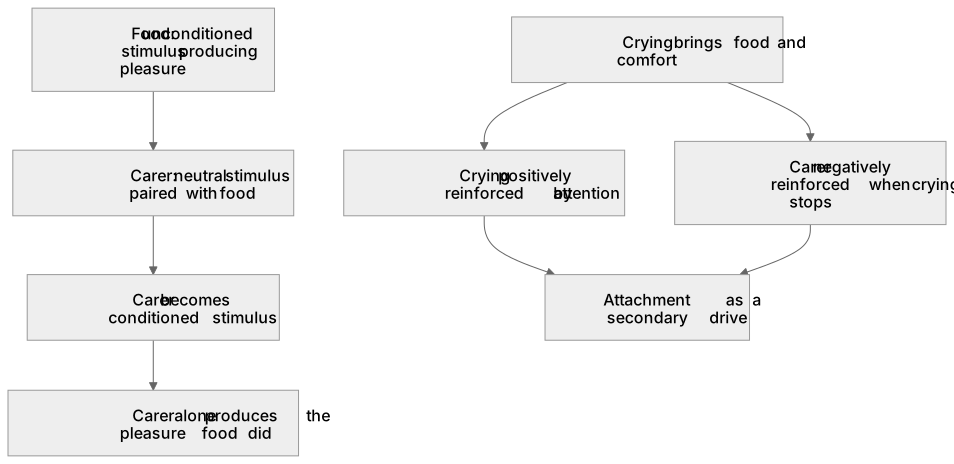
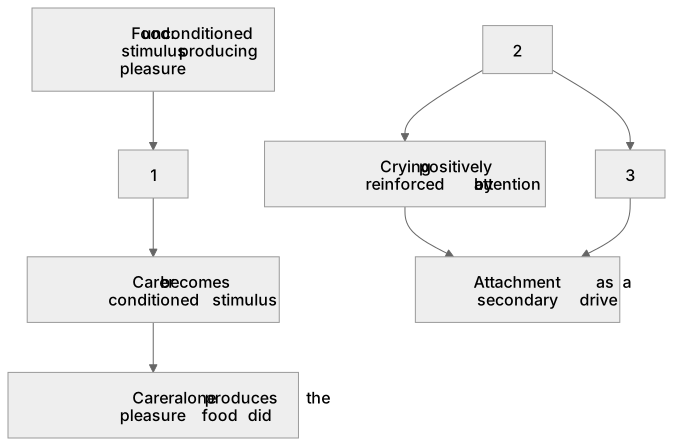
Two rival accounts explain why babies bond. Learning theory, the 'cupboard love' view, says the bond is learned: by classical conditioning, the carer is a neutral stimulus paired with food until the carer alone produces the pleasure food did; by operant conditioning, crying brings food and comfort, and the carer is negatively reinforced when it stops. Dollard and Miller call it a secondary drive. Bowlby rejects this: attachment is innate, triggered by social releasers like crying, focused on one primary figure (monotropy), formed in a critical period of about two years, and carried on as an internal working model templating later relationships. Harlow's monkeys fed from wire and clung to cloth, which learning theory cannot explain.
What earns the marks
- Classical conditioning: food as unconditioned stimulus producing pleasure, carer as neutral stimulus paired with it, carer becoming a conditioned stimulus.
- Operant conditioning and drive reduction: crying is positively reinforced by attention, the carer negatively reinforced by the crying stopping; attachment as a secondary drive.
- Bowlby's evolutionary basis: attachment is innate because it keeps an immobile infant close to a protector.
- Social releasers and the caregiver's innate response to them.
- Monotropy: one special attachment to a primary figure, which is central to Bowlby's monotropic theory.
- Critical (or sensitive) period of roughly two years, after which forming an attachment is much harder.
- Internal working model as a template for later relationships and for the learner's own parenting.
- Evaluation: Harlow counters cupboard love; Schaffer and Emerson's findings on multiple attachments counter monotropy; Bailey et al support intergenerational continuity.
Common mistakes and how to put them right
Mixing up the conditioning stages, usually by calling food the conditioned stimulus or the carer the unconditioned stimulus.
Writing that learning theory has been disproved rather than that food alone is insufficient, since association still plays a part.
Describing monotropy as attachment to the mother only, when Bowlby means one primary figure who need not be biological.
Confusing the internal working model with the critical period, or treating either as a mechanism that acts on its own.
Attributing the law of continuity and law of accumulated separation to maternal deprivation theory, when they actually belong to Bowlby's monotropic theory.
Exam tips
- Set out conditioning as a labelled sequence; examiners credit the stimulus labels, not a general story about food.
- If the question asks you to compare the two explanations, use a comparison sentence per paragraph rather than two separate descriptions.
- Use Schaffer and Emerson's findings on multiple attachments as counter-evidence against Bowlby's concept of monotropy.
- In an extended response, explain both theories concisely and develop evaluation through relevant evidence, comparisons and implications rather than repeating description.
Try the lesson
The start of the Attachment: Explanations of attachment: learning theory and Bowlby’s monotropic theory. The concepts of a critical period and an internal working model. lesson, made from checked teaching notes for this specification point.
Have a go first
According to learning theory explanations of attachment, how does an infant develop an attachment to their primary caregiver?
Listen
Two rival accounts explain why babies bond. Learning theory, the 'cupboard love' view, says the bond is learned: by classical conditioning, the carer is a neutral stimulus paired with food until the carer alone produces the pleasure food did; by operant conditioning, crying brings food and comfort, and the carer is negatively reinforced when it stops. Dollard and Miller call it a secondary drive. Bowlby rejects this: attachment is innate, triggered by social releasers like crying, focused on one primary figure (monotropy), formed in a critical period of about two years, and carried on as an internal working model templating later relationships. Harlow's monkeys fed from wire and clung to cloth, which learning theory cannot explain. A strong answer earns marks for these points. Classical conditioning: food as unconditioned stimulus producing pleasure, carer as neutral stimulus paired with it, carer becoming a conditioned stimulus. Operant conditioning and drive reduction: crying is positively reinforced by attention, the carer negatively reinforced by the crying stopping; attachment as a secondary drive. Bowlby's evolutionary basis: attachment is innate because it keeps an immobile infant close to a protector. Social releasers and the caregiver's innate response to them. Exam tip: Set out conditioning as a labelled sequence; examiners credit the stimulus labels, not a general story about food.
See it
Key words
Say what each word means before you turn the card.
Classical conditioning of attachment
Try answering aloud or in your head before turning the card.
Operant conditioning of attachment
Try answering aloud or in your head before turning the card.
Monotropy
Try answering aloud or in your head before turning the card.
Internal working model
Try answering aloud or in your head before turning the card.
See every definition
- Classical conditioning of attachment
- The carer is a neutral stimulus paired with food until the carer alone produces the pleasure food did.
- Operant conditioning of attachment
- Crying brings food and comfort, and the carer is negatively reinforced when it stops.
- Monotropy
- One special attachment to a primary figure, which is central to Bowlby's monotropic theory.
- Internal working model
- A template for later relationships and for the learner's own parenting.
Label the diagram
Some boxes have lost their names. Pick the right name for each number.
1Box 1
2Box 2
3Box 3
There is more to this lesson
The full lesson goes on to check your understanding and help you earn the marks. Create a free account to carry on, with your progress saved.
A week of Premium from your first lesson · Then the free plan continues · No card, no charge
Test your understanding of Attachment: Explanations of attachment: learning theory and Bowlby’s monotropic theory. The concepts of a critical period and an internal working model.
Active recall beats re-reading. Take an instant quiz now to test what you’ve learned and lock it into long-term memory.
A week of Premium from your first lesson · Then the free plan continues · No card, no charge