AQA · A-Level · Psychology
Course version: 7182-2025 · Exams from 2027
Attachment: Animal studies of attachment: Lorenz and Harlow.
Imprinting is a fast, innate bond to the first moving object seen.
Checked against the AQA 7182-2025 specification (opens in a new tab) on .
- Point 1 of 5
- 4 key terms
Study notes
From the checked teaching notes for this specification point.
The idea
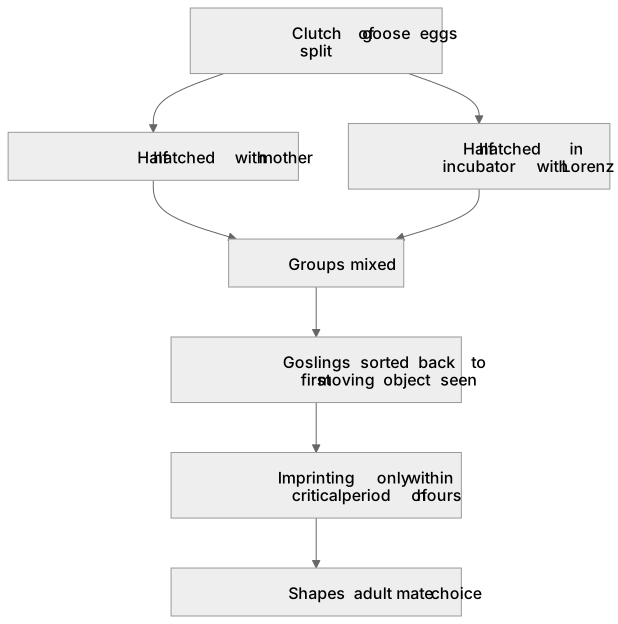
Imprinting is a fast, innate bond to the first moving object seen. Lorenz (1935) split a clutch of goose eggs: half hatched with the mother, half in an incubator where he was the first thing seen. His goslings followed him and, once the groups were mixed, sorted back to him. He argued imprinting happens only within a critical period of hours and shapes adult mate choice. Harlow (1958) gave infant rhesus monkeys a wire mother that dispensed milk and a cloth mother that did not; they clung to the cloth mother around 17-18 hours a day and visited the wire one only to feed, so contact comfort, not food, builds the bond. Deprived monkeys became aggressive and neglectful parents. Evaluation: birds are not mammals, Guiton showed imprinting can be reversed, and Harlow's monkeys were lastingly harmed.
What earns the marks
- Imprinting defined: an innate readiness to follow and bond with the first moving object, formed in a narrow time window.
- Lorenz's procedure: a clutch of goose eggs split between the natural mother and an incubator, then the hatchlings mixed to see whom they followed.
- Lorenz's findings: incubator goslings followed him, separated back to him when mixed, and imprinting did not occur outside a critical period of a few hours.
- Sexual imprinting as a long-term effect, illustrated by the peacock reared among tortoises.
- Harlow's procedure: infant rhesus monkeys given a wire mother with a feeding bottle and a cloth mother without one.
- Harlow's findings: monkeys spent 17-18 hours a day on the cloth mother and fed briefly from the wire one, showing contact comfort outweighs feeding.
- Harlow's long-term findings: maternally deprived monkeys were socially and sexually abnormal and neglected their own young.
- Evaluation: generalising from birds and monkeys to humans, reversibility of imprinting, and the ethics set against the practical value of the work.
Common mistakes and how to put them right
Saying Lorenz studied ducks or that the goslings were taught to follow him, when imprinting is innate and the birds were geese.
Reporting that the wire mother was ignored altogether, when the monkeys did go to it to feed, which is the point of the study.
Treating Harlow's monkeys as proof that human attachment works the same way, with no comment on the species difference.
Offering ethics as the only evaluation point, with no balancing statement about what the research changed in practice.
Exam tips
- Name the animal, the manipulation and the result for each study - vague sentences such as 'Harlow studied monkeys' earn nothing.
- A question on generalisability wants a reason, not a label: say what is different about a precocial bird or a rhesus monkey.
- For ethics, use the cost-benefit argument both ways, because a one-sided condemnation is not a developed evaluation.
- If the question names only one researcher, do not spend half the answer on the other.
Try the lesson
The start of the Attachment: Animal studies of attachment: Lorenz and Harlow. lesson, made from checked teaching notes for this specification point.
Have a go first
What did Harlow's research with rhesus monkeys demonstrate about the basis of attachment?
Listen
Imprinting is a fast, innate bond to the first moving object seen. Lorenz (1935) split a clutch of goose eggs: half hatched with the mother, half in an incubator where he was the first thing seen. His goslings followed him and, once the groups were mixed, sorted back to him. He argued imprinting happens only within a critical period of hours and shapes adult mate choice. Harlow (1958) gave infant rhesus monkeys a wire mother that dispensed milk and a cloth mother that did not; they clung to the cloth mother around 17-18 hours a day and visited the wire one only to feed, so contact comfort, not food, builds the bond. Deprived monkeys became aggressive and neglectful parents. Evaluation: birds are not mammals, Guiton showed imprinting can be reversed, and Harlow's monkeys were lastingly harmed. A strong answer earns marks for these points. Imprinting defined: an innate readiness to follow and bond with the first moving object, formed in a narrow time window. Lorenz's procedure: a clutch of goose eggs split between the natural mother and an incubator, then the hatchlings mixed to see whom they followed. Lorenz's findings: incubator goslings followed him, separated back to him when mixed, and imprinting did not occur outside a critical period of a few hours. Sexual imprinting as a long-term effect, illustrated by the peacock reared among tortoises. Exam tip: Name the animal, the manipulation and the result for each study - vague sentences such as 'Harlow studied monkeys' earn nothing.
See it
Key words
Say what each word means before you turn the card.
Imprinting
Try answering aloud or in your head before turning the card.
Critical period
Try answering aloud or in your head before turning the card.
Contact comfort
Try answering aloud or in your head before turning the card.
Maternal deprivation
Try answering aloud or in your head before turning the card.
See every definition
- Imprinting
- A fast, innate bond to the first moving object seen, formed in a narrow time window.
- Critical period
- A narrow time window of hours within which imprinting happens and outside which it does not occur.
- Contact comfort
- Clinging to a cloth mother that does not feed, showing that comfort rather than food builds the bond.
- Maternal deprivation
- Being without a mother, which in monkeys produced aggressive and neglectful parenting.
Label the diagram
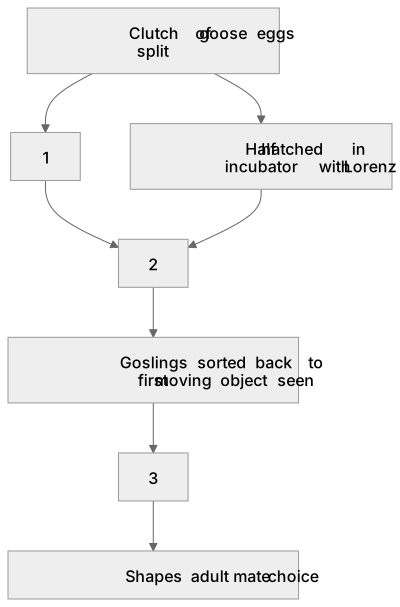
Some boxes have lost their names. Pick the right name for each number.
1Box 1
2Box 2
3Box 3
There is more to this lesson
The full lesson goes on to check your understanding and help you earn the marks. Create a free account to carry on, with your progress saved.
A week of Premium from your first lesson · Then the free plan continues · No card, no charge
Test your understanding of Attachment: Animal studies of attachment: Lorenz and Harlow.
Active recall beats re-reading. Take an instant quiz now to test what you’ve learned and lock it into long-term memory.
A week of Premium from your first lesson · Then the free plan continues · No card, no charge