AQA · A-Level · Psychology
Course version: 7182-2025 · Exams from 2027
The fight or flight response including the role of adrenaline.
Full specification wording
Biopsychology: The fight or flight response including the role of adrenaline.
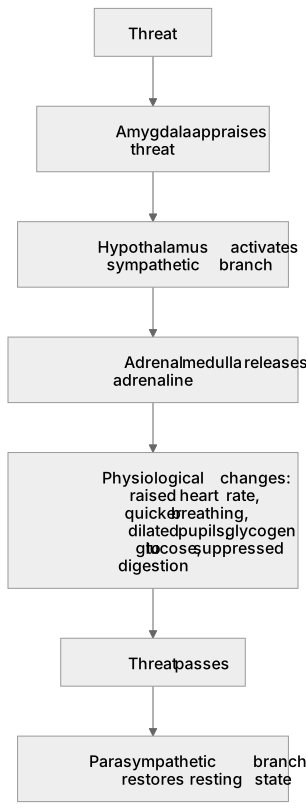
Faced with a threat, the amygdala signals the hypothalamus, activating the sympathetic branch of the autonomic nervous system.
Checked against the AQA 7182-2025 specification (opens in a new tab) on .
- Point 4 of 6
- 4 key terms
Study notes
From the checked teaching notes for this specification point.
The idea
Faced with a threat, the amygdala signals the hypothalamus, activating the sympathetic branch of the autonomic nervous system. This stimulates the adrenal medulla to release adrenaline into the bloodstream, causing rapid physiological changes. Heart rate rises, breathing quickens, pupils dilate, and stored glycogen converts to glucose for muscle energy. Digestion is suppressed as it is not needed for immediate survival. Once the threat passes, the parasympathetic branch returns the body to baseline. For evaluation, Taylor et al. (2000) argued the model is beta biased as females often show a tend and befriend response, while Gray (1988) noted the initial reaction is usually to freeze and scan for information.
What earns the marks
- Amygdala appraises the threat and sends a distress signal to the hypothalamus.
- Hypothalamus activates the sympathetic branch of the autonomic nervous system (the sympathomedullary pathway).
- Adrenal medulla releases adrenaline directly into the bloodstream, which is why the response is almost immediate.
- At least three physiological effects with a survival reason: raised heart rate to deliver oxygen, glycogen to glucose for energy, dilated pupils, suppressed digestion.
- Parasympathetic branch restores resting state once the threat ends.
- Evaluation: Taylor et al. (2000) on tend and befriend and beta bias; Gray (1988) on the freeze response; chronic activation linked to raised blood pressure and heart disease in modern life.
Common mistakes and how to put them right
Confusing adrenaline with cortisol.
Put it right: Adrenaline comes from the adrenal medulla in the acute response; cortisol comes from the adrenal cortex during prolonged stress.
Describing the effects without saying why they help, when the adaptive reason is usually required for full explanation.
Forgetting the parasympathetic 'rest and digest' return, so the answer implies arousal simply stops on its own.
Writing the evaluation as 'it ignores women' instead of naming tend and befriend and identifying beta bias as the criticism.
Exam tips
- Learn the pathway as a chain of four links (amygdala, hypothalamus, sympathetic branch, adrenal medulla) so an outline writes itself.
- Pair each physical change with its function; a list of changes reads as description while a change plus purpose reads as explanation.
- In extended response questions, evaluation carries significant weight, so ensure concepts like tend and befriend, the freeze response, and the costs of chronic arousal are developed in depth rather than just listed.
Try the lesson
The start of the Biopsychology: The fight or flight response including the role of adrenaline. lesson, made from checked teaching notes for this specification point.
Have a go first
Which division of the human nervous system is primarily activated during the fight or flight response, triggering the release of adrenaline?
Listen
Faced with a threat, the amygdala signals the hypothalamus, activating the sympathetic branch of the autonomic nervous system. This stimulates the adrenal medulla to release adrenaline into the bloodstream, causing rapid physiological changes. Heart rate rises, breathing quickens, pupils dilate, and stored glycogen converts to glucose for muscle energy. Digestion is suppressed as it is not needed for immediate survival. Once the threat passes, the parasympathetic branch returns the body to baseline. For evaluation, Taylor et al. (2000) argued the model is beta biased as females often show a tend and befriend response, while Gray (1988) noted the initial reaction is usually to freeze and scan for information. A strong answer earns marks for these points. Amygdala appraises the threat and sends a distress signal to the hypothalamus. Hypothalamus activates the sympathetic branch of the autonomic nervous system (the sympathomedullary pathway). Adrenal medulla releases adrenaline directly into the bloodstream, which is why the response is almost immediate. At least three physiological effects with a survival reason: raised heart rate to deliver oxygen, glycogen to glucose for energy, dilated pupils, suppressed digestion. Exam tip: Learn the pathway as a chain of four links (amygdala, hypothalamus, sympathetic branch, adrenal medulla) so an outline writes itself.
See it
Put it in order
Put these steps in the order they happen.
- 1. Parasympathetic branch restores resting state
- 2. Threat passes
- 3. Hypothalamus activates sympathetic branch
- 4. Physiological changes: raised heart rate, quicker breathing, dilated pupils, glycogen to glucose, suppressed digestion
- 5. Threat
- 6. Amygdala appraises threat
- 7. Adrenal medulla releases adrenaline
Key words
Say what each word means before you turn the card.
Sympathomedullary pathway
Try answering aloud or in your head before turning the card.
Adrenaline
Try answering aloud or in your head before turning the card.
Tend and befriend
Try answering aloud or in your head before turning the card.
Freeze response
Try answering aloud or in your head before turning the card.
See every definition
- Sympathomedullary pathway
- The hypothalamus activates the sympathetic branch of the autonomic nervous system, which stimulates the adrenal medulla to release adrenaline.
- Adrenaline
- Released by the adrenal medulla directly into the bloodstream, which is why the response is almost immediate.
- Tend and befriend
- A response females often show, used by Taylor et al. (2000) to argue the model is beta biased.
- Freeze response
- Noted by Gray (1988), who said the initial reaction is usually to freeze and scan for information.
Label the diagram
Some boxes have lost their names. Pick the right name for each number.
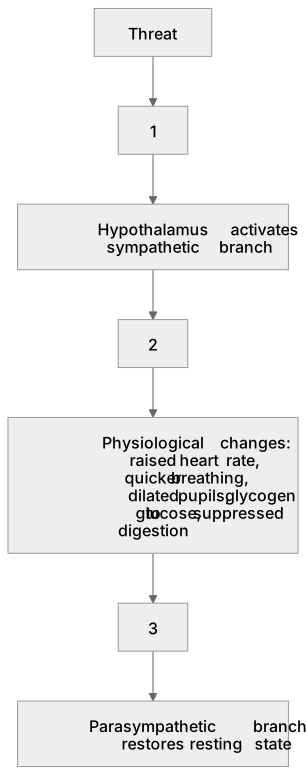
1Box 1
2Box 2
3Box 3
There is more to this lesson
The full lesson goes on to check your understanding and help you earn the marks. Create a free account to carry on, with your progress saved.
A week of Premium from your first lesson · Then the free plan continues · No card, no charge
Test your understanding of Biopsychology: The fight or flight response including the role of adrenaline.
Active recall beats re-reading. Take an instant quiz now to test what you’ve learned and lock it into long-term memory.
A week of Premium from your first lesson · Then the free plan continues · No card, no charge