AQA · A-Level · Psychology
Course version: 7182-2025 · Exams from 2027
The behavioural approach to explaining and treating phobias: the…
Full specification wording
Clinical Psychology and Mental Health: The behavioural approach to explaining and treating phobias: the two-process model, including classical and operant conditioning; systematic desensitisation, including relaxation and use of hierarchy; flooding.
Mowrer's two-process model says a phobia is learned twice.
Checked against the AQA 7182-2025 specification (opens in a new tab) on .
- Point 3 of 5
Study notes
From the checked teaching notes for this specification point.
The idea
Mowrer's two-process model says a phobia is learned twice. Classical conditioning acquires it: Watson and Rayner paired a white rat (neutral stimulus) with a loud noise until Little Albert cried at the rat alone. Operant conditioning maintains it: avoiding the feared object removes anxiety, and that relief is negative reinforcement. Systematic desensitisation counter-conditions it with relaxation training, an anxiety hierarchy and gradual exposure, since fear and relaxation cannot be felt together. Flooding uses immediate full exposure until adrenaline falls and fear extinguishes. Evaluate with Gilroy: 42 spider phobics given SD were less fearful at 33 months, while flooding is cheaper but traumatic with high refusal rates.
What earns the marks
- Two-process model: classical conditioning acquires the phobia by association, operant conditioning maintains it through negative reinforcement from avoidance.
- Correct use of conditioning terms, with the neutral stimulus, unconditioned stimulus and conditioned response identified in an example such as Little Albert.
- Systematic desensitisation described as relaxation training plus an anxiety hierarchy plus gradual exposure, working through reciprocal inhibition.
- Flooding described as immediate, prolonged exposure with no hierarchy, ending in extinction when the adrenaline response exhausts itself.
Common mistakes and how to put them right
Explaining only the classical conditioning half, so the answer never says why the phobia persists when the person is never bitten again.
Calling avoidance positive reinforcement, when the reinforcement is negative because an unpleasant feeling is removed rather than a reward added.
Describing systematic desensitisation as just facing the fear, leaving out the relaxation training and the hierarchy that make it desensitisation rather than flooding.
Claiming flooding is unethical and stopping there, when clients give informed consent and the real criticism is the trauma and dropout rate.
Exam tips
- When evaluating, ensure you link the evidence back to the specific explanation or treatment, rather than just stating the study findings.
- For treatment questions, order the stages and say what the therapist does at each one; examiners credit sequence as well as content.
- Use biological preparedness and the existence of phobias without any traumatic event as a competing explanation, not just as a passing criticism.
Try the lesson
The start of the Clinical Psychology and Mental Health: The behavioural approach to explaining and treating phobias: the two-process model, including classical and operant conditioning; systematic desensitisation, including relaxation and use of hierarchy; flooding. lesson, made from checked teaching notes for this specification point.
Have a go first
According to Mowrer's two-process model of phobias, how are phobic responses acquired and subsequently maintained?
Listen
Mowrer's two-process model says a phobia is learned twice. Classical conditioning acquires it: Watson and Rayner paired a white rat (neutral stimulus) with a loud noise until Little Albert cried at the rat alone. Operant conditioning maintains it: avoiding the feared object removes anxiety, and that relief is negative reinforcement. Systematic desensitisation counter-conditions it with relaxation training, an anxiety hierarchy and gradual exposure, since fear and relaxation cannot be felt together. Flooding uses immediate full exposure until adrenaline falls and fear extinguishes. Evaluate with Gilroy: 42 spider phobics given SD were less fearful at 33 months, while flooding is cheaper but traumatic with high refusal rates. A strong answer earns marks for these points. Two-process model: classical conditioning acquires the phobia by association, operant conditioning maintains it through negative reinforcement from avoidance. Correct use of conditioning terms, with the neutral stimulus, unconditioned stimulus and conditioned response identified in an example such as Little Albert. Systematic desensitisation described as relaxation training plus an anxiety hierarchy plus gradual exposure, working through reciprocal inhibition. Flooding described as immediate, prolonged exposure with no hierarchy, ending in extinction when the adrenaline response exhausts itself. Exam tip: When evaluating, ensure you link the evidence back to the specific explanation or treatment, rather than just stating the study findings.
See it
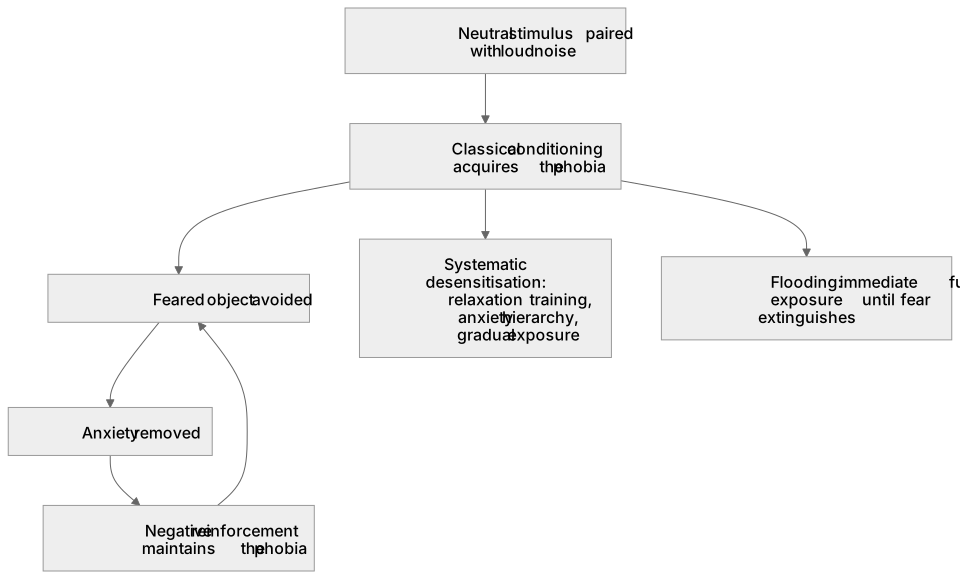
Label the diagram
Some boxes have lost their names. Pick the right name for each number.
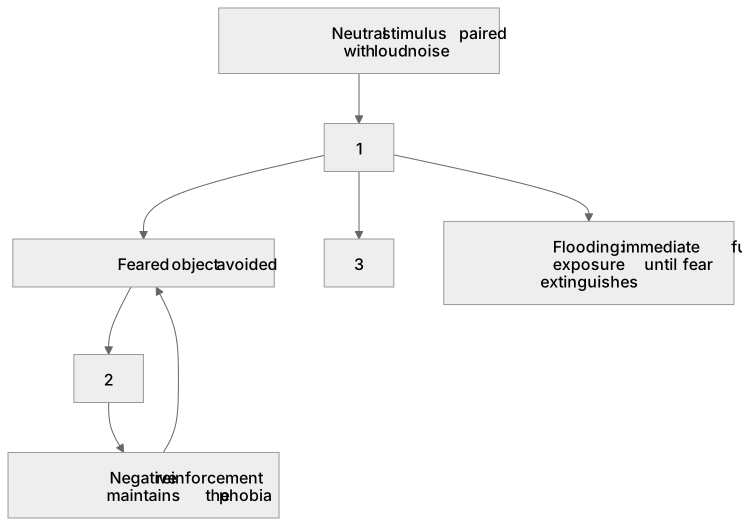
1Box 1
2Box 2
3Box 3
There is more to this lesson
The full lesson goes on to check your understanding and help you earn the marks. Create a free account to carry on, with your progress saved.
A week of Premium from your first lesson · Then the free plan continues · No card, no charge
Test your understanding of Clinical Psychology and Mental Health: The behavioural approach to explaining and treating phobias: the two-process model, including classical and operant conditioning; systematic desensitisation, including relaxation and use of hierarchy; flooding.
Active recall beats re-reading. Take an instant quiz now to test what you’ve learned and lock it into long-term memory.
A week of Premium from your first lesson · Then the free plan continues · No card, no charge