AQA · A-Level · Psychology
Course version: 7182-2025 · Exams from 2027
The cognitive approach to explaining and treating depression: Beck’s…
Full specification wording
Clinical Psychology and Mental Health: The cognitive approach to explaining and treating depression: Beck’s negative triad and Ellis’s ABC model; cognitive behaviour therapy (CBT), including challenging irrational thoughts.
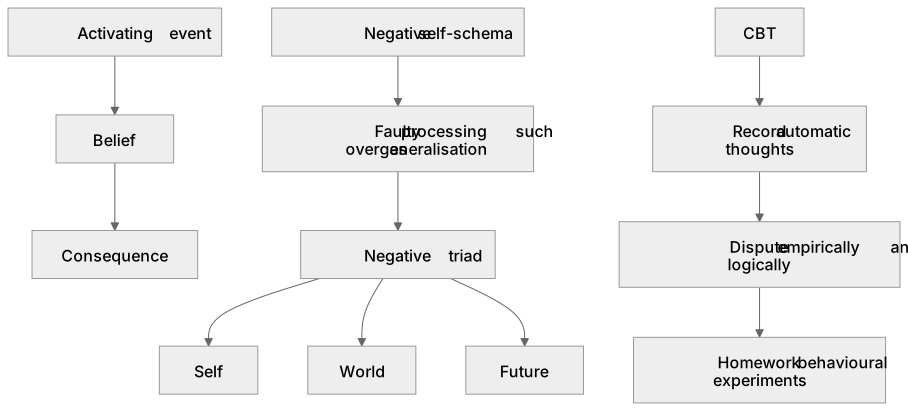
Beck traces depression to a negative self-schema formed in childhood, which produces faulty processing such as overgeneralisation, and settles into the negative triad: a pessimistic view of the…
Checked against the AQA 7182-2025 specification (opens in a new tab) on .
- Point 4 of 5
- 4 key terms
Study notes
From the checked teaching notes for this specification point.
The idea
Beck traces depression to a negative self-schema formed in childhood, which produces faulty processing such as overgeneralisation, and settles into the negative triad: a pessimistic view of the self, of the world and of the future, each feeding the next. Ellis writes it as ABC, where an Activating event meets a Belief and the Consequence follows from the belief rather than the event, so a demand such as I must succeed at everything produces the depression. CBT tests those beliefs: the client records automatic thoughts, the therapist disputes them empirically by asking for the evidence and logically by asking whether the conclusion follows, and homework sets behavioural experiments. March found 81% of adolescents improved on CBT, matching antidepressants. Evaluate: it cannot explain anger or hallucinations, and it risks blaming the client.
What earns the marks
- Beck's negative schema and cognitive biases, then the three elements of the negative triad named as self, world and future.
- Ellis's ABC model with each letter correctly expanded and the point that the belief, not the activating event, causes the emotional consequence.
- Named irrational beliefs such as musturbatory thinking or utopianism, used to show what an irrational belief actually looks like.
- CBT described as identifying, challenging and replacing irrational thoughts, with thought records, disputing and behavioural activation or homework.
- Evaluation: outcome evidence such as March's trial, the problem of cause versus effect in the negative triad, unsuitability for severe cases, and the alternative biological explanation.
Common mistakes and how to put them right
Writing the negative triad as three negative thoughts without naming self, world and future, which is the only part examiners can tick.
Muddling the ABC model by calling C the event and A the consequence, or leaving out the beliefs altogether.
Saying CBT just talks about problems, when the credited detail is disputing irrational beliefs and testing them as hypotheses.
Treating the correlation between negative thinking and depression as proof that the thinking came first.
Exam tips
- If a question names Beck or Ellis, answer on that theorist only; the other one is wasted writing.
- For a discuss response, explain both cognitive accounts clearly, then develop evidence-based evaluation using named research or a competing explanation.
- In application questions, pick the client's actual words from the stem and label them as the activating event, the irrational belief or the consequence.
Try the lesson
The start of the Clinical Psychology and Mental Health: The cognitive approach to explaining and treating depression: Beck’s negative triad and Ellis’s ABC model; cognitive behaviour therapy (CBT), including challenging irrational thoughts. lesson, made from checked teaching notes for this specification point.
Have a go first
According to Beck's cognitive theory of depression, which three elements make up the negative triad?
Listen
Beck traces depression to a negative self-schema formed in childhood, which produces faulty processing such as overgeneralisation, and settles into the negative triad: a pessimistic view of the self, of the world and of the future, each feeding the next. Ellis writes it as ABC, where an Activating event meets a Belief and the Consequence follows from the belief rather than the event, so a demand such as I must succeed at everything produces the depression. CBT tests those beliefs: the client records automatic thoughts, the therapist disputes them empirically by asking for the evidence and logically by asking whether the conclusion follows, and homework sets behavioural experiments. March found 81% of adolescents improved on CBT, matching antidepressants. Evaluate: it cannot explain anger or hallucinations, and it risks blaming the client. A strong answer earns marks for these points. Beck's negative schema and cognitive biases, then the three elements of the negative triad named as self, world and future. Ellis's ABC model with each letter correctly expanded and the point that the belief, not the activating event, causes the emotional consequence. Named irrational beliefs such as musturbatory thinking or utopianism, used to show what an irrational belief actually looks like. CBT described as identifying, challenging and replacing irrational thoughts, with thought records, disputing and behavioural activation or homework. Exam tip: If a question names Beck or Ellis, answer on that theorist only; the other one is wasted writing.
See it
Key words
Say what each word means before you turn the card.
Negative triad
Try answering aloud or in your head before turning the card.
ABC model
Try answering aloud or in your head before turning the card.
CBT
Try answering aloud or in your head before turning the card.
Empirical disputing
Try answering aloud or in your head before turning the card.
See every definition
- Negative triad
- A pessimistic view of the self, of the world and of the future, each feeding the next, which depression settles into.
- ABC model
- An Activating event meets a Belief and the Consequence follows from the belief rather than the event.
- CBT
- The client records automatic thoughts, the therapist disputes them empirically and logically, and homework sets behavioural experiments.
- Empirical disputing
- The therapist disputes the client's beliefs by asking for the evidence.
Label the diagram
Some boxes have lost their names. Pick the right name for each number.
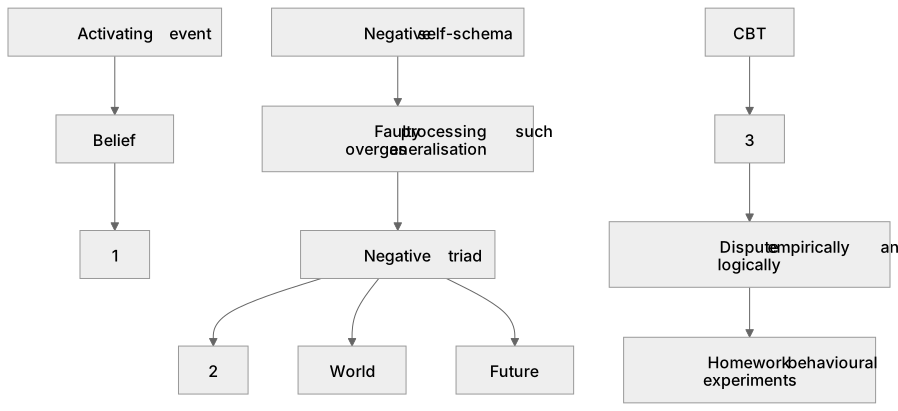
1Box 1
2Box 2
3Box 3
There is more to this lesson
The full lesson goes on to check your understanding and help you earn the marks. Create a free account to carry on, with your progress saved.
A week of Premium from your first lesson · Then the free plan continues · No card, no charge
Test your understanding of Clinical Psychology and Mental Health: The cognitive approach to explaining and treating depression: Beck’s negative triad and Ellis’s ABC model; cognitive behaviour therapy (CBT), including challenging irrational thoughts.
Active recall beats re-reading. Take an instant quiz now to test what you’ve learned and lock it into long-term memory.
A week of Premium from your first lesson · Then the free plan continues · No card, no charge