AQA · A-Level · Psychology
Course version: 7182-2025 · Exams from 2027
The biological approach to explaining and treating OCD: genetic and neural…
Full specification wording
Clinical Psychology and Mental Health: The biological approach to explaining and treating OCD: genetic and neural explanations; drug therapy.
OCD runs in families.
Checked against the AQA 7182-2025 specification (opens in a new tab) on .
- Point 5 of 5
- 4 key terms
Study notes
From the checked teaching notes for this specification point.
The idea
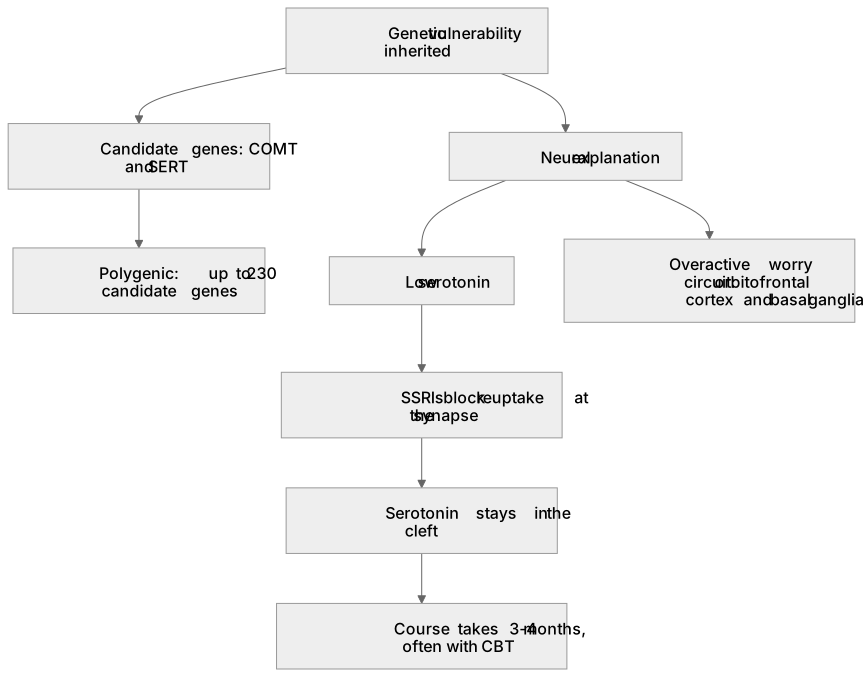
OCD runs in families. Lewis found 37% of his OCD patients had a parent with the disorder and 21% a sibling. Nestadt's twin study gave 68% concordance for identical twins against 31% for non-identical, showing vulnerability is inherited. Taylor identified up to 230 candidate genes, including COMT and SERT, regulating dopamine and serotonin, meaning OCD is polygenic. The neural explanation adds low serotonin and an overactive worry circuit in the orbitofrontal cortex and basal ganglia. For treating OCD, drug therapy uses SSRIs to block reuptake at the synapse so serotonin stays in the cleft. These take 3-4 months and are often combined with CBT. Evaluate with Soomro's review of 17 trials against side effects and drug company funding.
What earns the marks
- Genetic explanation: candidate genes such as COMT and SERT, the polygenic nature of OCD, and the diathesis-stress point that vulnerability rather than the disorder is inherited.
- Twin and family evidence quoted with figures, such as Nestadt's 68% concordance in identical twins against 31% in non-identical twins.
- Neural explanation: low serotonin and its effect on mood transmission, plus abnormal functioning of the orbitofrontal cortex, thalamus and basal ganglia worry circuit.
- Drug therapy: SSRIs preventing reuptake of serotonin in the synapse, the typical dose and course length, and alternatives such as clomipramine or an SNRI when SSRIs fail.
- Evaluation: supporting trial evidence, side effects and dropout, publication bias from drug company sponsorship, and the argument that drugs treat symptoms while leaving the cause untouched.
Common mistakes and how to put them right
Saying OCD is genetic or is caused by a faulty gene, when concordance well below 100% shows environment is involved and no single gene is responsible.
Describing SSRIs as increasing serotonin production rather than preventing its reuptake, which is the mechanism examiners look for.
Confusing the basal ganglia and orbitofrontal cortex with structures from other topics, or naming a brain area without saying what it does in OCD.
Treating drug side effects as an argument that the biological explanation is wrong, when they are an evaluation of the therapy, not of the explanation.
Exam tips
- Questions often split genetic and neural explanations, so know which studies belong to which before you start writing.
- Quote concordance figures rather than saying twins are similar; providing specific evidence demonstrates a deeper understanding of the genetic explanation.
- For evaluation, compare drugs with CBT on cost, dropout and relapse rather than simply saying drugs are effective.
Try the lesson
The start of the Clinical Psychology and Mental Health: The biological approach to explaining and treating OCD: genetic and neural explanations; drug therapy. lesson, made from checked teaching notes for this specification point.
Have a go first
According to the biological approach, which neurotransmitter is typically found at abnormally low levels in the brains of individuals with obsessive-compulsive disorder (OCD)?
Listen
OCD runs in families. Lewis found 37% of his OCD patients had a parent with the disorder and 21% a sibling. Nestadt's twin study gave 68% concordance for identical twins against 31% for non-identical, showing vulnerability is inherited. Taylor identified up to 230 candidate genes, including COMT and SERT, regulating dopamine and serotonin, meaning OCD is polygenic. The neural explanation adds low serotonin and an overactive worry circuit in the orbitofrontal cortex and basal ganglia. For treating OCD, drug therapy uses SSRIs to block reuptake at the synapse so serotonin stays in the cleft. These take 3-4 months and are often combined with CBT. Evaluate with Soomro's review of 17 trials against side effects and drug company funding. A strong answer earns marks for these points. Genetic explanation: candidate genes such as COMT and SERT, the polygenic nature of OCD, and the diathesis-stress point that vulnerability rather than the disorder is inherited. Twin and family evidence quoted with figures, such as Nestadt's 68% concordance in identical twins against 31% in non-identical twins. Neural explanation: low serotonin and its effect on mood transmission, plus abnormal functioning of the orbitofrontal cortex, thalamus and basal ganglia worry circuit. Drug therapy: SSRIs preventing reuptake of serotonin in the synapse, the typical dose and course length, and alternatives such as clomipramine or an SNRI when SSRIs fail. Exam tip: Questions often split genetic and neural explanations, so know which studies belong to which before you start writing.
See it
Key words
Say what each word means before you turn the card.
Candidate genes
Try answering aloud or in your head before turning the card.
Polygenic
Try answering aloud or in your head before turning the card.
Worry circuit
Try answering aloud or in your head before turning the card.
SSRIs
Try answering aloud or in your head before turning the card.
See every definition
- Candidate genes
- Genes such as COMT and SERT that regulate dopamine and serotonin, with up to 230 identified by Taylor, meaning OCD is polygenic.
- Polygenic
- OCD is influenced by many candidate genes rather than a single gene, as shown by Taylor identifying up to 230 candidate genes.
- Worry circuit
- An overactive circuit in the orbitofrontal cortex and basal ganglia, which the neural explanation adds alongside low serotonin.
- SSRIs
- Drug therapy that blocks reuptake at the synapse so serotonin stays in the cleft, taking 3-4 months and often combined with CBT.
Label the diagram
Some boxes have lost their names. Pick the right name for each number.
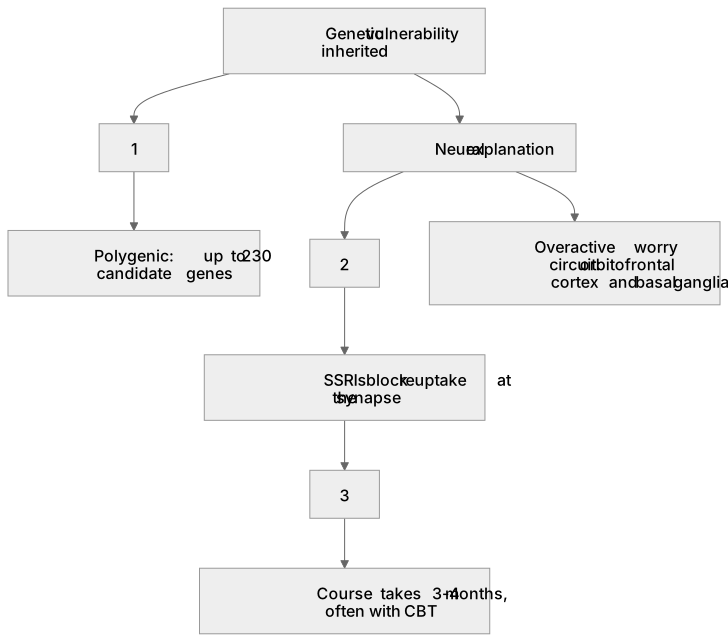
1Box 1
2Box 2
3Box 3
There is more to this lesson
The full lesson goes on to check your understanding and help you earn the marks. Create a free account to carry on, with your progress saved.
A week of Premium from your first lesson · Then the free plan continues · No card, no charge
Test your understanding of Clinical Psychology and Mental Health: The biological approach to explaining and treating OCD: genetic and neural explanations; drug therapy.
Active recall beats re-reading. Take an instant quiz now to test what you’ve learned and lock it into long-term memory.
A week of Premium from your first lesson · Then the free plan continues · No card, no charge