AQA · A-Level · Psychology
Course version: 7182-2025 · Exams from 2027
Piaget’s theory of cognitive development: schemas, assimilation,…
Full specification wording
Cognition and development: Piaget’s theory of cognitive development: schemas, assimilation, accommodation, equilibration, stages of intellectual development. Characteristics of these stages, including object permanence, conservation, egocentrism and class inclusion.
A schema is a mental packet of knowledge.
Checked against the AQA 7182-2025 specification (opens in a new tab) on .
- Point 1 of 4
- 4 key terms
Study notes
From the checked teaching notes for this specification point.
The idea
A schema is a mental packet of knowledge. Piaget argued children build them: experience fitting an existing schema is assimilated, clashing experience creates disequilibrium requiring accommodation, and equilibration drives the return to balance. Four stages of intellectual development follow: sensorimotor (object permanence at eight months), pre-operational (egocentrism, failure of conservation, failure of class inclusion), concrete operational, and formal operational. Evaluation is key: Hughes (1975) found 90% of young children could hide a doll from policemen, and McGarrigle and Donaldson (1974) raised conservation success from 16% to 62.5% when a naughty teddy made the change look accidental, showing Piaget understated early abilities.
What earns the marks
- Schema defined as a mental framework or packet of knowledge used to organise and interpret experience, constructed by the child rather than taught.
- Assimilation: new information is taken into an existing schema, which does not have to change.
- Accommodation: information that will not fit produces disequilibrium, so a schema is altered or a new one formed; equilibration is the return to a balanced state and is the motor of development.
- Named evidence: the blanket and hidden toy, the three mountains task, the counters and beakers conservation tasks, and the dogs-and-animals class inclusion question.
Common mistakes and how to put them right
Swapping assimilation and accommodation, or calling any new learning accommodation when nothing about the schema actually changed.
Attaching a characteristic to the wrong stage, most often putting object permanence in the pre-operational stage or conservation in the sensorimotor stage.
Explaining egocentrism as selfishness rather than an inability to represent another person’s viewpoint.
Listing the four stages with ages and stopping there, which caps an essay at the descriptive marks and throws away the larger evaluation allocation.
Saying the studies "prove Piaget wrong" when what they show is that his tasks made the competence look later than it is.
Exam tips
- When writing an extended essay, describe two or three stage features precisely and then spend most of the answer on the counter-evidence and on Vygotsky to ensure sufficient evaluation.
- In a scenario question, name the stage and quote the behaviour in the stem that shows it; the application mark is for the link, not for the label.
- If the question says outline, give the mechanism and no evaluation; if it says apply, every point must be anchored to the child described.
- Quote the finding, not just the researcher: the percentage from Hughes or from the naughty teddy study is what turns a vague criticism into a credited one.
Try the lesson
The start of the Cognition and development: Piaget’s theory of cognitive development: schemas, assimilation, accommodation, equilibration, stages of intellectual development. Characteristics of these stages, including object permanence, conservation, egocentrism and class inclusion. lesson, made from checked teaching notes for this specification point.
Have a go first
According to Piaget's theory of cognitive development, which term describes the process of altering an existing schema to incorporate new information that does not fit?
Listen
A schema is a mental packet of knowledge. Piaget argued children build them: experience fitting an existing schema is assimilated, clashing experience creates disequilibrium requiring accommodation, and equilibration drives the return to balance. Four stages of intellectual development follow: sensorimotor (object permanence at eight months), pre-operational (egocentrism, failure of conservation, failure of class inclusion), concrete operational, and formal operational. Evaluation is key: Hughes (1975) found 90% of young children could hide a doll from policemen, and McGarrigle and Donaldson (1974) raised conservation success from 16% to 62.5% when a naughty teddy made the change look accidental, showing Piaget understated early abilities. A strong answer earns marks for these points. Schema defined as a mental framework or packet of knowledge used to organise and interpret experience, constructed by the child rather than taught. Assimilation: new information is taken into an existing schema, which does not have to change. Accommodation: information that will not fit produces disequilibrium, so a schema is altered or a new one formed; equilibration is the return to a balanced state and is the motor of development. The stages of intellectual development named in the right order with rough ages: sensorimotor (birth to about two), pre-operational (two to seven), concrete operational (seven to eleven), formal operational (about eleven onwards). Exam tip: When writing an extended essay, describe two or three stage features precisely and then spend most of the answer on the counter-evidence and on Vygotsky to ensure sufficient evaluation.
See it
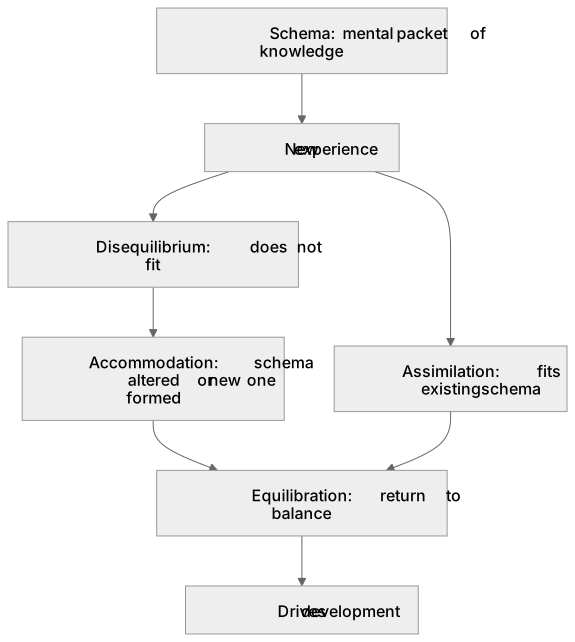
Key words
Say what each word means before you turn the card.
Schema
Try answering aloud or in your head before turning the card.
Assimilation
Try answering aloud or in your head before turning the card.
Accommodation
Try answering aloud or in your head before turning the card.
Equilibration
Try answering aloud or in your head before turning the card.
See every definition
- Schema
- A mental packet of knowledge, constructed by the child rather than taught, used to organise and interpret experience.
- Assimilation
- New information is taken into an existing schema, which does not have to change.
- Accommodation
- Information that will not fit produces disequilibrium, so a schema is altered or a new one formed.
- Equilibration
- The return to a balanced state, which drives development.
Label the diagram
Some boxes have lost their names. Pick the right name for each number.
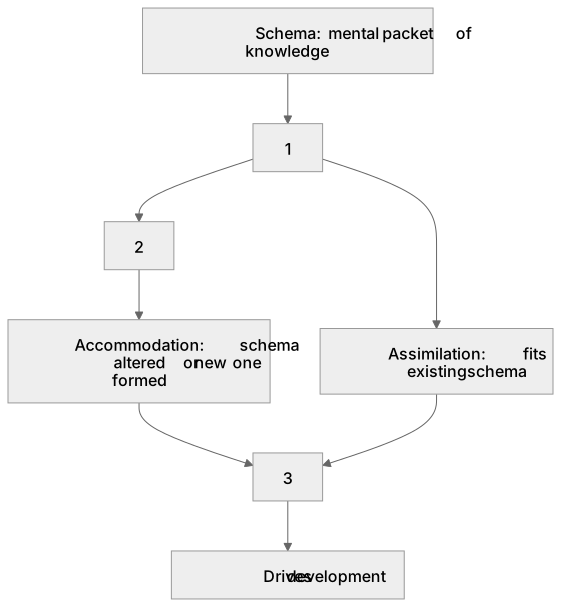
1Box 1
2Box 2
3Box 3
There is more to this lesson
The full lesson goes on to check your understanding and help you earn the marks. Create a free account to carry on, with your progress saved.
A week of Premium from your first lesson · Then the free plan continues · No card, no charge
Test your understanding of Cognition and development: Piaget’s theory of cognitive development: schemas, assimilation, accommodation, equilibration, stages of intellectual development. Characteristics of these stages, including object permanence, conservation, egocentrism and class inclusion.
Active recall beats re-reading. Take an instant quiz now to test what you’ve learned and lock it into long-term memory.
A week of Premium from your first lesson · Then the free plan continues · No card, no charge