AQA · A-Level · Psychology
Course version: 7182-2025 · Exams from 2027
Vygotsky’s theory of cognitive development, including the zone of proximal…
Full specification wording
Cognition and development: Vygotsky’s theory of cognitive development, including the zone of proximal development and scaffolding.
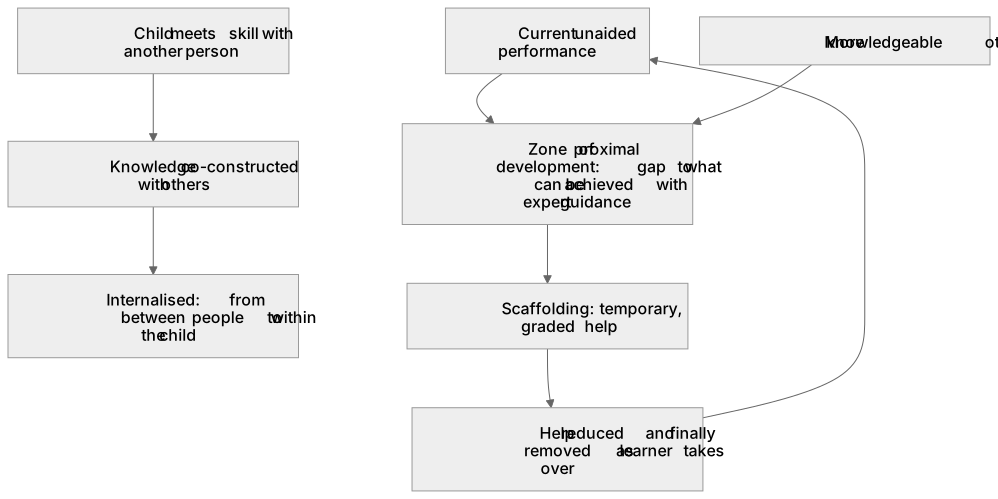
Vygotsky argued cognitive development is social before it is individual: a child meets a skill with another person first and internalises it afterwards, with culture and language supplying the tools.
Checked against the AQA 7182-2025 specification (opens in a new tab) on .
- Point 2 of 4
- 4 key terms
Study notes
From the checked teaching notes for this specification point.
The idea
Vygotsky argued cognitive development is social before it is individual: a child meets a skill with another person first and internalises it afterwards, with culture and language supplying the tools. The zone of proximal development is the gap between what a child manages alone and what they manage alongside a more knowledgeable other, measuring potential. Scaffolding is how the gap is crossed. Wood, Bruner and Ross (1976) listed recruiting interest, simplifying the task, keeping the child on target, marking critical features and demonstrating, with help withdrawn as competence grows. Roazzi and Bryant (1998) found four-year-olds estimating sweets in a jar succeeded far more often when an older child gave prompts than when working alone.
What earns the marks
- Development is social and cultural in origin: knowledge is co-constructed with others and then internalised, moving from between people to within the child.
- The zone of proximal development defined as the distance between current unaided performance and what can be achieved with expert guidance.
- The implication for teaching: instruction is pitched ahead of present ability, inside the zone, rather than waiting for readiness.
- Scaffolding defined as temporary, graded help from a more knowledgeable other that is reduced and finally removed as the learner takes over.
- Named scaffolding strategies from Wood, Bruner and Ross (1976), or levels of help ranging from general encouragement to specific demonstration.
- Supporting evidence: Roazzi and Bryant (1998) on prompted estimation, and McNaughton and Leyland (1990) on mothers adjusting help to task difficulty.
Common mistakes and how to put them right
Treating the zone of proximal development as a fixed stage or simply as work that is hard, instead of a gap specific to one child on one task at one time.
Describing scaffolding as doing the task for the child, or leaving out the withdrawal of support, which is the part that makes it scaffolding.
Crediting the word scaffolding to Vygotsky.
Put it right: He wrote about the zone, and the term comes from Wood, Bruner and Ross.
Listing differences from Piaget without drawing an implication, which reads as description and picks up no evaluation marks.
Exam tips
- When a stem describes a teacher, parent or older sibling helping, name the more knowledgeable other, the zone and the scaffolding behaviour separately and quote the stem for each.
- An educational application only earns AO3 if you say what actually changes in the classroom and what evidence backs it.
- Discuss means both sides and a judgement; end by saying which account the evidence favours and for which kind of learning.
- Vygotsky is the ready-made evaluation point in a Piaget essay and Piaget is the evaluation point here, so learn the comparison once and use it both ways.
Try the lesson
The start of the Cognition and development: Vygotsky’s theory of cognitive development, including the zone of proximal development and scaffolding. lesson, made from checked teaching notes for this specification point.
Have a go first
In Vygotsky's theory of cognitive development, what does the 'zone of proximal development' (ZPD) represent?
Listen
Vygotsky argued cognitive development is social before it is individual: a child meets a skill with another person first and internalises it afterwards, with culture and language supplying the tools. The zone of proximal development is the gap between what a child manages alone and what they manage alongside a more knowledgeable other, measuring potential. Scaffolding is how the gap is crossed. Wood, Bruner and Ross (1976) listed recruiting interest, simplifying the task, keeping the child on target, marking critical features and demonstrating, with help withdrawn as competence grows. Roazzi and Bryant (1998) found four-year-olds estimating sweets in a jar succeeded far more often when an older child gave prompts than when working alone. A strong answer earns marks for these points. Development is social and cultural in origin: knowledge is co-constructed with others and then internalised, moving from between people to within the child. The zone of proximal development defined as the distance between current unaided performance and what can be achieved with expert guidance. The implication for teaching: instruction is pitched ahead of present ability, inside the zone, rather than waiting for readiness. Scaffolding defined as temporary, graded help from a more knowledgeable other that is reduced and finally removed as the learner takes over. Exam tip: When a stem describes a teacher, parent or older sibling helping, name the more knowledgeable other, the zone and the scaffolding behaviour separately and quote the stem for each.
See it
Key words
Say what each word means before you turn the card.
Social construction of knowledge and internalisation
Try answering aloud or in your head before turning the card.
Zone of proximal development as potential ability
Try answering aloud or in your head before turning the card.
The more knowledgeable other
Try answering aloud or in your head before turning the card.
Scaffolding and the fading of support
Try answering aloud or in your head before turning the card.
See every definition
- Social construction of knowledge and internalisation
- Knowledge is co-constructed with others and then internalised, moving from between people to within the child.
- Zone of proximal development as potential ability
- The distance between current unaided performance and what can be achieved with expert guidance, measuring potential.
- The more knowledgeable other
- The person alongside whom a child manages what they cannot yet manage alone, crossing the gap.
- Scaffolding and the fading of support
- Temporary, graded help from a more knowledgeable other that is reduced and finally removed as the learner takes over.
Label the diagram
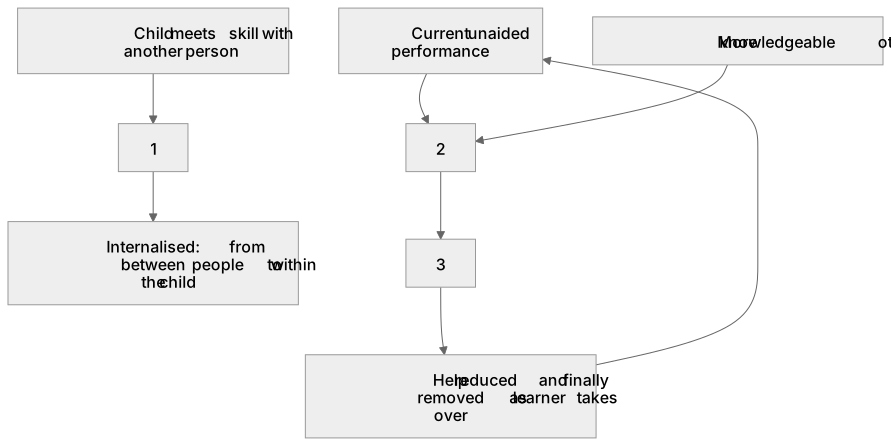
Some boxes have lost their names. Pick the right name for each number.
1Box 1
2Box 2
3Box 3
There is more to this lesson
The full lesson goes on to check your understanding and help you earn the marks. Create a free account to carry on, with your progress saved.
A week of Premium from your first lesson · Then the free plan continues · No card, no charge
Test your understanding of Cognition and development: Vygotsky’s theory of cognitive development, including the zone of proximal development and scaffolding.
Active recall beats re-reading. Take an instant quiz now to test what you’ve learned and lock it into long-term memory.
A week of Premium from your first lesson · Then the free plan continues · No card, no charge