AQA · A-Level · Psychology
Course version: 7182-2025 · Exams from 2027
The development of social cognition: Selman’s levels of…
Full specification wording
Cognition and development: The development of social cognition: Selman’s levels of perspective-taking; theory of mind; the Sally-Anne study. The role of the mirror neuron system in social cognition.
Social cognition involves understanding others' thoughts and feelings.
Checked against the AQA 7182-2025 specification (opens in a new tab) on .
- Point 4 of 4
- 4 key terms
Study notes
From the checked teaching notes for this specification point.
The idea
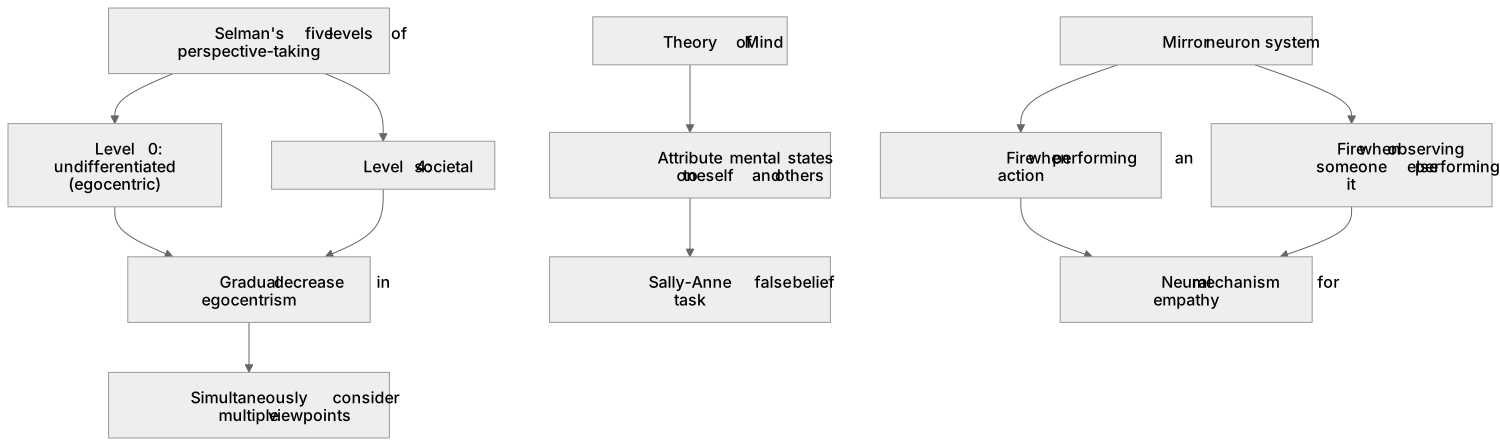
Social cognition involves understanding others' thoughts and feelings. Selman proposed five levels of perspective-taking, from undifferentiated (egocentric) to societal, where children gradually learn to simultaneously consider multiple viewpoints. Theory of Mind (ToM) is the ability to attribute mental states to oneself and others. This is classically tested using the Sally-Anne false belief task, where children must recognise that Sally will look for her marble where she falsely believes it is, not where Anne moved it. Biologically, the mirror neuron system (MNS) supports social cognition. These neurons fire both when an individual performs an action and when they observe someone else performing it, providing a neural mechanism for empathy.
What earns the marks
- Outline Selman's five levels of perspective-taking (0-4) and how they reflect a developmental decrease in egocentrism.
- Explain Theory of Mind as the cognitive ability to understand that others have different beliefs, desires, and intentions.
- Describe the Sally-Anne study as a false belief task used to assess ToM, noting that children typically pass this around age four.
- Explain the role of the mirror neuron system in simulating others' actions and emotions, facilitating empathy and observational learning.
Common mistakes and how to put them right
Confusing Selman's perspective-taking with Piaget's egocentrism.
Put it right by noting Selman focuses specifically on understanding interpersonal relationships and multiple viewpoints, not just physical perspectives.
Stating that failing the Sally-Anne task means a child has autism.
Put it right by explaining that while ToM deficits are linked to autism, failing the task is also typical for neurotypical children under four years old.
Describing mirror neurons as only firing during observation.
Put it right by emphasising they fire both when performing an action and when observing the same action.
Exam tips
- Use the Sally-Anne study to explicitly demonstrate how false belief tasks operationalise Theory of Mind in experimental conditions.
- When evaluating Selman's theory, use correlational evidence linking perspective-taking skills to social competence and peer relations.
- Link the mirror neuron system to specific social deficits, such as those seen in autism spectrum disorder, to provide biological evaluation.
Try the lesson
The start of the Cognition and development: The development of social cognition: Selman’s levels of perspective-taking; theory of mind; the Sally-Anne study. The role of the mirror neuron system in social cognition. lesson, made from checked teaching notes for this specification point.
Have a go first
What is the primary cognitive ability assessed by the Sally-Anne study in developmental psychology?
Listen
Social cognition involves understanding others' thoughts and feelings. Selman proposed five levels of perspective-taking, from undifferentiated (egocentric) to societal, where children gradually learn to simultaneously consider multiple viewpoints. Theory of Mind (ToM) is the ability to attribute mental states to oneself and others. This is classically tested using the Sally-Anne false belief task, where children must recognise that Sally will look for her marble where she falsely believes it is, not where Anne moved it. Biologically, the mirror neuron system (MNS) supports social cognition. These neurons fire both when an individual performs an action and when they observe someone else performing it, providing a neural mechanism for empathy. A strong answer earns marks for these points. Outline Selman's five levels of perspective-taking (0-4) and how they reflect a developmental decrease in egocentrism. Explain Theory of Mind as the cognitive ability to understand that others have different beliefs, desires, and intentions. Describe the Sally-Anne study as a false belief task used to assess ToM, noting that children typically pass this around age four. Explain the role of the mirror neuron system in simulating others' actions and emotions, facilitating empathy and observational learning. A common slip: Confusing Selman's perspective-taking with Piaget's egocentrism. Instead, noting Selman focuses specifically on understanding interpersonal relationships and multiple viewpoints, not just physical perspectives. Exam tip: Use the Sally-Anne study to explicitly demonstrate how false belief tasks operationalise Theory of Mind in experimental conditions.
See it
Key words
Say what each word means before you turn the card.
Theory of Mind
Try answering aloud or in your head before turning the card.
Mirror neuron system
Try answering aloud or in your head before turning the card.
Sally-Anne study
Try answering aloud or in your head before turning the card.
Perspective-taking
Try answering aloud or in your head before turning the card.
See every definition
- Theory of Mind
- The ability to attribute mental states to oneself and others.
- Mirror neuron system
- Neurons that fire both when an individual performs an action and when they observe someone else performing it, providing a neural mechanism for empathy.
- Sally-Anne study
- A false belief task where children must recognise that Sally will look for her marble where she falsely believes it is, not where Anne moved it.
- Perspective-taking
- Selman proposed five levels, from undifferentiated (egocentric) to societal, where children gradually learn to simultaneously consider multiple viewpoints.
Label the diagram
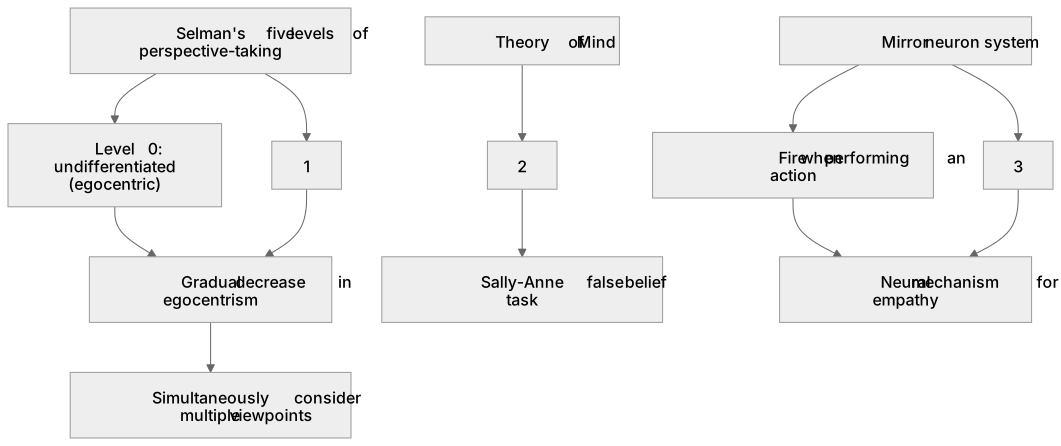
Some boxes have lost their names. Pick the right name for each number.
1Box 1
2Box 2
3Box 3
There is more to this lesson
The full lesson goes on to check your understanding and help you earn the marks. Create a free account to carry on, with your progress saved.
A week of Premium from your first lesson · Then the free plan continues · No card, no charge
Test your understanding of Cognition and development: The development of social cognition: Selman’s levels of perspective-taking; theory of mind; the Sally-Anne study. The role of the mirror neuron system in social cognition.
Active recall beats re-reading. Take an instant quiz now to test what you’ve learned and lock it into long-term memory.
A week of Premium from your first lesson · Then the free plan continues · No card, no charge