AQA · A-Level · Psychology
Course version: 7182-2025 · Exams from 2027
Baillargeon’s explanation of early infant abilities, including knowledge…
Full specification wording
Cognition and development: Baillargeon’s explanation of early infant abilities, including knowledge of the physical world; violation of expectation research.
Baillargeon’s explanation of early infant abilities argues Piaget measured motor skill rather than knowledge of the physical world: an infant who does not reach for a hidden toy may know it is…
Checked against the AQA 7182-2025 specification (opens in a new tab) on .
- Point 3 of 4
- 4 key terms
Study notes
From the checked teaching notes for this specification point.
The idea
Baillargeon’s explanation of early infant abilities argues Piaget measured motor skill rather than knowledge of the physical world: an infant who does not reach for a hidden toy may know it is there but be unable to act. Violation of expectation research tests looking instead. Infants are habituated to an event, then shown a possible and an impossible version. Looking longer at the impossible event implies an expectation was broken. In the tall carrot study (Baillargeon and DeVos, 1991), infants looked at the impossible event for 33.07 seconds against 25.11 for the possible one. She infers a physical reasoning system that is innate and primitive, present long before the eight months Piaget allowed for object permanence, and refined by experience rather than assembled from nothing.
What earns the marks
- The criticism of Piaget stated as a competence and performance distinction: failing a search task involves motor coordination, memory and interest, so it understates knowledge of the physical world.
- The violation of expectation procedure: habituation to an event, then test trials in which one version is physically possible and the other impossible, with looking time as the dependent variable.
- The inference made explicit: longer looking indicates surprise, surprise indicates a violated expectation, and an expectation requires knowledge of the hidden object.
- A named study with its findings: Baillargeon and DeVos (1991) on the tall and short carrots, with looking times of 33.07 against 25.11 seconds, or the drawbridge study of Baillargeon, Spelke and Wasserman (1985).
- The physical reasoning system: an innate awareness that objects persist, plus event categories whose variables are learned with experience, explaining why physical understanding is universal and early.
Common mistakes and how to put them right
Writing that the research proves infants understand physics.
Put it right: Looking time is only evidence of an expectation, and that inference is exactly what critics attack.
Leaving out the habituation phase, which makes the impossible event sound merely more interesting than the possible one.
Describing the study with no ages and no figures, so the answer says only that infants looked longer.
Claiming Baillargeon disproves Piaget outright instead of showing that his tasks placed the same ability far too late.
Treating an infant sample as if it were a straightforward self-report, and ignoring that the whole finding rests on how an adult codes gaze.
Exam tips
- Structure an explanation as habituation, then test events, then looking time, then the conclusion drawn; examiners credit the logic of the inference, not the apparatus.
- Use Baillargeon as evaluation in a Piaget essay and Piaget as evaluation here, but make the comparison explicit or it reads as description.
- When asked to outline and evaluate, ensure the evaluation outweighs the description; two crisp descriptive paragraphs are enough before the criticism starts.
- If asked to apply the method to a new scenario, say precisely which event would be impossible and what looking pattern would count as support.
Try the lesson
The start of the Cognition and development: Baillargeon’s explanation of early infant abilities, including knowledge of the physical world; violation of expectation research. lesson, made from checked teaching notes for this specification point.
Have a go first
Which of the following best describes the 'violation of expectation' method used by Baillargeon to investigate infant cognitive abilities?
Listen
Baillargeon’s explanation of early infant abilities argues Piaget measured motor skill rather than knowledge of the physical world: an infant who does not reach for a hidden toy may know it is there but be unable to act. Violation of expectation research tests looking instead. Infants are habituated to an event, then shown a possible and an impossible version. Looking longer at the impossible event implies an expectation was broken. In the tall carrot study (Baillargeon and DeVos, 1991), infants looked at the impossible event for 33.07 seconds against 25.11 for the possible one. She infers a physical reasoning system that is innate and primitive, present long before the eight months Piaget allowed for object permanence, and refined by experience rather than assembled from nothing. A strong answer earns marks for these points. The criticism of Piaget stated as a competence and performance distinction: failing a search task involves motor coordination, memory and interest, so it understates knowledge of the physical world. The violation of expectation procedure: habituation to an event, then test trials in which one version is physically possible and the other impossible, with looking time as the dependent variable. The inference made explicit: longer looking indicates surprise, surprise indicates a violated expectation, and an expectation requires knowledge of the hidden object. A named study with its findings: Baillargeon and DeVos (1991) on the tall and short carrots, with looking times of 33.07 against 25.11 seconds, or the drawbridge study of Baillargeon, Spelke and Wasserman (1985). Exam tip: Structure an explanation as habituation, then test events, then looking time, then the conclusion drawn; examiners credit the logic of the inference, not the apparatus.
See it
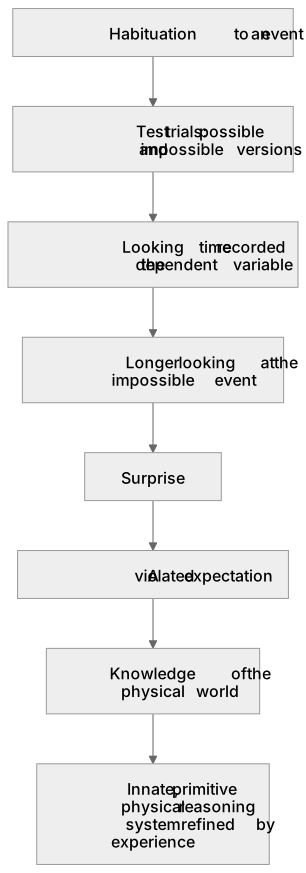
Put it in order
Put these steps in the order they happen.
- 1. Surprise
- 2. Innate, primitive physical reasoning system refined by experience
- 3. A violated expectation
- 4. Habituation to an event
- 5. Test trials: possible and impossible versions
- 6. Knowledge of the physical world
- 7. Looking time recorded as the dependent variable
- 8. Longer looking at the impossible event
Key words
Say what each word means before you turn the card.
Competence versus performance in infant testing
Try answering aloud or in your head before turning the card.
Habituation and looking time as a measure
Try answering aloud or in your head before turning the card.
Innate knowledge and nativism
Try answering aloud or in your head before turning the card.
Object persistence earlier than Piaget claimed
Try answering aloud or in your head before turning the card.
See every definition
- Competence versus performance in infant testing
- Failing a search task involves motor coordination, memory and interest, so it understates knowledge of the physical world.
- Habituation and looking time as a measure
- Infants are habituated to an event, then shown a possible and an impossible version, with looking time as the dependent variable.
- Innate knowledge and nativism
- A physical reasoning system that is innate and primitive, refined by experience rather than assembled from nothing.
- Object persistence earlier than Piaget claimed
- Present long before the eight months Piaget allowed for object permanence.
Label the diagram
Some boxes have lost their names. Pick the right name for each number.
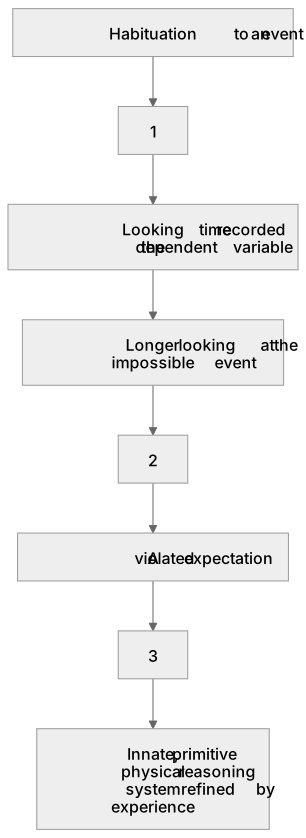
1Box 1
2Box 2
3Box 3
There is more to this lesson
The full lesson goes on to check your understanding and help you earn the marks. Create a free account to carry on, with your progress saved.
A week of Premium from your first lesson · Then the free plan continues · No card, no charge
Test your understanding of Cognition and development: Baillargeon’s explanation of early infant abilities, including knowledge of the physical world; violation of expectation research.
Active recall beats re-reading. Take an instant quiz now to test what you’ve learned and lock it into long-term memory.
A week of Premium from your first lesson · Then the free plan continues · No card, no charge