AQA · A-Level · Psychology
Course version: 7182-2025 · Exams from 2027
Data handling and analysis: Coding in content analysis.
Coding is the initial stage of content analysis where large amounts of qualitative data, such as interview transcripts or media articles, are categorised into meaningful units.
Checked against the AQA 7182-2025 specification (opens in a new tab) on .
- Point 8 of 8
- 4 key terms
Study notes
From the checked teaching notes for this specification point.
The idea
Coding is the initial stage of content analysis where large amounts of qualitative data, such as interview transcripts or media articles, are categorised into meaningful units. Because qualitative data is often extensive, researchers must establish a coding system to systematically identify specific concepts. For example, when analysing diaries for signs of depression, a researcher might create codes for words like 'hopeless' or 'exhausted'. By tallying the frequency of these codes, the researcher transforms rich qualitative information into quantitative data. This allows for easier comparison, identification of patterns, and subsequent statistical analysis, making the data more manageable and objective.
What earns the marks
- Define coding as the process of categorising qualitative data into manageable, meaningful units.
- Explain that coding typically transforms qualitative data into quantitative data through the use of frequencies or tallies.
- Describe the necessity of establishing clear, operationalised coding categories before or during the analysis of the data.
- Outline how researchers apply the coding system systematically across the entire dataset to ensure consistency and reliability.
Common mistakes and how to put them right
Confusing coding with thematic analysis.
Put it right: Coding typically generates quantitative data by counting frequencies, whereas thematic analysis keeps data qualitative by identifying broader descriptive themes.
Failing to operationalise categories.
Put it right: Ensure coding categories are explicitly defined so that independent researchers would code the data identically, ensuring inter-rater reliability.
Assuming coding only applies to written text.
Put it right: Coding can be applied to various media, including audio recordings, video footage, and visual advertisements.
Exam tips
- When asked to design a content analysis, explicitly state the specific codes you would use for the given scenario.
- Mention how inter-rater reliability can be established by having two independent researchers apply the same coding system and correlating their tallies.
- Clearly distinguish between the qualitative input (the raw data) and the quantitative output (the tallied codes) when explaining the process.
Try the lesson
The start of the Data handling and analysis: Coding in content analysis. lesson, made from checked teaching notes for this specification point.
Have a go first
What is the primary purpose of coding in content analysis?
Listen
Coding is the initial stage of content analysis where large amounts of qualitative data, such as interview transcripts or media articles, are categorised into meaningful units. Because qualitative data is often extensive, researchers must establish a coding system to systematically identify specific concepts. For example, when analysing diaries for signs of depression, a researcher might create codes for words like 'hopeless' or 'exhausted'. By tallying the frequency of these codes, the researcher transforms rich qualitative information into quantitative data. This allows for easier comparison, identification of patterns, and subsequent statistical analysis, making the data more manageable and objective. A strong answer earns marks for these points. Define coding as the process of categorising qualitative data into manageable, meaningful units. Explain that coding typically transforms qualitative data into quantitative data through the use of frequencies or tallies. Describe the necessity of establishing clear, operationalised coding categories before or during the analysis of the data. Outline how researchers apply the coding system systematically across the entire dataset to ensure consistency and reliability. A common slip: Confusing coding with thematic analysis. Instead, Coding typically generates quantitative data by counting frequencies, whereas thematic analysis keeps data qualitative by identifying broader descriptive themes. Exam tip: When asked to design a content analysis, explicitly state the specific codes you would use for the given scenario.
See it
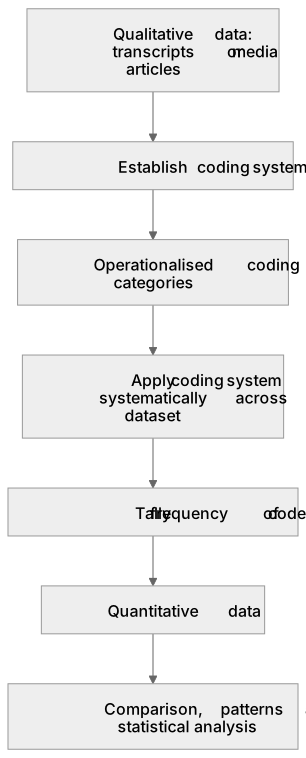
Put it in order
Put these steps in the order they happen.
- 1. Comparison, patterns and statistical analysis
- 2. Quantitative data
- 3. Operationalised coding categories
- 4. Tally frequency of codes
- 5. Qualitative data: transcripts or media articles
- 6. Establish coding system
- 7. Apply coding system systematically across dataset
Key words
Say what each word means before you turn the card.
Coding
Try answering aloud or in your head before turning the card.
Qualitative data
Try answering aloud or in your head before turning the card.
Quantitative data
Try answering aloud or in your head before turning the card.
Reliability
Try answering aloud or in your head before turning the card.
See every definition
- Coding
- The initial stage of content analysis where large amounts of qualitative data are categorised into meaningful units.
- Qualitative data
- Often extensive information, such as interview transcripts or media articles, that researchers must categorise into meaningful units.
- Quantitative data
- Data produced by tallying the frequency of codes, allowing for easier comparison, identification of patterns, and subsequent statistical analysis.
- Reliability
- Ensured by applying the coding system systematically across the entire dataset to ensure consistency.
Label the diagram
Some boxes have lost their names. Pick the right name for each number.
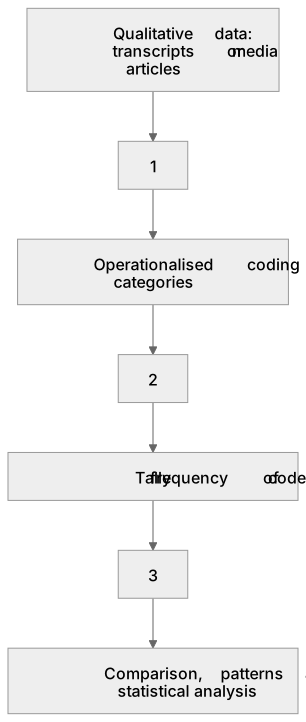
1Box 1
2Box 2
3Box 3
There is more to this lesson
The full lesson goes on to check your understanding and help you earn the marks. Create a free account to carry on, with your progress saved.
A week of Premium from your first lesson · Then the free plan continues · No card, no charge
Test your understanding of Data handling and analysis: Coding in content analysis.
Active recall beats re-reading. Take an instant quiz now to test what you’ve learned and lock it into long-term memory.
A week of Premium from your first lesson · Then the free plan continues · No card, no charge