AQA · A-Level · Psychology
Course version: 7182-2025 · Exams from 2027
Levels of measurement: nominal, ordinal and interval.
Full specification wording
Data handling and analysis: Levels of measurement: nominal, ordinal and interval.
Levels of measurement rank data by how much information each score carries, and the level decides what you may legitimately do with it.
Checked against the AQA 7182-2025 specification (opens in a new tab) on .
- Point 7 of 8
- 4 key terms
Study notes
From the checked teaching notes for this specification point.
The idea
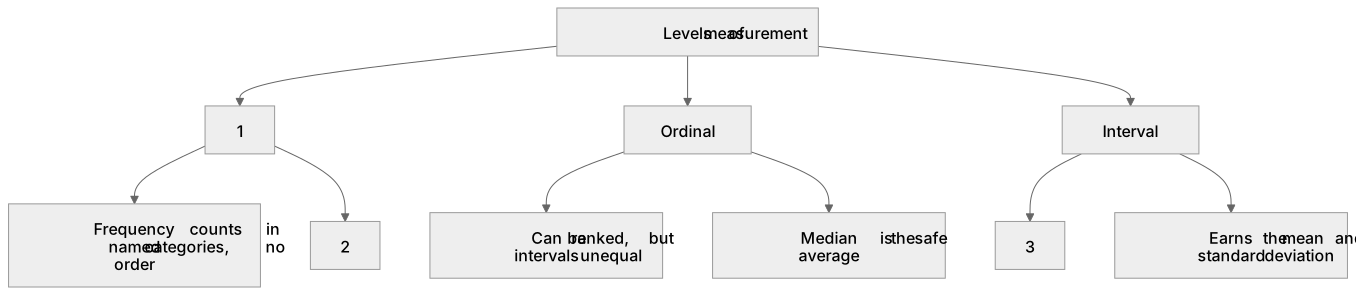
Levels of measurement rank data by how much information each score carries, and the level decides what you may legitimately do with it. Nominal data is counted in categories: how many chose each brand, how many passed and how many failed. Every item falls in one category only, the categories have no order, and the mode is the only average available. Ordinal data can be placed in rank order, but the gaps between ranks are unequal and the units are not standardised; a mood rating out of ten is ordinal, because your seven and my seven are not the same thing, so the median is the safe average. Interval data uses equal, fixed units on a publicly agreed scale, such as seconds or words recalled, and only interval data earns the mean and standard deviation.
What earns the marks
- Nominal: frequency counts in named categories that have no order, with each score placed in one category only.
- Ordinal: scores can be ranked, but the intervals between them are unequal and the scale rests on subjective judgement.
- Interval: equal intervals on a standardised, publicly agreed scale, such as time in seconds or temperature.
- The level determines the appropriate average: mode for nominal, median for ordinal, mean for interval.
- The level is one of the three things that choose an inferential test, alongside whether the study tests difference or correlation and whether the design is related or unrelated.
- Evaluation: interval data carries the most information, so tests using it are more powerful and less likely to miss a real effect.
Common mistakes and how to put them right
Classifying anything numerical as interval, when a questionnaire total out of twenty is ordinal.
Reading 'nominal' as meaning small numbers rather than named categories.
Saying ordinal data cannot be analysed, when it is ranked for tests such as Wilcoxon and Spearman's.
Calculating a mean from a set of subjective ratings, which assumes an equality of intervals the scale does not possess.
Exam tips
- Ask where the numbers came from: a stopwatch or a count of words is interval, a rating scale or a placing is ordinal, a tally of categories is nominal.
- When asked to identify and justify a level of measurement, name the level and use because to link it to how the data were produced.
- State the level before naming the test; examiners credit the reasoning chain, not just the test's name.
Try the lesson
The start of the Data handling and analysis: Levels of measurement: nominal, ordinal and interval. lesson, made from checked teaching notes for this specification point.
Have a go first
A researcher categorises participants based on their preferred mode of transport to work: car, bus, train, or bicycle. Which level of measurement is being used to collect this data?
Listen
Levels of measurement rank data by how much information each score carries, and the level decides what you may legitimately do with it. Nominal data is counted in categories: how many chose each brand, how many passed and how many failed. Every item falls in one category only, the categories have no order, and the mode is the only average available. Ordinal data can be placed in rank order, but the gaps between ranks are unequal and the units are not standardised; a mood rating out of ten is ordinal, because your seven and my seven are not the same thing, so the median is the safe average. Interval data uses equal, fixed units on a publicly agreed scale, such as seconds or words recalled, and only interval data earns the mean and standard deviation. A strong answer earns marks for these points. Nominal: frequency counts in named categories that have no order, with each score placed in one category only. Ordinal: scores can be ranked, but the intervals between them are unequal and the scale rests on subjective judgement. Interval: equal intervals on a standardised, publicly agreed scale, such as time in seconds or temperature. The level determines the appropriate average: mode for nominal, median for ordinal, mean for interval. Exam tip: Ask where the numbers came from: a stopwatch or a count of words is interval, a rating scale or a placing is ordinal, a tally of categories is nominal.
See it

Key words
Say what each word means before you turn the card.
Nominal data
Try answering aloud or in your head before turning the card.
Ordinal data
Try answering aloud or in your head before turning the card.
Interval data
Try answering aloud or in your head before turning the card.
Levels of measurement
Try answering aloud or in your head before turning the card.
See every definition
- Nominal data
- Counted in categories, with every item falling in one category only, the categories having no order, and the mode the only average available.
- Ordinal data
- Can be placed in rank order, but the gaps between ranks are unequal and the units are not standardised, so the median is the safe average.
- Interval data
- Uses equal, fixed units on a publicly agreed scale, such as seconds or words recalled, and only this level earns the mean and standard deviation.
- Levels of measurement
- Rank data by how much information each score carries, and the level decides what you may legitimately do with it.
Label the diagram
Some boxes have lost their names. Pick the right name for each number.
1Box 1
2Box 2
3Box 3
There is more to this lesson
The full lesson goes on to check your understanding and help you earn the marks. Create a free account to carry on, with your progress saved.
A week of Premium from your first lesson · Then the free plan continues · No card, no charge
Test your understanding of Data handling and analysis: Levels of measurement: nominal, ordinal and interval.
Active recall beats re-reading. Take an instant quiz now to test what you’ve learned and lock it into long-term memory.
A week of Premium from your first lesson · Then the free plan continues · No card, no charge