AQA · A-Level · Psychology
Course version: 7182-2025 · Exams from 2027
Primary and secondary data, including meta-analysis.
Full specification wording
Data handling and analysis: Primary and secondary data, including meta-analysis.
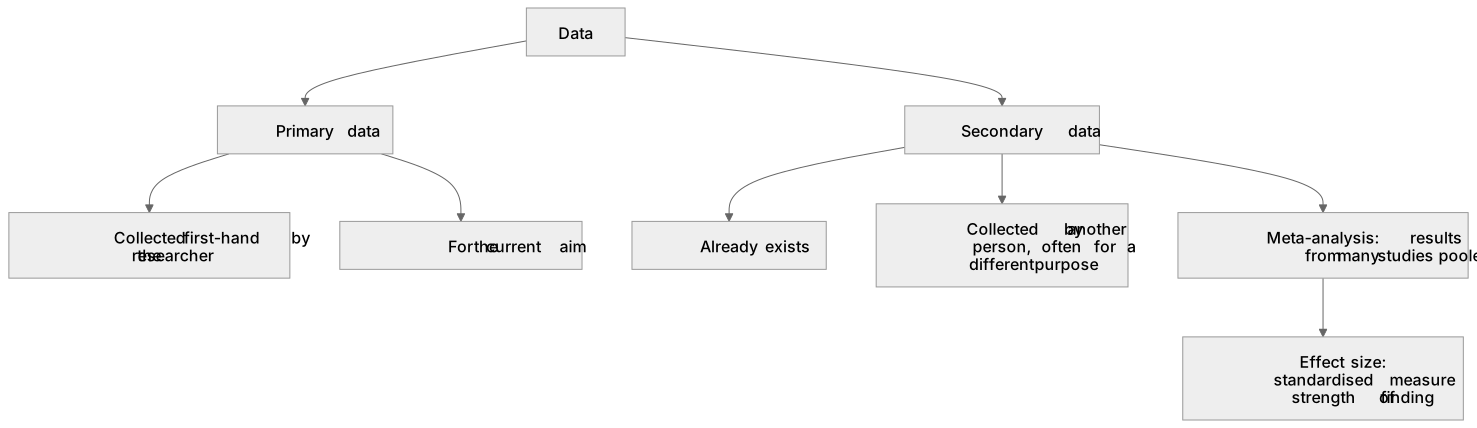
Primary data is gathered first-hand by the researcher, for this investigation's own aim, through an experiment, questionnaire, interview or observation.
Checked against the AQA 7182-2025 specification (opens in a new tab) on .
- Point 2 of 8
- 4 key terms
Study notes
From the checked teaching notes for this specification point.
The idea
Primary data is gathered first-hand by the researcher, for this investigation's own aim, through an experiment, questionnaire, interview or observation. Secondary data already exists: somebody else collected it, usually for another purpose, as with government statistics, medical records or a published study. Primary data fits the hypothesis exactly but costs time and money; secondary data is cheap and immediate, though it may be outdated, incomplete or produced under conditions you cannot check. A meta-analysis is the disciplined use of secondary data: results from many studies of one question are pooled and an effect size, a standardised measure of how strong the finding is, lets studies of different sizes be compared. Van IJzendoorn and Kroonenberg pooled 32 Strange Situation studies and found variation within countries larger than between them.
What earns the marks
- Primary data: collected first-hand by the researcher for the current aim.
- Secondary data: already in existence, collected by another person, often for a different purpose.
- Strength of primary data: it targets the hypothesis, and the researcher controls the conditions under which it was produced.
- Strengths of secondary data: inexpensive, immediately available and often drawn from far larger samples than one researcher could gather.
- Meta-analysis defined as the statistical pooling of results from many studies of the same question, with an effect size calculated as a standardised measure of the strength of the finding.
- Evaluation of meta-analysis: the combined sample is huge, so generalisability improves, but publication bias means non-significant studies are less likely to be in print and the pooled effect can be inflated.
Common mistakes and how to put them right
Labelling every published study as secondary data.
Put it right: A study is primary data for the team that ran it and secondary only for the researcher who later reuses it.
Defining meta-analysis as 'a review of lots of studies', which describes a literature review.
Put it right: The defining feature is that the results are combined and analysed statistically.
Omitting effect size altogether, which is the term the examiner is looking for.
Asserting that secondary data is always less valid, when official statistics are often collected far more rigorously than a single researcher could manage.
Exam tips
- Settle primary versus secondary on who collected it and for what aim, not on how old the data is.
- For a four-mark 'outline and evaluate meta-analysis', one clean definition plus one developed strength and one developed limitation beats four undeveloped points.
- Name the evaluative problem, such as publication bias or differences in method between the pooled studies, rather than writing that the findings 'might not be accurate'.
Try the lesson
The start of the Data handling and analysis: Primary and secondary data, including meta-analysis. lesson, made from checked teaching notes for this specification point.
Have a go first
A researcher conducts a study on memory by administering a new recall test to 50 participants and recording their scores. Which type of data has the researcher collected?
Listen
Primary data is gathered first-hand by the researcher, for this investigation's own aim, through an experiment, questionnaire, interview or observation. Secondary data already exists: somebody else collected it, usually for another purpose, as with government statistics, medical records or a published study. Primary data fits the hypothesis exactly but costs time and money; secondary data is cheap and immediate, though it may be outdated, incomplete or produced under conditions you cannot check. A meta-analysis is the disciplined use of secondary data: results from many studies of one question are pooled and an effect size, a standardised measure of how strong the finding is, lets studies of different sizes be compared. Van IJzendoorn and Kroonenberg pooled 32 Strange Situation studies and found variation within countries larger than between them. A strong answer earns marks for these points. Primary data: collected first-hand by the researcher for the current aim. Secondary data: already in existence, collected by another person, often for a different purpose. Strength of primary data: it targets the hypothesis, and the researcher controls the conditions under which it was produced. Strengths of secondary data: inexpensive, immediately available and often drawn from far larger samples than one researcher could gather. Exam tip: Settle primary versus secondary on who collected it and for what aim, not on how old the data is.
See it
Key words
Say what each word means before you turn the card.
Primary data
Try answering aloud or in your head before turning the card.
Secondary data
Try answering aloud or in your head before turning the card.
Meta-analysis
Try answering aloud or in your head before turning the card.
Effect size
Try answering aloud or in your head before turning the card.
See every definition
- Primary data
- Gathered first-hand by the researcher, for this investigation's own aim, through an experiment, questionnaire, interview or observation.
- Secondary data
- Already exists, having been collected by somebody else, usually for another purpose, as with government statistics, medical records or a published study.
- Meta-analysis
- The disciplined use of secondary data in which results from many studies of one question are pooled.
- Effect size
- A standardised measure of how strong the finding is, letting studies of different sizes be compared.
Label the diagram
Some boxes have lost their names. Pick the right name for each number.
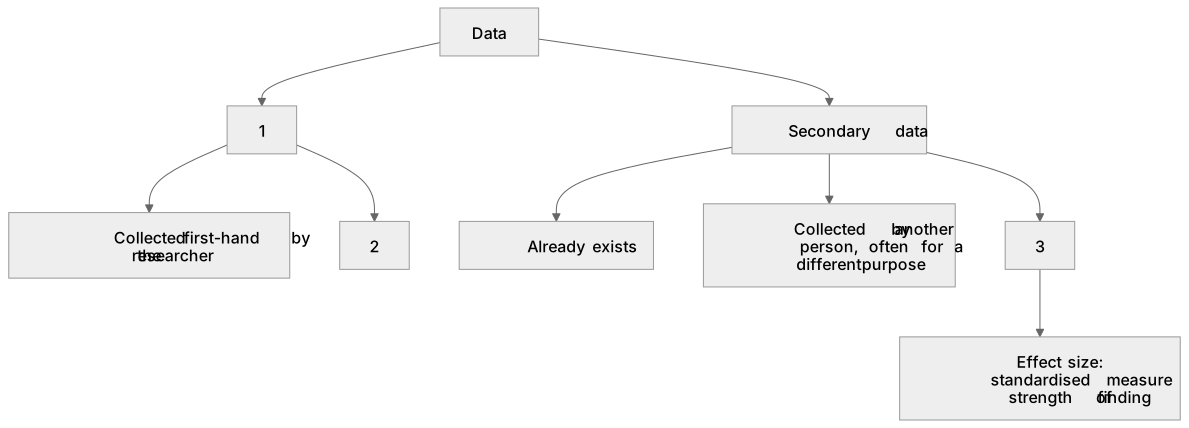
1Box 1
2Box 2
3Box 3
There is more to this lesson
The full lesson goes on to check your understanding and help you earn the marks. Create a free account to carry on, with your progress saved.
A week of Premium from your first lesson · Then the free plan continues · No card, no charge
Test your understanding of Data handling and analysis: Primary and secondary data, including meta-analysis.
Active recall beats re-reading. Take an instant quiz now to test what you’ve learned and lock it into long-term memory.
A week of Premium from your first lesson · Then the free plan continues · No card, no charge