AQA · A-Level · Psychology
Course version: 7182-2025 · Exams from 2027
Quantitative and qualitative data; the distinction between qualitative and…
Full specification wording
Data handling and analysis: Quantitative and qualitative data; the distinction between qualitative and quantitative data collection techniques.
A number is quantitative, a word is qualitative, and the technique you choose decides which you get.
Checked against the AQA 7182-2025 specification (opens in a new tab) on .
- Point 1 of 8
- 4 key terms
Study notes
From the checked teaching notes for this specification point.
The idea
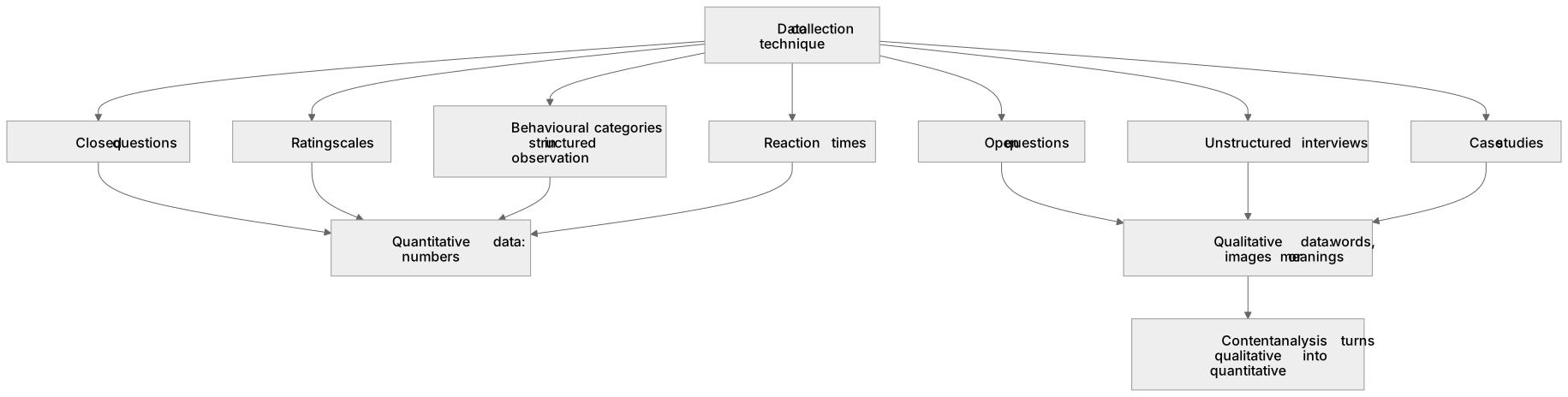
A number is quantitative, a word is qualitative, and the technique you choose decides which you get. Closed questions, rating scales, behavioural categories in a structured observation and reaction times all produce scores; open questions, unstructured interviews and case studies produce language. Milgram gives you both: 65% of participants going to 450 volts is quantitative, while his notes on grown men sweating, stuttering and laughing nervously are qualitative. Quantitative data is objective, quick to analyse and easy to compare across conditions, but it strips out meaning; qualitative data is rich and has greater external validity, yet what it means depends on the researcher reading it, so it invites bias and resists summary. Content analysis turns the second into the first.
What earns the marks
- Quantitative data is recorded as numbers; qualitative data is recorded as words, images or meanings.
- Naming the technique that produces each: closed questions, structured observation and experiments give quantitative data, while open questions, unstructured interviews and case studies give qualitative data.
- Strength of quantitative data: it is objective, can be summarised with descriptive statistics and analysed with an inferential test, so conditions can be compared directly.
- Strength of qualitative data: it captures detail and meaning the researcher never anticipated, which raises external validity.
- The matching limitations stated as consequences: a score can misrepresent the experience behind it, and qualitative material has to be interpreted, so the conclusion may carry the researcher's bias.
- Applying the distinction to the stem by saying which type the study produced and quoting the detail that shows it.
Common mistakes and how to put them right
Confusing quantitative with quantity, so a long interview transcript is called quantitative because there is a great deal of it.
Claiming qualitative data cannot be analysed, when content analysis and thematic analysis exist precisely to analyse it.
Offering 'it is more detailed' as a strength without saying what the detail buys, which only earns the mark once the consequence for validity is stated.
Treating the two as rival loyalties rather than tools, when many studies deliberately collect both.
Exam tips
- When the question says 'from the stem', quote the detail that settles it: a rating scale out of ten is quantitative, an open 'describe how you felt' is qualitative.
- For a two-mark 'explain one limitation', name the limitation in the first sentence and spend the second on what it does to the conclusion.
- Where an item asks you to distinguish between the two, write about both inside one sentence; a paragraph on each often never states the difference at all.
Try the lesson
The start of the Data handling and analysis: Quantitative and qualitative data; the distinction between qualitative and quantitative data collection techniques. lesson, made from checked teaching notes for this specification point.
Have a go first
Which of the following best describes the fundamental difference between quantitative and qualitative data?
Listen
A number is quantitative, a word is qualitative, and the technique you choose decides which you get. Closed questions, rating scales, behavioural categories in a structured observation and reaction times all produce scores; open questions, unstructured interviews and case studies produce language. Milgram gives you both: 65% of participants going to 450 volts is quantitative, while his notes on grown men sweating, stuttering and laughing nervously are qualitative. Quantitative data is objective, quick to analyse and easy to compare across conditions, but it strips out meaning; qualitative data is rich and has greater external validity, yet what it means depends on the researcher reading it, so it invites bias and resists summary. Content analysis turns the second into the first. A strong answer earns marks for these points. Quantitative data is recorded as numbers; qualitative data is recorded as words, images or meanings. Naming the technique that produces each: closed questions, structured observation and experiments give quantitative data, while open questions, unstructured interviews and case studies give qualitative data. Strength of quantitative data: it is objective, can be summarised with descriptive statistics and analysed with an inferential test, so conditions can be compared directly. Strength of qualitative data: it captures detail and meaning the researcher never anticipated, which raises external validity. Exam tip: When the question says 'from the stem', quote the detail that settles it: a rating scale out of ten is quantitative, an open 'describe how you felt' is qualitative.
See it
Key words
Say what each word means before you turn the card.
Quantitative data
Try answering aloud or in your head before turning the card.
Qualitative data
Try answering aloud or in your head before turning the card.
Collection techniques
Try answering aloud or in your head before turning the card.
External validity
Try answering aloud or in your head before turning the card.
See every definition
- Quantitative data
- Recorded as numbers, it is objective, quick to analyse and easy to compare across conditions, but it strips out meaning.
- Qualitative data
- Recorded as words, images or meanings, it is rich and has greater external validity, yet what it means depends on the researcher reading it, so it invites bias and resists summary.
- Collection techniques
- Closed questions, rating scales, behavioural categories in a structured observation and reaction times produce scores, while open questions, unstructured interviews and case studies produce language.
- External validity
- Raised by qualitative data, which captures detail and meaning the researcher never anticipated.
Label the diagram
Some boxes have lost their names. Pick the right name for each number.
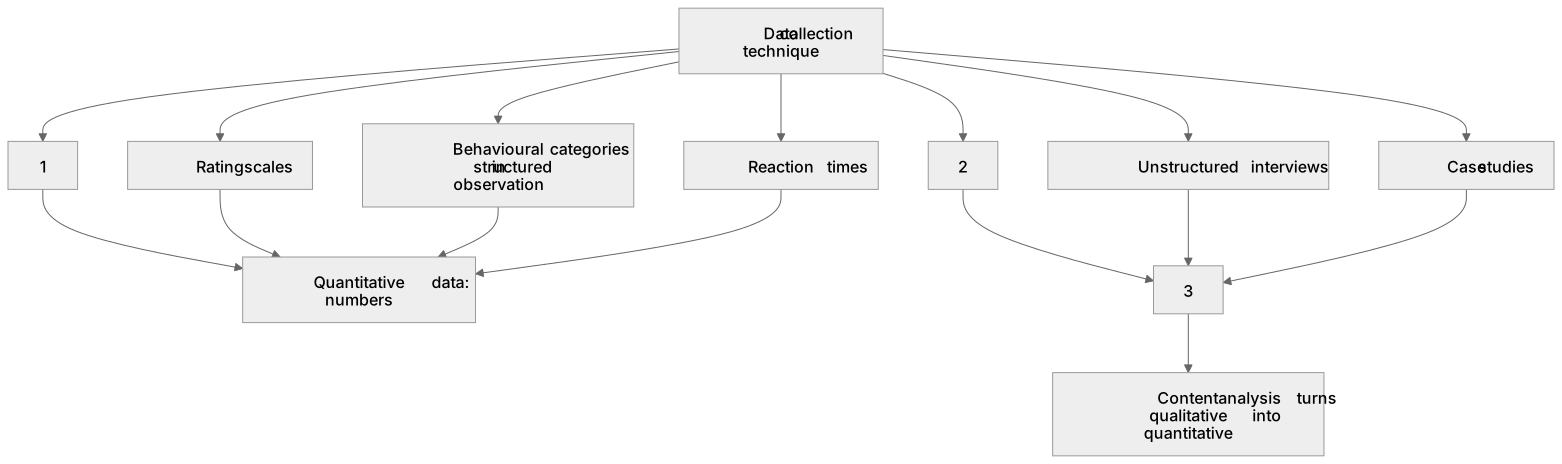
1Box 1
2Box 2
3Box 3
There is more to this lesson
The full lesson goes on to check your understanding and help you earn the marks. Create a free account to carry on, with your progress saved.
A week of Premium from your first lesson · Then the free plan continues · No card, no charge
Test your understanding of Data handling and analysis: Quantitative and qualitative data; the distinction between qualitative and quantitative data collection techniques.
Active recall beats re-reading. Take an instant quiz now to test what you’ve learned and lock it into long-term memory.
A week of Premium from your first lesson · Then the free plan continues · No card, no charge