AQA · A-Level · Psychology
Course version: 7182-2025 · Exams from 2027
Explanations for food preferences: the evolutionary explanation, including…
Full specification wording
Eating behaviour: Explanations for food preferences: the evolutionary explanation, including reference to neophobia and taste aversion; the role of learning in food preference, including social and cultural influences.
Food preference is not free choice but an inherited solution to an old problem.
Checked against the AQA 7182-2025 specification (opens in a new tab) on .
- Point 1 of 6
- 4 key terms
Study notes
From the checked teaching notes for this specification point.
The idea
Food preference is not free choice but an inherited solution to an old problem. Sweetness signalled ripe calories and bitterness signalled plant toxins, so those biases were selected for in ancestral foragers. Neophobia, the flat refusal of unfamiliar food that peaks between the ages of two and six, kept mobile toddlers from sampling poison. Taste aversion is the strongest evidence: Garcia and Koelling found rats avoided sweetened water after a single pairing with radiation-induced nausea, even with hours between taste and sickness, which breaks the contiguity rule of ordinary classical conditioning and shows biological preparedness. Learning matters too. Birch shifted preschoolers' vegetable choices simply by seating them beside peers who preferred the other vegetable, and culture decides what reaches the plate at all.
What earns the marks
- AO1: state the evolutionary logic - preferences that raised survival in ancestral environments were selected, so energy-dense sweet and fatty tastes are preferred and bitterness is rejected as a toxin cue.
- AO1: define neophobia as the avoidance of unfamiliar foods, note that it peaks in early childhood, and give the adaptive advantage of not sampling unknown plants.
- AO1: describe taste aversion learning and credit Garcia and Koelling for one-trial, long-delay conditioning in rats.
- AO1: explain learning through association, social reinforcement, parental and peer modelling, and cultural availability and prohibition, using Birch's peer-modelling study.
- AO3: the evidence base is largely non-human, so extrapolation to human food choice is questionable.
- AO3: evolutionary accounts are post-hoc and hard to falsify, and cannot explain rapid modern dietary change or the deliberate liking of bitter foods such as coffee and chilli.
- AO3: the explanations combine better than they compete - preparedness sets what is easy to learn, culture sets what is actually learned.
Common mistakes and how to put them right
Describing taste aversion as ordinary classical conditioning without saying what makes it special.
Put it right: The single trial and the delay of hours between taste and sickness.
Treating neophobia as fussiness or a disorder rather than an adaptive, age-related mechanism.
Writing that a preference 'helped us survive' with no mechanism named, which credits nothing because any evolutionary answer could say it.
Confusing taste aversion with food allergy, or with disgust acquired by watching other people react.
Exam tips
- If the question names neophobia or taste aversion, both must appear; an answer on general evolution alone caps the knowledge marks.
- For a scenario about a child refusing new food, name neophobia explicitly and then say what the parent should do - repeated neutral exposure and modelling - to earn the application marks.
- In an extended essay covering both evolutionary and learning explanations, ensure both are credited as description (AO1) if requested, and evaluate them by contrasting their approaches, such as biological preparedness versus cultural transmission.
Try the lesson
The start of the Eating behaviour: Explanations for food preferences: the evolutionary explanation, including reference to neophobia and taste aversion; the role of learning in food preference, including social and cultural influences. lesson, made from checked teaching notes for this specification point.
Have a go first
Which of the following best describes the evolutionary concept of food neophobia?
Listen
Food preference is not free choice but an inherited solution to an old problem. Sweetness signalled ripe calories and bitterness signalled plant toxins, so those biases were selected for in ancestral foragers. Neophobia, the flat refusal of unfamiliar food that peaks between the ages of two and six, kept mobile toddlers from sampling poison. Taste aversion is the strongest evidence: Garcia and Koelling found rats avoided sweetened water after a single pairing with radiation-induced nausea, even with hours between taste and sickness, which breaks the contiguity rule of ordinary classical conditioning and shows biological preparedness. Learning matters too. Birch shifted preschoolers' vegetable choices simply by seating them beside peers who preferred the other vegetable, and culture decides what reaches the plate at all. A strong answer earns marks for these points. state the evolutionary logic - preferences that raised survival in ancestral environments were selected, so energy-dense sweet and fatty tastes are preferred and bitterness is rejected as a toxin cue. define neophobia as the avoidance of unfamiliar foods, note that it peaks in early childhood, and give the adaptive advantage of not sampling unknown plants. describe taste aversion learning and credit Garcia and Koelling for one-trial, long-delay conditioning in rats. explain learning through association, social reinforcement, parental and peer modelling, and cultural availability and prohibition, using Birch's peer-modelling study. Exam tip: If the question names neophobia or taste aversion, both must appear; an answer on general evolution alone caps the knowledge marks.
See it

Key words
Say what each word means before you turn the card.
Neophobia
Try answering aloud or in your head before turning the card.
Taste aversion
Try answering aloud or in your head before turning the card.
Biological preparedness
Try answering aloud or in your head before turning the card.
Social learning
Try answering aloud or in your head before turning the card.
See every definition
- Neophobia
- The flat refusal of unfamiliar food, peaking between the ages of two and six, which kept mobile toddlers from sampling poison.
- Taste aversion
- Avoidance of sweetened water after a single pairing with radiation-induced nausea, even with hours between taste and sickness, showing biological preparedness.
- Biological preparedness
- Shown by one-trial, long-delay conditioning that breaks the contiguity rule of ordinary classical conditioning.
- Social learning
- Shifting preschoolers' vegetable choices by seating them beside peers who preferred the other vegetable.
Label the diagram
Some boxes have lost their names. Pick the right name for each number.
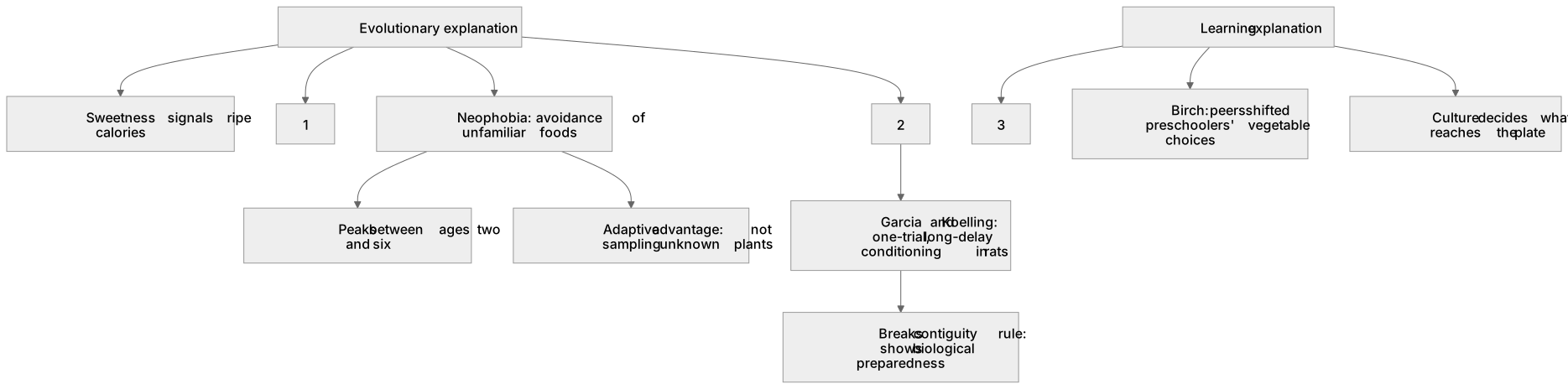
1Box 1
2Box 2
3Box 3
There is more to this lesson
The full lesson goes on to check your understanding and help you earn the marks. Create a free account to carry on, with your progress saved.
A week of Premium from your first lesson · Then the free plan continues · No card, no charge
Test your understanding of Eating behaviour: Explanations for food preferences: the evolutionary explanation, including reference to neophobia and taste aversion; the role of learning in food preference, including social and cultural influences.
Active recall beats re-reading. Take an instant quiz now to test what you’ve learned and lock it into long-term memory.
A week of Premium from your first lesson · Then the free plan continues · No card, no charge