AQA · A-Level · Psychology
Course version: 7182-2025 · Exams from 2027
Neural and hormonal mechanisms involved in the control of eating…
Full specification wording
Eating behaviour: Neural and hormonal mechanisms involved in the control of eating behaviour, including the role of the hypothalamus, ghrelin and leptin.
Eating is homeostatic: the body defends a fairly stable store of energy, and the hypothalamus is where the signals are read.
Checked against the AQA 7182-2025 specification (opens in a new tab) on .
- Point 2 of 6
- 4 key terms
Study notes
From the checked teaching notes for this specification point.
The idea
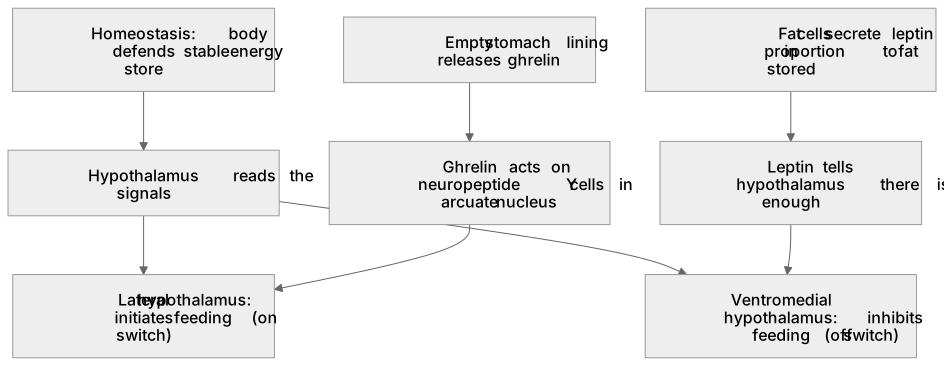
Eating is homeostatic: the body defends a fairly stable store of energy, and the hypothalamus is where the signals are read. The classic dual-centre model makes the lateral hypothalamus the on switch and the ventromedial hypothalamus the off switch - lesion the ventromedial area in a rat and it overeats into obesity, lesion the lateral area and it starves. Hormones carry the news. Ghrelin is released by the empty stomach lining, acts on neuropeptide Y cells in the arcuate nucleus, and rises sharply in the minutes before a meal then falls once food arrives, as Cummings showed with repeated blood sampling. Leptin is secreted by fat cells in proportion to fat stored and tells the hypothalamus there is enough; mice bred without it eat until grossly obese.
What earns the marks
- AO1: establish homeostasis and the hypothalamus as the control centre before naming any structure.
- AO1: the lateral hypothalamus initiates feeding and the ventromedial hypothalamus inhibits it, evidenced by aphagia and hyperphagia after lesioning in rats.
- AO1: ghrelin is a short-term hunger hormone from the stomach lining acting via the arcuate nucleus, rising before meals and falling afterwards.
- AO1: leptin is a long-term satiety hormone from adipose tissue signalling the size of fat stores to the hypothalamus.
- AO3: the dual-centre model is oversimplified - ventromedial lesions also damage the paraventricular nucleus and fibres of passage, so the overeating may not be caused by that nucleus at all.
- AO3: biologically reductionist - it cannot explain eating for pleasure, boredom or social occasion, when people eat although satiety signals say stop.
- AO3: application - leptin replacement cures congenital leptin deficiency but fails in common obesity, where leptin is already high and receptors are insensitive, which supports leptin resistance.
Common mistakes and how to put them right
Swapping the two hypothalamic centres, or writing that the lateral hypothalamus stops eating.
Saying ghrelin and leptin 'cause hunger and fullness' without naming where each is made and where it acts.
Reporting rat lesion findings as though they were human evidence, with no comment on extrapolation.
Describing leptin as a meal-to-meal signal.
Put it right: It tracks stored fat over long periods, which is why it is the long-term signal.
Exam tips
- A frequent stem describes someone who has lost weight and cannot stop feeling hungry; apply falling leptin and rising ghrelin rather than discussing motivation.
- Name each hormone's source, target and direction of effect in one sentence apiece - that structure banks the knowledge marks quickly and leaves room for evaluation.
- 'Neural and hormonal' means both; an answer that is all hypothalamus and no hormones is only half a response.
Try the lesson
The start of the Eating behaviour: Neural and hormonal mechanisms involved in the control of eating behaviour, including the role of the hypothalamus, ghrelin and leptin. lesson, made from checked teaching notes for this specification point.
Have a go first
When a person has not eaten for several hours, which action of ghrelin helps initiate eating behaviour?
Listen
Eating is homeostatic: the body defends a fairly stable store of energy, and the hypothalamus is where the signals are read. The classic dual-centre model makes the lateral hypothalamus the on switch and the ventromedial hypothalamus the off switch - lesion the ventromedial area in a rat and it overeats into obesity, lesion the lateral area and it starves. Hormones carry the news. Ghrelin is released by the empty stomach lining, acts on neuropeptide Y cells in the arcuate nucleus, and rises sharply in the minutes before a meal then falls once food arrives, as Cummings showed with repeated blood sampling. Leptin is secreted by fat cells in proportion to fat stored and tells the hypothalamus there is enough; mice bred without it eat until grossly obese. A strong answer earns marks for these points. establish homeostasis and the hypothalamus as the control centre before naming any structure. the lateral hypothalamus initiates feeding and the ventromedial hypothalamus inhibits it, evidenced by aphagia and hyperphagia after lesioning in rats. ghrelin is a short-term hunger hormone from the stomach lining acting via the arcuate nucleus, rising before meals and falling afterwards. leptin is a long-term satiety hormone from adipose tissue signalling the size of fat stores to the hypothalamus. Exam tip: A frequent stem describes someone who has lost weight and cannot stop feeling hungry; apply falling leptin and rising ghrelin rather than discussing motivation.
See it
Key words
Say what each word means before you turn the card.
Homeostasis and negative feedback
Try answering aloud or in your head before turning the card.
The dual-centre model
Try answering aloud or in your head before turning the card.
Ghrelin as a short-term hunger signal
Try answering aloud or in your head before turning the card.
Leptin, adipose tissue and leptin resistance
Try answering aloud or in your head before turning the card.
See every definition
- Homeostasis and negative feedback
- Eating is homeostatic: the body defends a fairly stable store of energy, and the hypothalamus is where the signals are read.
- The dual-centre model
- The lateral hypothalamus is the on switch and the ventromedial hypothalamus is the off switch for feeding.
- Ghrelin as a short-term hunger signal
- Released by the empty stomach lining, it acts on neuropeptide Y cells in the arcuate nucleus, rising sharply before a meal and falling once food arrives.
- Leptin, adipose tissue and leptin resistance
- Secreted by fat cells in proportion to fat stored, it tells the hypothalamus there is enough, and in common obesity leptin is already high and receptors are insensitive.
Label the diagram
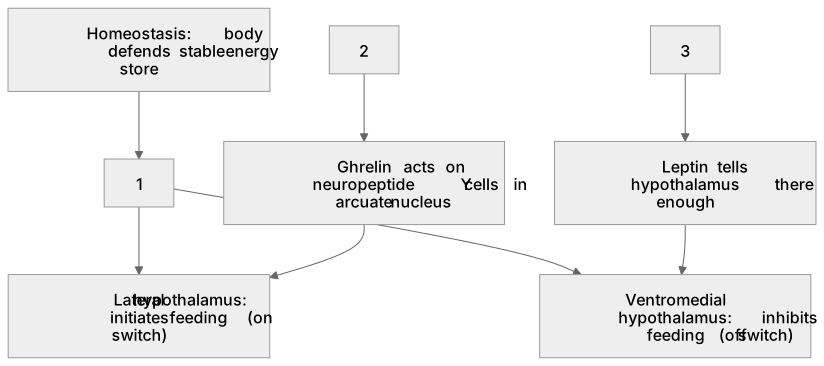
Some boxes have lost their names. Pick the right name for each number.
1Box 1
2Box 2
3Box 3
There is more to this lesson
The full lesson goes on to check your understanding and help you earn the marks. Create a free account to carry on, with your progress saved.
A week of Premium from your first lesson · Then the free plan continues · No card, no charge
Test your understanding of Eating behaviour: Neural and hormonal mechanisms involved in the control of eating behaviour, including the role of the hypothalamus, ghrelin and leptin.
Active recall beats re-reading. Take an instant quiz now to test what you’ve learned and lock it into long-term memory.
A week of Premium from your first lesson · Then the free plan continues · No card, no charge