AQA · A-Level · Psychology
Course version: 7182-2025 · Exams from 2027
Psychological explanations for obesity, including restraint theory,…
Full specification wording
Eating behaviour: Psychological explanations for obesity, including restraint theory, disinhibition and the boundary model.
Psychological explanations for obesity focus on cognitive and behavioural factors.
Checked against the AQA 7182-2025 specification (opens in a new tab) on .
- Point 6 of 6
- 4 key terms
Study notes
From the checked teaching notes for this specification point.
The idea
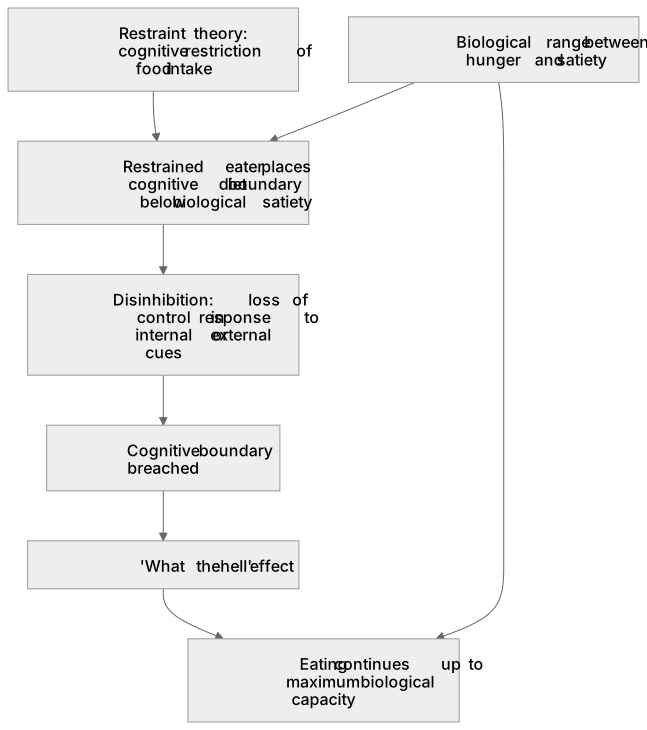
Psychological explanations for obesity focus on cognitive and behavioural factors. Restraint theory suggests that strict dieting and cognitive restriction of food intake paradoxically lead to overeating, as individuals become preoccupied with food. Disinhibition occurs when these restrained eaters encounter triggers, such as stress or high-calorie foods, causing them to lose control and binge eat. Herman and Polivy’s boundary model integrates these concepts, proposing a biological range between hunger and satiety. Restrained eaters impose a cognitive diet boundary below their biological satiety level. When this cognitive boundary is breached, known as the 'what the hell' effect, they continue eating until reaching maximum biological capacity.
What earns the marks
- Define restraint theory as the cognitive restriction of food intake which paradoxically increases the risk of overeating.
- Explain disinhibition as the loss of control over eating behaviour in response to specific internal or external cues.
- Describe the boundary model's biological zones of hunger and satiety, and the placement of the cognitive diet boundary.
- Explain the 'what the hell' effect within the boundary model, where breaching the cognitive boundary leads to eating up to maximum capacity.
- Evaluate psychological explanations by discussing their inability to explain why some restrained eaters successfully lose weight.
Common mistakes and how to put them right
Treating restraint theory and the boundary model as completely separate, unrelated theories.
Put it right: Explain that the boundary model was developed to integrate and explain the mechanisms behind restraint theory and disinhibition.
Stating that the cognitive diet boundary is placed above the biological satiety boundary.
Put it right: Specify that restrained eaters place their cognitive diet boundary below the biological satiety boundary to restrict intake.
Confusing biological hunger with cognitive boundaries.
Put it right: Clearly distinguish between the innate biological drive to eat and the self-imposed psychological limit.
Exam tips
- Describe the boundary model diagram in your answer to clearly illustrate the zones of biological hunger, satiety, and the cognitive boundary.
- Use the 'what the hell' effect as a concrete example of disinhibition when evaluating the boundary model.
- Contrast psychological explanations with biological ones to build a strong, synoptic evaluation paragraph.
Try the lesson
The start of the Eating behaviour: Psychological explanations for obesity, including restraint theory, disinhibition and the boundary model. lesson, made from checked teaching notes for this specification point.
Have a go first
According to restraint theory, why are individuals who consciously restrict their food intake more likely to experience episodes of overeating?
Listen
Psychological explanations for obesity focus on cognitive and behavioural factors. Restraint theory suggests that strict dieting and cognitive restriction of food intake paradoxically lead to overeating, as individuals become preoccupied with food. Disinhibition occurs when these restrained eaters encounter triggers, such as stress or high-calorie foods, causing them to lose control and binge eat. Herman and Polivy’s boundary model integrates these concepts, proposing a biological range between hunger and satiety. Restrained eaters impose a cognitive diet boundary below their biological satiety level. When this cognitive boundary is breached, known as the 'what the hell' effect, they continue eating until reaching maximum biological capacity. A strong answer earns marks for these points. Define restraint theory as the cognitive restriction of food intake which paradoxically increases the risk of overeating. Explain disinhibition as the loss of control over eating behaviour in response to specific internal or external cues. Describe the boundary model's biological zones of hunger and satiety, and the placement of the cognitive diet boundary. Explain the 'what the hell' effect within the boundary model, where breaching the cognitive boundary leads to eating up to maximum capacity. A common slip: Treating restraint theory and the boundary model as completely separate, unrelated theories. Instead, Explain that the boundary model was developed to integrate and explain the mechanisms behind restraint theory and disinhibition. Exam tip: Describe the boundary model diagram in your answer to clearly illustrate the zones of biological hunger, satiety, and the cognitive boundary.
See it
Key words
Say what each word means before you turn the card.
Restraint theory
Try answering aloud or in your head before turning the card.
Disinhibition
Try answering aloud or in your head before turning the card.
Boundary model
Try answering aloud or in your head before turning the card.
'What the hell' effect
Try answering aloud or in your head before turning the card.
See every definition
- Restraint theory
- The cognitive restriction of food intake which paradoxically increases the risk of overeating.
- Disinhibition
- The loss of control over eating behaviour in response to specific internal or external cues.
- Boundary model
- A model proposing a biological range between hunger and satiety, with restrained eaters imposing a cognitive diet boundary below their biological satiety level.
- 'What the hell' effect
- When the cognitive boundary is breached, restrained eaters continue eating until reaching maximum biological capacity.
Label the diagram
Some boxes have lost their names. Pick the right name for each number.
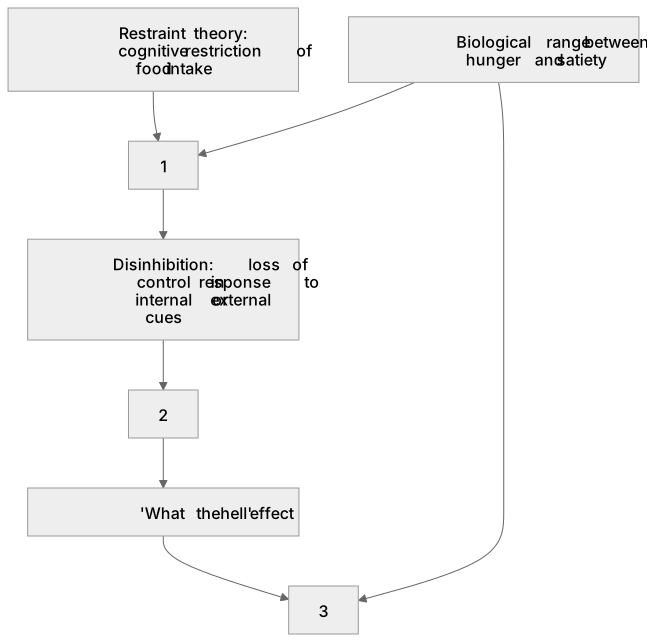
1Box 1
2Box 2
3Box 3
There is more to this lesson
The full lesson goes on to check your understanding and help you earn the marks. Create a free account to carry on, with your progress saved.
A week of Premium from your first lesson · Then the free plan continues · No card, no charge
Test your understanding of Eating behaviour: Psychological explanations for obesity, including restraint theory, disinhibition and the boundary model.
Active recall beats re-reading. Take an instant quiz now to test what you’ve learned and lock it into long-term memory.
A week of Premium from your first lesson · Then the free plan continues · No card, no charge