AQA · A-Level · Psychology
Course version: 7182-2025 · Exams from 2027
Dealing with offending behaviour: the aims of custodial sentencing and the…
Full specification wording
Forensic Psychology: Dealing with offending behaviour: the aims of custodial sentencing and the psychological effects of custodial sentencing. Behaviour modification in custody. Anger management and restorative justice programmes.
Custodial sentencing involves incarcerating offenders to achieve deterrence, incapacitation, retribution, and rehabilitation.
Checked against the AQA 7182-2025 specification (opens in a new tab) on .
- Point 4 of 4
- 4 key terms
Study notes
From the checked teaching notes for this specification point.
The idea
Custodial sentencing involves incarcerating offenders to achieve deterrence, incapacitation, retribution, and rehabilitation. However, it causes severe psychological effects, including institutionalisation (inability to function outside), depression, and high suicide rates. To rehabilitate offenders, behaviour modification uses token economies based on operant conditioning, rewarding desirable behaviours with privileges. Anger management is a cognitive-behavioural approach helping offenders identify triggers and learn relaxation and coping techniques to prevent aggressive outbursts. Restorative justice shifts the focus from state punishment to victim healing, facilitating supervised communication between the offender and victim to encourage offender accountability and provide closure for the victim.
What earns the marks
- Identify and explain the four main aims of custodial sentencing: deterrence, incapacitation, retribution, and rehabilitation.
- Describe the psychological effects of imprisonment, such as stress, depression, institutionalisation, and prisonisation.
- Explain how behaviour modification in custody applies operant conditioning through token economies to reinforce pro-social behaviour.
- Outline the three stages of anger management: cognitive preparation, skill acquisition, and application practice.
- Discuss the process and aims of restorative justice, emphasising victim involvement, offender accountability, and the flexibility of the programme.
Common mistakes and how to put them right
Confusing negative reinforcement with punishment in behaviour modification.
Put it right: Clearly state that token economies rely on positive reinforcement (giving tokens for good behaviour), not punishment.
Assuming restorative justice is always a face-to-face meeting.
Put it right: Note that restorative justice can involve mediation, letters, or financial restitution, and does not strictly require direct physical contact.
Treating anger management as a purely behavioural therapy.
Put it right: Describe anger management as a cognitive-behavioural therapy (CBT) because it involves identifying cognitive triggers before applying behavioural coping skills.
Exam tips
- Use recidivism rates as a key evaluative point across all methods of dealing with offending behaviour, comparing the effectiveness of custodial sentencing against alternatives.
- When evaluating token economies, highlight the issue of generalisation; behaviours learned in prison often do not transfer to the outside world once rewards cease.
- Evaluate restorative justice by discussing its reliance on the offender showing genuine remorse, which can limit its effectiveness if offenders participate solely to reduce their sentence.
Try the lesson
The start of the Forensic Psychology: Dealing with offending behaviour: the aims of custodial sentencing and the psychological effects of custodial sentencing. Behaviour modification in custody. Anger management and restorative justice programmes. lesson, made from checked teaching notes for this specification point.
Have a go first
Which of the following is a primary aim of custodial sentencing that focuses on preventing the offender from committing further crimes by physically isolating them from society?
Listen
Custodial sentencing involves incarcerating offenders to achieve deterrence, incapacitation, retribution, and rehabilitation. However, it causes severe psychological effects, including institutionalisation (inability to function outside), depression, and high suicide rates. To rehabilitate offenders, behaviour modification uses token economies based on operant conditioning, rewarding desirable behaviours with privileges. Anger management is a cognitive-behavioural approach helping offenders identify triggers and learn relaxation and coping techniques to prevent aggressive outbursts. Restorative justice shifts the focus from state punishment to victim healing, facilitating supervised communication between the offender and victim to encourage offender accountability and provide closure for the victim. A strong answer earns marks for these points. Identify and explain the four main aims of custodial sentencing: deterrence, incapacitation, retribution, and rehabilitation. Describe the psychological effects of imprisonment, such as stress, depression, institutionalisation, and prisonisation. Explain how behaviour modification in custody applies operant conditioning through token economies to reinforce pro-social behaviour. Outline the three stages of anger management: cognitive preparation, skill acquisition, and application practice. A common slip: Confusing negative reinforcement with punishment in behaviour modification. Instead, Clearly state that token economies rely on positive reinforcement (giving tokens for good behaviour), not punishment. Exam tip: Use recidivism rates as a key evaluative point across all methods of dealing with offending behaviour, comparing the effectiveness of custodial sentencing against alternatives.
See it

Key words
Say what each word means before you turn the card.
Custodial sentencing
Try answering aloud or in your head before turning the card.
Institutionalisation
Try answering aloud or in your head before turning the card.
Behaviour modification
Try answering aloud or in your head before turning the card.
Restorative justice
Try answering aloud or in your head before turning the card.
See every definition
- Custodial sentencing
- Incarcering offenders to achieve deterrence, incapacitation, retribution, and rehabilitation.
- Institutionalisation
- An inability to function outside prison, described as a severe psychological effect of custodial sentencing.
- Behaviour modification
- Uses token economies based on operant conditioning, rewarding desirable behaviours with privileges to rehabilitate offenders.
- Restorative justice
- Shifts the focus from state punishment to victim healing, facilitating supervised communication between the offender and victim to encourage offender accountability and provide closure for the victim.
Label the diagram
Some boxes have lost their names. Pick the right name for each number.
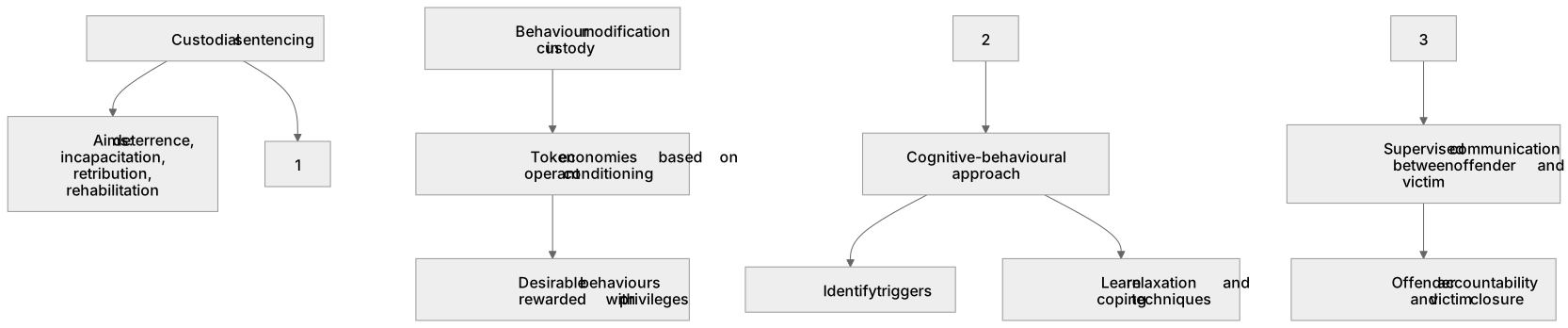
1Box 1
2Box 2
3Box 3
There is more to this lesson
The full lesson goes on to check your understanding and help you earn the marks. Create a free account to carry on, with your progress saved.
A week of Premium from your first lesson · Then the free plan continues · No card, no charge
Test your understanding of Forensic Psychology: Dealing with offending behaviour: the aims of custodial sentencing and the psychological effects of custodial sentencing. Behaviour modification in custody. Anger management and restorative justice programmes.
Active recall beats re-reading. Take an instant quiz now to test what you’ve learned and lock it into long-term memory.
A week of Premium from your first lesson · Then the free plan continues · No card, no charge