AQA · A-Level · Psychology
Course version: 7182-2025 · Exams from 2027
Psychological explanations of offending behaviour: Eysenck’s theory of the…
Full specification wording
Forensic Psychology: Psychological explanations of offending behaviour: Eysenck’s theory of the criminal personality; cognitive explanations; level of moral reasoning and cognitive distortions, including hostile attribution bias and minimalisation; differential association theory.
Eysenck proposed the criminal personality is characterised by high extraversion (seeking stimulation), neuroticism (reactive), and psychoticism (lacking empathy).
Checked against the AQA 7182-2025 specification (opens in a new tab) on .
- Point 3 of 4
- 3 key terms
Study notes
From the checked teaching notes for this specification point.
The idea
Eysenck proposed the criminal personality is characterised by high extraversion (seeking stimulation), neuroticism (reactive), and psychoticism (lacking empathy). Cognitive explanations focus on faulty thinking. Kohlberg suggested offenders often show pre-conventional moral reasoning, driven by avoiding punishment and gaining rewards. Cognitive distortions are irrational thoughts justifying crime: hostile attribution bias misinterprets ambiguous cues as aggressive, while minimalisation downplays the severity of an offence (e.g., calling theft 'borrowing'). Finally, Sutherland’s differential association theory posits that offending is learned through interactions, acquiring pro-criminal attitudes and specific criminal techniques that outweigh anti-criminal values.
What earns the marks
- Outline Eysenck's three dimensions (Extraversion, Neuroticism, Psychoticism) and their biological basis in nervous system arousal.
- Explain Kohlberg's pre-conventional level of moral reasoning as a driver for offending behaviour based on reward and punishment.
- Define hostile attribution bias as misinterpreting non-aggressive cues as threatening, and minimalisation as underestimating the harm caused by an offence.
- Describe differential association theory in terms of learning pro-criminal attitudes and specific criminal acts through socialisation with intimate groups.
- Evaluate these explanations using empirical evidence, such as Palmer and Hollin's findings on moral reasoning or Farrington's longitudinal studies on differential association.
Common mistakes and how to put them right
Confusing hostile attribution bias with minimalisation.
Put it right: Ensure hostile attribution bias is described as a trigger for aggression (misinterpreting cues), whereas minimalisation is a post-hoc justification (downplaying harm).
Stating Eysenck's theory is purely psychological.
Put it right: Clarify that Eysenck's theory has a biological basis, as the personality traits are rooted in the functioning of the autonomic and central nervous systems.
Describing differential association as just 'peer pressure'.
Put it right: Explain it as a specific learning process involving the mathematical ratio of pro-criminal to anti-criminal attitudes, alongside learning specific criminal techniques.
Exam tips
- When evaluating Eysenck's theory, use the concept of cultural bias, noting that Hispanic and African-American offenders were found to be less extraverted than a non-criminal control group.
- Link cognitive distortions directly to specific types of crime, such as minimalisation in white-collar crime or sexual offences, to demonstrate applied understanding.
- Contrast differential association theory with biological explanations to build a strong 'nature versus nurture' evaluation paragraph.
Try the lesson
The start of the Forensic Psychology: Psychological explanations of offending behaviour: Eysenck’s theory of the criminal personality; cognitive explanations; level of moral reasoning and cognitive distortions, including hostile attribution bias and minimalisation; differential association theory. lesson, made from checked teaching notes for this specification point.
Have a go first
According to Eysenck’s theory of the criminal personality, which combination of personality traits is most characteristic of an offender?
Listen
Eysenck proposed the criminal personality is characterised by high extraversion (seeking stimulation), neuroticism (reactive), and psychoticism (lacking empathy). Cognitive explanations focus on faulty thinking. Kohlberg suggested offenders often show pre-conventional moral reasoning, driven by avoiding punishment and gaining rewards. Cognitive distortions are irrational thoughts justifying crime: hostile attribution bias misinterprets ambiguous cues as aggressive, while minimalisation downplays the severity of an offence (e.g., calling theft 'borrowing'). Finally, Sutherland’s differential association theory posits that offending is learned through interactions, acquiring pro-criminal attitudes and specific criminal techniques that outweigh anti-criminal values. A strong answer earns marks for these points. Outline Eysenck's three dimensions (Extraversion, Neuroticism, Psychoticism) and their biological basis in nervous system arousal. Explain Kohlberg's pre-conventional level of moral reasoning as a driver for offending behaviour based on reward and punishment. Define hostile attribution bias as misinterpreting non-aggressive cues as threatening, and minimalisation as underestimating the harm caused by an offence. Describe differential association theory in terms of learning pro-criminal attitudes and specific criminal acts through socialisation with intimate groups. A common slip: Confusing hostile attribution bias with minimalisation. Instead, Ensure hostile attribution bias is described as a trigger for aggression (misinterpreting cues), whereas minimalisation is a post-hoc justification (downplaying harm). Exam tip: When evaluating Eysenck's theory, use the concept of cultural bias, noting that Hispanic and African-American offenders were found to be less extraverted than a non-criminal control group.
See it
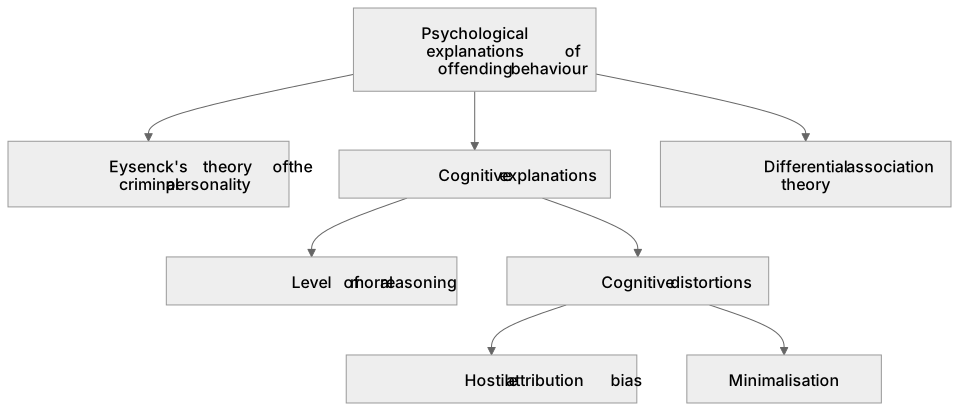
Key words
Say what each word means before you turn the card.
Criminal personality
Try answering aloud or in your head before turning the card.
Cognitive distortions
Try answering aloud or in your head before turning the card.
Minimalisation
Try answering aloud or in your head before turning the card.
See every definition
- Criminal personality
- Characterised by high extraversion, neuroticism and psychoticism, with a biological basis in nervous system arousal.
- Cognitive distortions
- Irrational thoughts that justify crime, including hostile attribution bias and minimalisation.
- Minimalisation
- Downplaying the severity of an offence, for example calling theft 'borrowing'.
Label the diagram
Some boxes have lost their names. Pick the right name for each number.
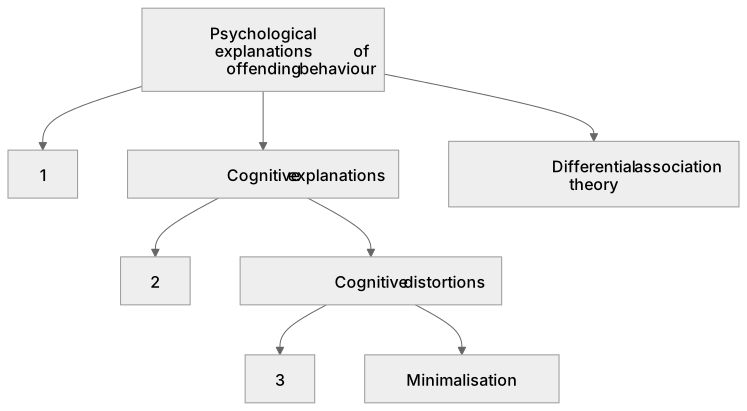
1Box 1
2Box 2
3Box 3
There is more to this lesson
The full lesson goes on to check your understanding and help you earn the marks. Create a free account to carry on, with your progress saved.
A week of Premium from your first lesson · Then the free plan continues · No card, no charge
Test your understanding of Forensic Psychology: Psychological explanations of offending behaviour: Eysenck’s theory of the criminal personality; cognitive explanations; level of moral reasoning and cognitive distortions, including hostile attribution bias and minimalisation; differential association theory.
Active recall beats re-reading. Take an instant quiz now to test what you’ve learned and lock it into long-term memory.
A week of Premium from your first lesson · Then the free plan continues · No card, no charge